


JEE Advanced · Mathematics · 4. P&C
Let \(a_{n}\) denote the number of all \(n\)-digit positive integers formed by the digits 0,1 or both such that no consecutive digits in them are 0 . Let \(b_{n}=\) the number of such \(n\)-digit integers ending with digit 1 and \(c_{n}=\) the number of such \(n\)-digit integers ending with digit 0 .
Question:
Which of the following is correct?
- A \(a_{17}=a_{16}+a_{15}\)
- B \(c_{17} \neq c_{16}+c_{15}\)
- C \(b_{17} \neq b_{16}+c_{16}\)
- D \(a_{17}=c_{17}+b_{16}\)
Answer & Solution
Correct Answer
(A) \(a_{17}=a_{16}+a_{15}\)
Step-by-step Solution
Detailed explanation
By recurring formula, \(a_{17}=a_{16}+a_{15}\) is correct
Also \(c_{17} \neq c_{16}+c_{15}\)
\(\Rightarrow a_{15} \neq a_{14}+a_{13}\left(\because c_{n}=a_{n-2}\right)\)
\(\therefore\) Incorrect
Similarly, other parts are also incorrect.
Also \(c_{17} \neq c_{16}+c_{15}\)
\(\Rightarrow a_{15} \neq a_{14}+a_{13}\left(\because c_{n}=a_{n-2}\right)\)
\(\therefore\) Incorrect
Similarly, other parts are also incorrect.
See the Complete Solution
Get step-by-step explanations for this and 2.5 Lakh+ more JEE, NEET & CET questions.
- Unlock all solutions
- Practice the full chapter
- Track accuracy across PYQs
4.8 rated on Google Play · 14,000+ reviews
More questions from Mathematics
- Paragraph:
Let \(M=\left\{(x, y) \in \mathbb{R} \times \mathbb{R}: x^{2}+y^{2} \leq r^{2}\right\}\),
where \(r>0 .\) Consider the geometric progression \(a_{n}=\frac{1}{2^{n-1}}, n=1,2,3, \ldots .\) Let \(S_{0}=0\) and, for \(n \geq 1\), let \(S_{n}\) denote the sum of the first \(n\) terms of this progression. For \(n \geq 1\), let \(C_{n}\) denote the circle with center \(\left(S_{n-1}, 0\right)\) and radius \(a_{n}\), and \(D_{n}\) denote the circle with center \(\left(S_{n-1}, S_{n-1}\right)\) and radius \(a_{n}\).
Question:
Consider \(M\) with \(r=\frac{\left(2^{199}-1\right) \sqrt{2}}{2^{198}} .\) The number of all those circles \(D_{n}\) that are inside \(M\) isJEE Advanced 2021 Medium - Let \(\vec{w}=\hat{i}+\hat{j}-2 \hat{k}\), and \(\overrightarrow{\mathrm{u}}\) and \(\overrightarrow{\mathrm{v}}\) be two vectors such that \(\vec{u} \times \vec{v}=\vec{w}\) and \(\vec{v} \times \vec{w}=\vec{u}\). Let \(\alpha, \beta, \gamma\) and \(t\) be real numbers such that \(\vec{u}=\alpha \hat{i}+\beta \hat{j}+\gamma \hat{k},-t \alpha+\beta+\gamma=0, \alpha-t \beta+\gamma=0\), and \(\alpha+\beta-t \gamma=0\).
Match each entry in List-I to the correct entry in List-II and choose the correct option.
LIST - I LIST - II (P) \(|\vec{v}|^2\) is equal to (1) 0 (Q) If \(\alpha=\sqrt{3}\),then \(\gamma^2\) is equal to (2) 1 (R) If \(\alpha=\sqrt{3}\),then \((\beta+\gamma)^2\) is equal to (3) 2 (S) If \(\alpha=\sqrt{2}\),then \(t+3\) is equal to (4) 3 (5) 5 JEE Advanced 2025 Hard - Let \(L=\lim _{x \rightarrow 0} \frac{a-\sqrt{a^2-x^2}-\frac{x^2}{4}}{x^4}\), \(a>0\). If \(L\) is finite, thenJEE Advanced 2009 Medium
- The value of is_____.JEE Advanced 2018 Easy
- Paragraph:
Let \(A\) be the set of all \(3 \times 3\) symmetric matrices all of whose entries are either 0 or 1 . Five of these entries are 1 and four of them are 0 .Question:
The number of matrices \(A\) in \(A\) for which the system of linear equations \(A\left[\begin{array}{l}x \\ y \\ z\end{array}\right]=\left[\begin{array}{l}1 \\ 0 \\ 0\end{array}\right]\) is is inconsistent, isJEE Advanced 2009 Hard - Let and .Further and , where C is the set of all complex numbers. If and O represents the origin, thenJEE Advanced 2013 Hard
More PYQs from JEE Advanced
- The set of values of \(\theta\) satisfying the inequation \(2 \sin ^2 \theta-5 \sin \theta+2>0\), where \(0 < \theta < 2 \pi\), isJEE Advanced 2006 Easy
- A conducting wire of parabolic shape, initially is moving with velocity in a non-uniform magnetic field as shown in figure. If and are positive constants and is the potential difference developed between the ends of the wire, then the correct statement(s) is/are:
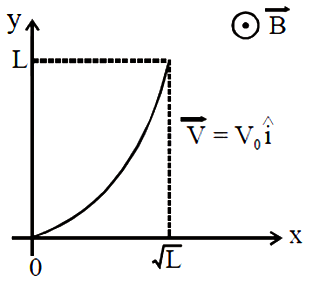 JEE Advanced 2019 Medium
 - Paragraph : In electromagnetic theory, the electric and magnetic phenomena are related to each other. Therefore, the dimensions of electric and magnetic quantities must also be related to each other. In the questions below, stand for dimensions of electric and magnetic fields respectively, while and stand for dimensions of the permittivity and permeability of free space respectively. are dimensions of length and time respectively. All the quantities are given in units
Question : The relation between isJEE Advanced 2018 Easy - A small particle of mass moving inside a heavy, hollow and straight tube along the tube axis, undergoes elastic collision at two ends. The tube has no friction and it is closed at one end by a flat surface while the other end is fitted with a heavy movable flat piston as shown in figure. When the distance of the piston from closed end is the particle speed is The piston is moved inward at a very low speed such that where is the infinitesimal displacement of the piston. Which of the following statement(s) is/are correct?
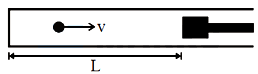 JEE Advanced 2019 Hard
 - The reaction of -methyloct--ene with in the presence of gives two isomeric bromides in a ratio, with a combined yield of . Of these, the entire amount of the primary alkyl bromide was reacted with an appropriate amount of diethylamine followed by treatment with aq. to give a non-ionic product in Yield. The mass (in ) of obtained is
[Use molar mass (in ): ]JEE Advanced 2023 Hard - A series \(R\) - \(C\) circuit is connected to \(A C\) voltage source. Consider two cases; \((A)\) when \(C\) is without a dielectric medium and \((B)\) when \(C\) is filled with dielectric of constant 4. The current \(I_R\) through the resistor and voltage \(V_C\) across the capacitor are compared in the two cases. Which of the following is/are true?JEE Advanced 2011 Easy