


JEE Advanced · Chemistry · 17. Electrochemistry
Electrolysis of dilute aq. \(\mathrm{NaCl}\) solution was carried out by passing \(10 \mathrm{~mA}\) current. The time required to liberate \(0.01\) mole of \(\mathrm{H}_2\) gas at the cathode is (1 Faraday \(=96500 \mathrm{C} \mathrm{mol}^{-1}\) )
- A \(9.65 \times 10^4 \mathrm{~s}\)
- B \(19.3 \times 10^4 \mathrm{~s}\)
- C \(28.95 \times 10^4 \mathrm{~s}\)
- D \(38.6 \times 10^4 \mathrm{~s}\)
Answer & Solution
Correct Answer
(B) \(19.3 \times 10^4 \mathrm{~s}\)
Step-by-step Solution
Detailed explanation
\(2 \mathrm{H}_2 \mathrm{O}+2 e^{-} \longrightarrow \mathrm{H}_2+2 \mathrm{OH}^{-}\)
For \(0.01\) mole of \(\mathrm{H}_2, 0.02\) mole of electrons are consumed Charge required \(=0.02 \times 96500 \mathrm{C}=i \times t\)
\(
\text { Time required }=\frac{0.02 \times 96500}{10 \times 10^{-3}}=19.3 \times 10^4 \mathrm{~s}
\)
For \(0.01\) mole of \(\mathrm{H}_2, 0.02\) mole of electrons are consumed Charge required \(=0.02 \times 96500 \mathrm{C}=i \times t\)
\(
\text { Time required }=\frac{0.02 \times 96500}{10 \times 10^{-3}}=19.3 \times 10^4 \mathrm{~s}
\)
See the Complete Solution
Get step-by-step explanations for this and 2.5 Lakh+ more JEE, NEET & CET questions.
- Unlock all solutions
- Practice the full chapter
- Track accuracy across PYQs
4.8 rated on Google Play · 14,000+ reviews
More questions from Chemistry
- A positron is emitted from \({ }_{11}^{23} \mathrm{Na}\). The ratio of the atomic mass and atomic number of the resulting nuclide isJEE Advanced 2007 Easy
- Liquids A and B form ideal solution over the entire range of composition. At temperature , equimolar binary solution of liquids A and B has vapour pressure . At the same temperature, a new solution of A and B having mole fractions , respectively, has vapour pressure of . The value of , in the new solution is ____.
(Given that the vapour pressure of pure liquid A is at temperature )JEE Advanced 2018 Medium - Consider the following list of reagents: Acidified , alkaline and . The total number of reagents that can oxidise aqueous iodide to iodine isJEE Advanced 2014 Medium
- Among the triatomic molecules/ions, and , the total number of linear molecule(s)/ion(s) where the hybridization of the central atom does not have contribution from the d-orbital(s) is
[Atomic number: S = 16, Cl = 17, I = 53 and Xe = 54]JEE Advanced 2015 Medium - The total number of diprotic acids among the following is
\(\begin{array}{lll}\mathrm{H}_3 \mathrm{PO}_4 & \mathrm{H}_2 \mathrm{SO}_4 & \mathrm{H}_3 \mathrm{PO}_3 \\ \mathrm{H}_2 \mathrm{CO}_3 & \mathrm{H}_2 \mathrm{~S}_2 \mathrm{O}_7 & \mathrm{H}_3 \mathrm{BO}_3 \\ \mathrm{H}_3 \mathrm{PO}_2 & \mathrm{H}_2 \mathrm{CrO}_4 & \mathrm{H}_2 \mathrm{SO}_3\end{array}\)JEE Advanced 2010 Hard - Hydrogen peroxide in its reaction with KIO4 and NH2OH respectively, is acting as aJEE Advanced 2014 Medium
More PYQs from JEE Advanced
- Let be a invertible matrix with real entries and let denote the identity matrix. , then which of the following statements is/are ALWAYS TRUE?JEE Advanced 2020 Easy
- A steady current \(I\) goes through a wire loop \(P Q R\) having shape of a right angle triangle with \(P Q=3 x, P R=4 x\) and \(Q R=5 x\). If the magnitude of the magnetic field at \(P\) due to this loop is \(k\left(\frac{\mu_0 I}{48 \pi x}\right)\), find the value of \(k\).JEE Advanced 2009 Easy
- The plot of versus for a reversible reaction is shown.
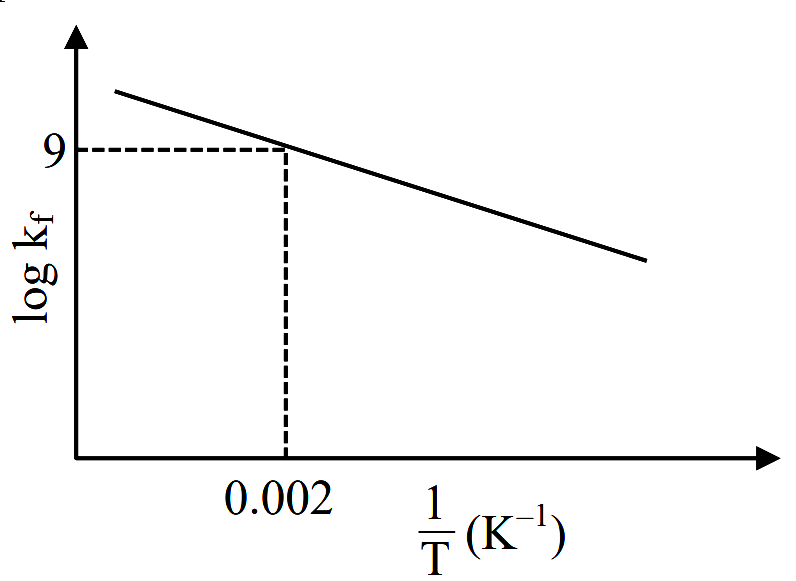
Pre-exponential factors for the forward and backward reactions are and , respectively. If the value of for the reaction at is , the value of at is
equilibrium constant of the reaction, rate constant of forward reaction, rate constant of backward reaction]JEE Advanced 2023 Easy - Paragraph:
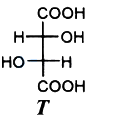
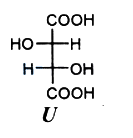
\(P\) and \(Q\) are isomers of dicarboxylic acid \(\mathrm{C}_{4} \mathrm{H}_{4} \mathrm{O}_{4}\). Both decolorize \(\mathrm{Br}_{2} / \mathrm{H}_{2} \mathrm{O}\). On heating, \(\boldsymbol{P}\) forms the cyclic anhydride.
Upon treatment with dilute alkaline \(\mathrm{KMnO}_{4}, \boldsymbol{P}\) as well as \(\boldsymbol{Q}\) could produce one or more than one from \(\boldsymbol{S}, \boldsymbol{T}\) and \(\boldsymbol{U}\).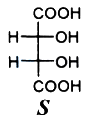
Question:
Compounds formed from \(\boldsymbol{P}\) and \(\boldsymbol{Q}\) are, respectivelyJEE Advanced 2013 Medium - Paragraph:
Read the following passage and answer the questions.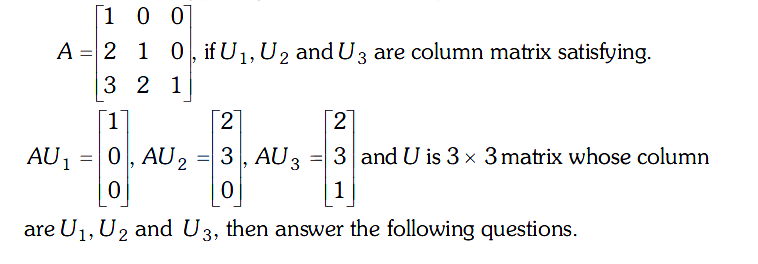
Question:
The value of the elements of \(U^{-1}\) isJEE Advanced 2006 Medium - Among \(\mathrm{V}(\mathrm{CO})_6, \mathrm{Cr}(\mathrm{CO})_5, \mathrm{Cu}(\mathrm{CO})_3,\)\(\operatorname{Mn}(\mathrm{CO})_5, \mathrm{Fe}(\mathrm{CO})_5,\left[\mathrm{Co}(\mathrm{CO})_3\right]^{3-},\left[\mathrm{Cr}(\mathrm{CO})_4\right]^{4-}\), and \(\operatorname{Ir}(\mathrm{CO})_3\), the total number of species isoelectronic with \(\mathrm{Ni}(\mathrm{CO})_4\) is ________.
[Given, atomic number:\(\mathrm{V}=23, \mathrm{Cr}=24, \mathrm{Mn}=25,\) \(\mathrm{Fe}=26, \mathrm{Co}=27, \mathrm{Ni}=28, \mathrm{Cu}=29,\) \(\mathrm{Ir}=77\)]JEE Advanced 2024 Easy