


JEE Advanced · Chemistry · 8. Ionic Equilibrium
\(2.5 \mathrm{~mL}\) of \(\frac{2}{5} \mathrm{M}\) weak monoacidic base \(\left(K_b=1 \times 10^{-12}\right.\) at \(\left.25^{\circ} \mathrm{C}\right)\) is titrated with \(\frac{2}{15}\) \(\mathrm{M} \mathrm{HCl}\) in water at \(25^{\circ} \mathrm{C}\). The concentration of \(\mathrm{H}^{+}\)at equivalence point is \(\left(K_w=1 \times 10^{-14}\right.\) at \(\left.25^{\circ} \mathrm{C}\right)\)
- A \(3.7 \times 10^{-13} \mathrm{M}\)
- B \(3.2 \times 10^{-7} \mathrm{M}\)
- C \(3.2 \times 10^{-2} \mathrm{M}\)
- D \(2.7 \times 10^{-2} \mathrm{M}\)
Answer & Solution
Correct Answer
(D) \(2.7 \times 10^{-2} \mathrm{M}\)
Step-by-step Solution
Detailed explanation
Weak monoacidic base, e.g. \(\mathrm{BOH}\) is neutralised.
\(
\mathrm{BOH}+\mathrm{HCl} \longrightarrow \mathrm{BCl}+\mathrm{H}_2 \mathrm{O}
\)
At equivalence point all \(\mathrm{BOH}\) gets converted into salt and remember! the concentration of \(\mathrm{H}^{+}\)(or \(\mathrm{pH}\) of solution) is due to hydrolysis of resultant salt ( \(\mathrm{BCl}\), cationic hydrolysis here)
\(
\underset{\mathrm{C}(1-h)}{\mathrm{B}^{+}}+\mathrm{H}_2 \mathrm{O} \rightleftharpoons \underset{\mathrm{Ch}}{\rightleftharpoons} \mathrm{OH}+\underset{\mathrm{Ch}}{\mathrm{H}^{+}}
\)
Volume of \(\mathrm{HCl}\) used up,
\(
V_a=\frac{N_b V_b}{N_a}=\frac{2.5 \times 2 \times 15}{2 \times 5}=7.5 \mathrm{~mL}
\)
Concentration of salt,
\({[\mathrm{BCl}] } =\frac{\text { Concentration of base }}{\text { Total volume }}=\frac{2 \times 25}{5(7.5+2.5)}=\) \(\frac{1}{10}=0.1\)
\(K_h =\frac{C h^2}{1-h}=\frac{K_w}{K_b}\)
( \(h\) should be estimated whether that can be neglected or not) on calculating \(h=0.27\) (significant, not negligible)
\(
\left[\mathrm{H}^{+}\right]=C h=0.1 \times 0.27=2.7 \times 10^{-2} \mathrm{M}
\)
When \(\left[\mathrm{H}^{+}\right]\)is asked to calculate in connection with neutralisation, it
Should be calculated:
Before neutralisation Using Oslwald's dilution law
During neutralisation \(\quad\) Considering buffer solution
Half neutralisation \(\mathrm{pH}=\mathrm{p} K_a\) and \(\mathrm{p} K_b\)
At the end of neutralisation \(\quad\) Considering hydrolysis of salt
\(
\mathrm{BOH}+\mathrm{HCl} \longrightarrow \mathrm{BCl}+\mathrm{H}_2 \mathrm{O}
\)
At equivalence point all \(\mathrm{BOH}\) gets converted into salt and remember! the concentration of \(\mathrm{H}^{+}\)(or \(\mathrm{pH}\) of solution) is due to hydrolysis of resultant salt ( \(\mathrm{BCl}\), cationic hydrolysis here)
\(
\underset{\mathrm{C}(1-h)}{\mathrm{B}^{+}}+\mathrm{H}_2 \mathrm{O} \rightleftharpoons \underset{\mathrm{Ch}}{\rightleftharpoons} \mathrm{OH}+\underset{\mathrm{Ch}}{\mathrm{H}^{+}}
\)
Volume of \(\mathrm{HCl}\) used up,
\(
V_a=\frac{N_b V_b}{N_a}=\frac{2.5 \times 2 \times 15}{2 \times 5}=7.5 \mathrm{~mL}
\)
Concentration of salt,
\({[\mathrm{BCl}] } =\frac{\text { Concentration of base }}{\text { Total volume }}=\frac{2 \times 25}{5(7.5+2.5)}=\) \(\frac{1}{10}=0.1\)
\(K_h =\frac{C h^2}{1-h}=\frac{K_w}{K_b}\)
( \(h\) should be estimated whether that can be neglected or not) on calculating \(h=0.27\) (significant, not negligible)
\(
\left[\mathrm{H}^{+}\right]=C h=0.1 \times 0.27=2.7 \times 10^{-2} \mathrm{M}
\)
When \(\left[\mathrm{H}^{+}\right]\)is asked to calculate in connection with neutralisation, it
Should be calculated:
Before neutralisation Using Oslwald's dilution law
During neutralisation \(\quad\) Considering buffer solution
Half neutralisation \(\mathrm{pH}=\mathrm{p} K_a\) and \(\mathrm{p} K_b\)
At the end of neutralisation \(\quad\) Considering hydrolysis of salt
See the Complete Solution
Get step-by-step explanations for this and 2.5 Lakh+ more JEE, NEET & CET questions.
- Unlock all solutions
- Practice the full chapter
- Track accuracy across PYQs
4.8 rated on Google Play · 14,000+ reviews
More questions from Chemistry
- The unbalanced chemical reactions given in List I show missing reagent or condition (?) which are provided in list II. match List I with List II and select the correct answer using the code given below the lists :
List - I List - II A. \(PbO _2+ H _2 SO _4 \xrightarrow{?}\) \(PbSO _4 + O _2+\) other product P. \(\text{NO}\) B. \(Na _2 S_2 O _3+ H _2 O \xrightarrow{?}\) \(NaHSO _4~+\) other product Q. \(\text{I}_2\) C. \(N _2 H _4 \xrightarrow{?} N_2 +\) other product R. Warm D. \(XeF _2 \xrightarrow{?} Xe ~+\) other product S. \(\text{Cl}_2\) JEE Advanced 2013 Easy - For the reduction of \(\mathrm{NO}_3^{-}\)ion in an aqueous solution \(E^{\circ}\) is \(+0.96 \mathrm{~V}\). Values of \(E^{\circ}\) for some metal ions are given below.
\(
\begin{aligned}
& \mathrm{V}^{2+}(a q)+2 e^{-} \longrightarrow \mathrm{V} ; E^{\circ}=-1.19 \mathrm{~V} \\
& \mathrm{Fe}^{3+}(a q)+3 e^{-} \longrightarrow \mathrm{Fe} ; \mathrm{E}^{\circ}=-0.04 \mathrm{~V} \\
& \mathrm{Au}^{3+}(a q)+3 e^{-} \longrightarrow \mathrm{Au} ; E^{\circ}=+1.40 \mathrm{~V}
\end{aligned}
\)
\(
\mathrm{Hg}^{2+}(a q)+2 e^{-} \longrightarrow \mathrm{Hg} ; E^{\circ}=+0.86 \mathrm{~V}
\)
The pair(s) of metals that is (are) oxidised by \(\mathrm{NO}_3^{-}\)in aqueous solution is (are)JEE Advanced 2009 Medium - The number of structural isomers for \(\mathrm{C}_6 \mathrm{H}_{14}\) isJEE Advanced 2007 Medium
- In the following reaction sequence, the amount of (in g) formed from moles of acetophenone is ____.
(Atomic weights in The yield (%) corresponding to the product in each step is given in the parenthesis)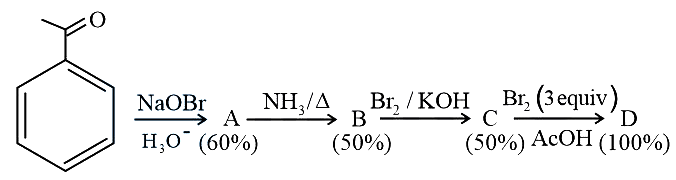 JEE Advanced 2018 Medium
 - The IUPAC name of the following compound, is
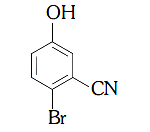 JEE Advanced 2009 Easy
 - Statement 1 Aniline on reaction with \(\mathrm{NaNO}_2 / \mathrm{HCl}\) at \(0^{\circ} \mathrm{C}\) followed by coupling with \(\beta\)-naphthol gives a dark coloured precipitate.
Statement 2 The colour of the compound formed in the reaction of aniline with \(\mathrm{NaNO}_2 / \mathrm{HCl}\) at \(0^{\circ} \mathrm{C}\) followed by coupling with \(\beta\)-naphthol is due to the extended conjugation.JEE Advanced 2008 Medium
More PYQs from JEE Advanced
- When benzene sulphonic acid and \(p\)-nitrophenol are treated with \(\mathrm{NaHCO}_3\), the gases released respectively areJEE Advanced 2006 Hard
- Paragraph:
Chemical reactions involve interaction of atoms and molecules. A large number of atoms/molecules (approximately \(6.023 \times 10^{23}\) ) are present in a few grams of any chemical compound varying with their atomic/molecular masses. To handle such large numbers conveniently, the mole concept was introduced. This concept has implications in diverse areas such as analytical chemistry, biochemistry, electrochemistry and radiochemistry. The following example illustrates a typical case, involving chemical/electrochemical reaction, which requires a clear understanding of the mole concept.
A \(4.0\) molar aqueous solution of \(\mathrm{NaCl}\) is prepared and \(500 \mathrm{~mL}\) of this solution is electrolysed. This leads to the evolution of chlorine gas at one of electrodes (atomic mass: \(\mathrm{Na}=23, \mathrm{Hg}=200 ; 1\) faraday \(=96500\) coulombs).
Question:
The total charge (coulombs) required for complete electrolysis isJEE Advanced 2007 Medium - Let \(\mathbb{R}\) denote the set of all real numbers. Then the area of the region \(\left\{(x, y) \in \mathbb{R} \times \mathbb{R}: x>0, y>\frac{1}{x}, 5 x-4 y-1>0,4 x+4 y-17 <0\right\}\) isJEE Advanced 2025 Hard
- The function has a local minimum or a local maximum atJEE Advanced 2013 Hard
- is reduced to by usingJEE Advanced 2015 Easy
- Among \(H_2, H e_2^{+}, L i_2, B e_2, B_2, C_2, N_2, O_2^{-}\), and \(F_2\), the number of diamagnetic species is -
(Atomic number : \(H=1, H e=2, L i=3, B e=4, B=5,\) \(C=6, N =7, O=8, F=9\) )JEE Advanced 2017 Easy