


JEE Advanced · Chemistry · 17. Electrochemistry
Paragraph:
Chemical reactions involve interaction of atoms and molecules. A large number of atoms/molecules (approximately \(6.023 \times 10^{23}\) ) are present in a few grams of any chemical compound varying with their atomic/molecular masses. To handle such large numbers conveniently, the mole concept was introduced. This concept has implications in diverse areas such as analytical chemistry, biochemistry, electrochemistry and radiochemistry. The following example illustrates a typical case, involving chemical/electrochemical reaction, which requires a clear understanding of the mole concept.
A \(4.0\) molar aqueous solution of \(\mathrm{NaCl}\) is prepared and \(500 \mathrm{~mL}\) of this solution is electrolysed. This leads to the evolution of chlorine gas at one of electrodes (atomic mass: \(\mathrm{Na}=23, \mathrm{Hg}=200 ; 1\) faraday \(=96500\) coulombs).
Question:
The total charge (coulombs) required for complete electrolysis is
- A 24125
- B 48250
- C 96500
- D 193000
Answer & Solution
Correct Answer
(D) 193000
Step-by-step Solution
Detailed explanation
\(2 \mathrm{Cl}^{-} \longrightarrow \mathrm{Cl}_2+2 e^{-}\)
Total charge \(=2 \times 96500\) Coulamb \(=193000\) coulomb
Total charge \(=2 \times 96500\) Coulamb \(=193000\) coulomb
See the Complete Solution
Get step-by-step explanations for this and 2.5 Lakh+ more JEE, NEET & CET questions.
- Unlock all solutions
- Practice the full chapter
- Track accuracy across PYQs
4.8 rated on Google Play · 14,000+ reviews
More questions from Chemistry
- Statement I Glucose gives a reddish-brown precipitate with Fehling's solution.
Statement II Reaction of glucose with Fehling's solution gives \(\mathrm{CuO}\) and gluconic acid.JEE Advanced 2007 Medium - The carbon-based reduction method is NOT used for the extraction ofJEE Advanced 2013 Easy
- The density (in \(\mathrm{g} \mathrm{cm}^{-3}\) ) of the metal which forms a cubic close packed (ccp) lattice with an axial distance (edge length) equal to 400 pm is \(\qquad\) .
Use: Atomic mass of metal \(=105.6 \mathrm{amu}\) and Avogadro's constant \(=6 \times 10^{23} \mathrm{~mol}^{-1}\)JEE Advanced 2025 Medium - For a dilute solution containing \(2.5 \mathrm{~g}\) of a non-volatile non-electrolyte solute in \(100 \mathrm{~g}\) of water, the elevation in boiling point at 1 atm pressure is \(2^{\circ} \mathrm{C}\). Assuming concentration of solute is much lower than the concentration of solvent, the vapour pressure ( \(\mathrm{mm}\) of \(\mathrm{Hg}\) ) of the solution is (take \(K_{b}=0.76 \mathrm{~K} \mathrm{~kg} \mathrm{~mol}^{-1}\) )JEE Advanced 2012 Medium
- Paragraph:
A fixed mass of a gas is subjected to transformation of states from to to to and back to as shown in the figure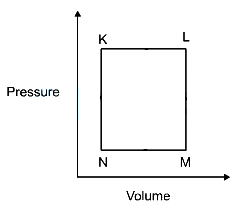
Question :
The pair of isochoric processes among the transformation of states isJEE Advanced 2013 Easy - Paragraph:
Carbon-14 is used to determine the age of organic material. The procedure is based on the formation of \({ }^{14} \mathrm{C}\) by neutron capture in the upper atmosphere.
\(
{ }_7^{14} \mathrm{~N}+{ }_0^1 n \longrightarrow{ }_6^{14} \mathrm{C}+{ }_1 n^1
\)
\({ }^{14} \mathrm{C}\) is absorbed by living organisms during photosynthesis. The \({ }^{14} \mathrm{C}\) content is constant in living organism once the plant or animal dies, the uptake of carbon dioxide by it ceases and the level of \({ }^{14} \mathrm{C}\) in the dead being, falls to the decay which \({ }^{14} \mathrm{C}\) undergoes.
\(
{ }_6^{14} \mathrm{C} \longrightarrow{ }_7^{14} \mathrm{~N}+\beta^{-}
\)
The half life period of \({ }^{14} \mathrm{C}\) is 5770 years. The decay constant \((\lambda)\) can be calculated by using the following formula \(\lambda=\frac{0.693}{t_{1 / 2}}\).
The comparison of the \(\beta^{-}\)activity of the dead matter with that of the carbon still in circulation enables measurement of the period of the isolation of the material from the living cycle. The method however, ceases to be accurate over periods longer than 30,000 years. The proportion of \({ }^{14} \mathrm{C}\) to \({ }^{12} \mathrm{C}\) in living matter is \(1: 10^{12}\).
Question:
A nuclear explosion has taken place leading to increase in concentration of \(C^{14}\) in nearby areas. \(\mathrm{C}^{14}\) concentration is \(C_1\) in nearby areas and \(C_2\) in areas far away. If the age of the fossil is determined to be \(T_1\) and \(T_2\) at the places respectively thenJEE Advanced 2006 Hard
More PYQs from JEE Advanced
- Paragraph :
A wooden cylinder of diameter \(4 r\), height \(H\) and density \(\rho / 3\) is kept on a hole of diameter \(2 r\) of a tank, filled with liquid of density \(\rho\) as shown in the figure.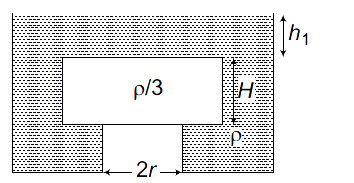
Question :
If height \(h_2\) of water level is further decreased, thenJEE Advanced 2006 Hard - Paragraph:
A small block of mass \(1 \mathrm{~kg}\) is released from rest at the top of a rough track. The track is a circular arc of radius \(40 \mathrm{~m}\). The block slides along the track without toppling and a frictional force acts on it in the direction opposite to the instantaneous velocity. The work done in overcoming the friction up to the point \(Q\), as shown in the figure below, is \(150 \mathrm{~J}\). (Take the acceleration due to gravity, \(g=10 \mathrm{~m} \mathrm{~s}^{-2}\) ).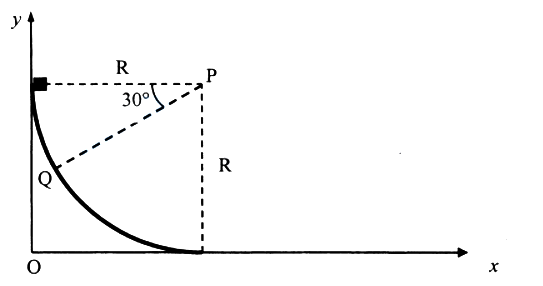
Question :
The magnitude of the normal reaction that acts on the block at the point \(Q\) isJEE Advanced 2013 Easy - Let denote the set of all the terms of an infinite arithmetic progression with first term a and common difference If then equals ____JEE Advanced 2019 Medium
- The correct option(s) related to adsorption processes is(are)JEE Advanced 2022 Easy
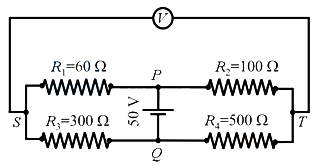
- In the balanced condition, the values of the resistances of the four arms of a Wheatstone bridge are shown in the figure below. The resistance has temperature coefficient . If the temperature of is increased by the voltage developed between and will be __________ volt.
 JEE Advanced 2020 Medium
 - Let \(g(x)=\frac{(x-1)^n}{\log \cos ^m(x-1)} ; 0 < x < 2, m\) and \(n\) are integers, \(m \neq 0, n>0\) and let \(p\) be the left hand derivative of \(|x-1|\) at \(x=1\). If \(\lim _{x \rightarrow 1^{+}} g(x)=p\), thenJEE Advanced 2008 Medium