


WBJEE · Physics · Mathematics in Physics
Three vectors \(\mathbf{A}=a \mathbf{i}+\mathbf{j}+\mathbf{k} ; \mathbf{B}=\mathbf{i}+b \mathbf{j}+\mathbf{k}\)
and \(\mathbf{C}=\mathbf{i}+\mathbf{j}+c \mathbf{k}\) are mutually perpendicular (i, \(\mathbf{j}\) and \(\mathbf{k}\) are unit vectors along \(X, Y\) and \(Z\) axes respectively). The respective values of \(a\), \(b\) and \(c\) are
- A 0,0,0
- B \(-\frac{1}{2},-\frac{1}{2},-\frac{1}{2}\)
- C 1,-1,1
- D \(\frac{1}{2}, \frac{1}{2}, \frac{1}{2}\)
Answer & Solution
Correct Answer
(B) \(-\frac{1}{2},-\frac{1}{2},-\frac{1}{2}\)
Step-by-step Solution
Detailed explanation
Three vectors are mutually perpendicular, so the scalar or dot product of two vectors will zero. So, \(\mathbf{A} \cdot \mathbf{B}=0, \mathbf{B} \mathbf{C}=0,\) So,…
See the Complete Solution
Get step-by-step explanations for this and 2.5 Lakh+ more JEE, NEET & CET questions.
- Unlock all solutions
- Practice the full chapter
- Track accuracy across PYQs
4.8 rated on Google Play · 14,000+ reviews
More questions from Physics
- When a spring is stretched by \(10 \mathrm{cm}\), the potential energy stored is \(E\). When the spring is stretched by \(10 \mathrm{cm}\) more, the potential energy stored in the spring becomesWBJEE 2012 Easy
- The de-Broglie wavelength of an electron (mass \(=1 \times 10^{-30} \mathrm{kg},\) charge \(\left.=16 \times 10^{-19} \mathrm{C}\right)\) with a kinetic energy of \(200 \mathrm{eV}\) is (Planck's constant \(=6.6 \times 10^{-34} \mathrm{Js}\)WBJEE 2013 Medium
-
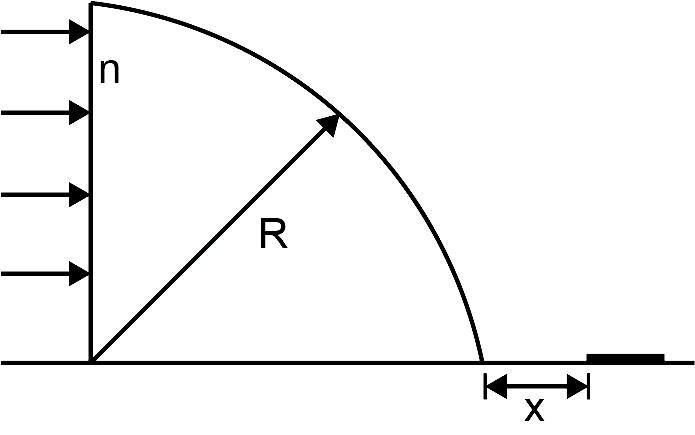
A parallel beam of light is incident on a glass prism in the shape of a quarter cylinder of radius \(R=0.05 \mathrm{m}\) and refractive index \(n=1.5,\) placed on a horizontal table as shown in the figure. Beyond the cylinder, a patch of light is found whose the nearest distance \(x\) from the cylinder isWBJEE 2017 Medium - An electron of charge \(e\) and mass \(m\) is moving in a circular of radius \(r\) with a uniform angular speed \(\omega .\) Then which of the following statements are correct?WBJEE 2013 Easy
- Two simple harmonic motions are given by \(x_{1}=a \sin \omega t+a \cos \omega t\) and \(x_{2}=a \sin \omega t+\frac{a}{\sqrt{3}} \cos \omega t\) The ratio of the amplitudes of first and second motion and the phase difference between them are respectivelyWBJEE 2013 Easy
- Air inside a closed container is saturated with water vapour. The air pressure is \(\mathrm{p}\) and the saturated vapour pressure of water is \(\bar{p}\). If the mixture is compressed to one half of its volume by maintaining temperature constant, the pressure becomesWBJEE 2011 Medium
More PYQs from WBJEE
- For a reaction \(2 \mathrm{~A}+\mathrm{B} \rightarrow \mathrm{P}\), when concentration of \(\mathrm{B}\) alone is doubled, rate does not change and when concentrations of both \(\mathrm{A}\) and \(\mathrm{B}\) is doubled, rate increases by a factor of 4 . The unit of rate constant is,WBJEE 2020 Hard
- If \(\int_{-1}^4 f(x) d x=4\) and \(\int_2^4\{3-f(x)\} d x=7\) then the value of \(\int_{-1}^2 \mathrm{f}(\mathrm{x}) \mathrm{dx}\)WBJEE 2009 Easy
- \(\triangle O A B\) is an equilateral triangle inscribed in the parabola \(y^2=4 a x, a\gt0\) with \(O\) as the vertex, then the length of the side of \(\triangle \mathrm{OAB}\) isWBJEE 2024 Medium
- The greatest and least values of \(f(x)=\tan ^{-1} x-\frac{1}{2} \ln x\) on \(\left[\frac{1}{\sqrt{3}}, \sqrt{3}\right]\) areWBJEE 2021 Medium
- A homonuclear diatomic gas molecule shows 2-electron magnetic moment. The one-electron and two-electron reduced species obtained from above gas molecule can act as both oxidizing and reducing agents. When the gas molecule is one-electron oxidized the bond length decreases compared to the neutral molecule. The gas molecule isWBJEE 2020 Easy
- Find the equivalent capacitance between \(A\) and \(B\) of the following arrangement :
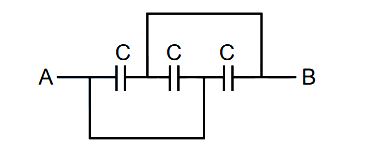 WBJEE 2022 Easy