


WBJEE · Physics · Dual Nature of Matter
The de-Broglie wavelength of an electron is \(0.4 \times 10^{-10} \mathrm{m}\) when its kinetic energy is \(1.0 \mathrm{keV} .\) Its wavelength will be \(1.0 \times 10^{-10} \mathrm{m}\)
when its kinetic energy is
- A \(0.2 \mathrm{keV}\)
- B \(0.8 \mathrm{keV}\)
- C \(0.63 \mathrm{keV}\)
- D \(0.16 \mathrm{keV}\)
Answer & Solution
Correct Answer
(D) \(0.16 \mathrm{keV}\)
Step-by-step Solution
Detailed explanation
De-Broglie wavelength, \(\lambda=\frac{h}{\sqrt{2 m E}}\) \(\therefore \quad \frac{\lambda_{1}}{\lambda_{2}}=\sqrt{\frac{E_{2}}{E_{1}}}\) \(\lambda_{1}=\) Wave length of electron…
See the Complete Solution
Get step-by-step explanations for this and 2.5 Lakh+ more JEE, NEET & CET questions.
- Unlock all solutions
- Practice the full chapter
- Track accuracy across PYQs
4.8 rated on Google Play · 14,000+ reviews
More questions from Physics
- A 2 V cell is connected across to points A and B as shown in the figure. Assume that the resistance of each diode is zero in forward bias and infinity in reverse bias. The current supplied by the cell is
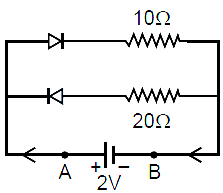 WBJEE 2024 Easy
 - A straight wire is placed in a magnetic field that varies with distance \(x\) from origin as \(\vec{B}=B_0\left(2-\frac{x}{a}\right) \hat{k}\). Ends of wire are at \((a, 0)\) and \((2 a, 0)\) and it carries a current \(\mathrm{I}\). If force on wire is \(\vec{F}=\mathrm{IB}_0\left(\frac{k a}{2}\right) \hat{\mathrm{j}}\), then value of \(k\) isWBJEE 2022 Medium
- A positive charge \(Q\) is situated at the centre of a cube. The electric flux through any face of the cube is (in SI units)WBJEE 2017 Easy
- A charged particle of mass \(m_{1}\) and charge \(q_{1}\) is revolving in a circle of radius \(r .\) Another charged particle of charge \(q_{2}\) and mass \(m_{2}\) is situated at the centre of the circle. If the velocity and time period of the revolving particle be \(v\) and \(T\) respectively, thenWBJEE 2016 Hard
- Two simple harmonic motions are given by \(x_{1}=a \sin \omega t+a \cos \omega t\) and \(x_{2}=a \sin \omega t+\frac{a}{\sqrt{3}} \cos \omega t\) The ratio of the amplitudes of first and second motion and the phase difference between them are respectivelyWBJEE 2013 Easy
- The variation of displacement with time of a simple harmonic motion (SHM) for a particle of mass \(m\) is represented by \(y=2 \sin \left(\frac{\pi t}{2}+\phi\right) \mathrm{cm}\). The maximum acceleration of the particle isWBJEE 2025 Easy
More PYQs from WBJEE
- A uniform long tube is bent into a circle of radius \(\mathrm{R}\) and it lies in vertical plane. Two liquids of same volume but densities \(\rho\) and \(\delta\) fill half the tube. The angle \(\theta\) is
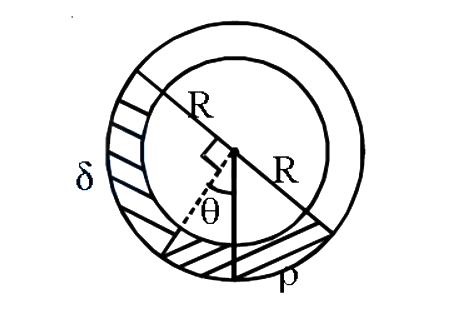 WBJEE 2010 Hard
 - The half-life of a radioactive element is 10 hours. How much will be left after 4 hours in \(1 \mathrm{~g}\) atom sample?WBJEE 2009 Hard
- A drop of some liquid of volume \(0.04 \mathrm{cm}^{3}\) is placed on the surface of a glass slide. Then another glass slide is placed on it in such a way that the liquid forms a thin layer of area \(20 \mathrm{cm}^{2}\) between the surfaces of the two slides. To separate the slides a force of \(16 \times 10^{5}\) dyne has to be applied normal to the surfaces. The surface tension of the liquid is (in dyne-cm \(^{-1}\) )WBJEE 2014 Medium
- Baeyer's reagent isWBJEE 2013 Easy
-
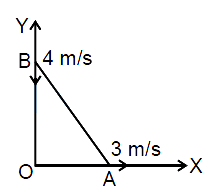
A uniform rod AB of length 1m and mass 4kg is sliding along two mutually perpendicular frictionless walls OX and OY.
The velocity of the two ends of the rod A and B are 3 m/s and 4 m/s respectively, as shown in the figure. Then which
of the following statement(s) is/are correct?WBJEE 2024 Medium - If \(A=\left(\begin{array}{cc}3 & x-1 \\ 2 x+3 & x+2\end{array}\right)\) is a symmetric matrix, then the value of \(x\) isWBJEE 2011 Easy