


WBJEE · Physics · Rotational Motion
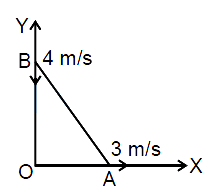
A uniform rod AB of length 1m and mass 4kg is sliding along two mutually perpendicular frictionless walls OX and OY.
The velocity of the two ends of the rod A and B are 3 m/s and 4 m/s respectively, as shown in the figure. Then which
of the following statement(s) is/are correct?
- A The velocity of the centre of mass of the rod is 2.5 m/s.
- B Rotational kinetic energy of the rod is \(\frac{25}{6}\) joule.
- C The angular velocity of the rod is 5 rad/s clockwise.
- D The angular velocity of the rod is 5 rad/s anticlockwise.
Answer & Solution
Correct Answer
(D) The angular velocity of the rod is 5 rad/s anticlockwise.
Step-by-step Solution
Detailed explanation
Get \(\theta\) \[ 3 \cos \theta=4 \sin \theta \] \[ \begin{aligned} & \omega=\frac{3 \sin \theta+4 \sin \theta}{\ell} \\ & (\mathrm{KE})_{\text {rotation }}=\frac{1}{2} \frac{1}{12} \mathrm{ml}^2 \omega^2=\frac{25}{6} \end{aligned} \]
See the Complete Solution
Get step-by-step explanations for this and 2.5 Lakh+ more JEE, NEET & CET questions.
- Unlock all solutions
- Practice the full chapter
- Track accuracy across PYQs
4.8 rated on Google Play · 14,000+ reviews
More questions from Physics
- A thin charged rod is bent into the shape of a small circle of radius \(\mathrm{R}\) the charge per unit length of the rod being \(\lambda\). The circle is rotated about its axis with a time period \(T\) and it is found that the magnetic field at a distance ' \(d\) ' away \((d>>R)\) from the center and on the axis, varies as \(\frac{\mathrm{R}^{\mathrm{m}}}{\mathrm{d}^{\mathrm{n}}} .\) The values of \(\mathrm{m}\) and \(\mathrm{n}\) respectively areWBJEE 2021 Hard
- Two black bodies \(A\) and \(B\) have equal surface areas and are maintained at temperatures \(27^{\circ} \mathrm{C}\) and \(177^{\circ} \mathrm{C}\) respectively. What will be the ratio of the thermal energy radiated per second by \(A\) to that by \(B ?\)WBJEE 2019 Medium
- A beam of monochromatic blue light of wavelength \(4200 Å\) in air travels in water of refractive index \(4 / 3\). Its wavelength in water will be:WBJEE 2009 Medium
- The change in the gravitational potential energy when a body of mass \(m\) is raised to a height \(n \mathrm{R}\) above the surface of the Earth is (here \(R\) is the radius of the Earth)WBJEE 2010 Easy
- A galvanometer having internal resistance \(10 \Omega\) requires 0.01 A for a full scale deflection. To convert this galvanometer to a voltmeter of full-scale deflection at \(120 \mathrm{V}\), we need to connect a resistance ofWBJEE 2014 Easy
- When the frequency of the light used is changed from \(4 \times 10^{14} \mathrm{s}^{-1}\) to \(5 \times 10^{14} \mathrm{s}^{-1}\). the angular width of the principal (central) maximum in a single slit Fraunhoffer diffraction pattern changes by 0.6 radian. What is the width of the slit (assume that the experiment is performed in vacuumWBJEE 2019 Medium
More PYQs from WBJEE
- A particle is acted upon by a constant power. Then, which of the following physical quantity remains constant?WBJEE 2013 Easy
- The sum of all real roots of the equation \(|x-2|^2+|x-2|-2=0\)WBJEE 2009 Medium
- The number of ways in which the letters of the word ARRANGE can be permuted such that the R's occur together, isWBJEE 2016 Medium
- The value of \(I=\int_{0}^{\frac{\pi}{4}}\left(\tan ^{n+1} x\right) d x\)
\(+\frac{1}{2} \int_{0}^{\frac{\pi}{2}} \tan ^{n+1}\left(\frac{x}{2}\right) d x\) isWBJEE 2013 Medium - A shell of mass \(5 M\), acted upon by no external force and initially at rest, bursts into three fragments of masses \(M, 2 M\) and \(2 M\) respectively. The first two fragments move in opposite directions with velocities of magnitudes 2v and \(v\) respectively. The third fragment willWBJEE 2013 Easy
- If \(p=\left(\begin{array}{cc}\cos \frac{\pi}{4} & -\sin \frac{\pi}{4} \\ \sin \frac{\pi}{4} & \cos \frac{\pi}{4}\end{array}\right)\) and \(X=\left(\begin{array}{c}\frac{1}{\sqrt{2}} \\ \frac{1}{\sqrt{2}}\end{array}\right)\). Then,
\(P^{3} X\) is equal toWBJEE 2013 Medium