


WBJEE · Physics · Oscillations
The variation of displacement with time of a simple harmonic motion (SHM) for a particle of mass \(m\) is represented by \(y=2 \sin \left(\frac{\pi t}{2}+\phi\right) \mathrm{cm}\). The maximum acceleration of the particle is
- A \(\frac{\pi}{2} \mathrm{~cm} / \mathrm{sec}^2\)
- B \(\frac{\pi}{2 \mathrm{~m}} \mathrm{~cm} / \mathrm{sec}^2\)
- C \(\frac{\pi^2}{2 \mathrm{~m}} \mathrm{~cm} / \mathrm{sec}^2\)
- D \(\frac{\pi^2}{2} \mathrm{~cm} / \mathrm{sec}^2\)
Answer & Solution
Correct Answer
(D) \(\frac{\pi^2}{2} \mathrm{~cm} / \mathrm{sec}^2\)
Step-by-step Solution
Detailed explanation
\(\begin{aligned} & \text { Given } y=2 \sin \left(\frac{\pi \mathrm{t}}{2}+\phi\right) \mathrm{cm} \\ & \mathrm{a}_{\max }=\omega^2 \mathrm{~A} \\ & =\left(\frac{\pi}{2}\right)^2 \cdot 2=\frac{\pi^2}{2} \mathrm{~cm} / \mathrm{sec}^2\end{aligned}\)
See the Complete Solution
Get step-by-step explanations for this and 2.5 Lakh+ more JEE, NEET & CET questions.
- Unlock all solutions
- Practice the full chapter
- Track accuracy across PYQs
4.8 rated on Google Play · 14,000+ reviews
More questions from Physics
-
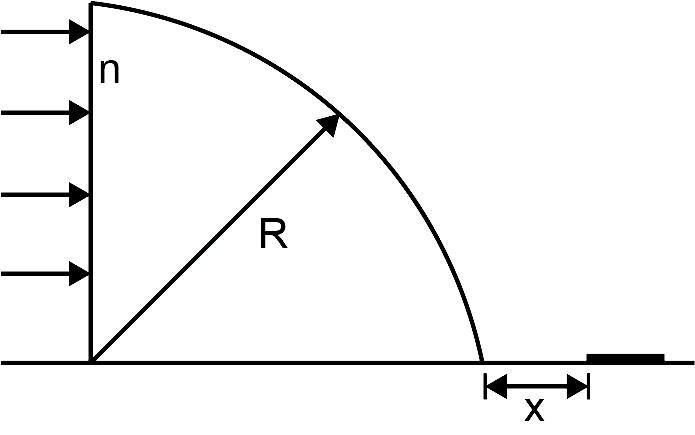
A parallel beam of light is incident on a glass prism in the shape of a quarter cylinder of radius \(R=0.05 \mathrm{m}\) and refractive index \(n=1.5,\) placed on a horizontal table as shown in the figure. Beyond the cylinder, a patch of light is found whose the nearest distance \(x\) from the cylinder isWBJEE 2017 Medium - A straight conductor \(0.1 \mathrm{m}\) long moves in uniform magnetic field \(0.1 \mathrm{T}\). The velocity the conductor is \(15 \mathrm{m} / \mathrm{s}\) and is directer perpendicular to the field. The emf inducod between the two ends of the conductor isWBJEE 2015 Easy
- If the kinetic energy of a body changes by \(20 \%\) then its momentum would change by -WBJEE 2009 Medium
- A particle is moving with a uniform speed \(v\) in a circular path of radius \(r\) with the centre at \(O\). When the particle moves from a point \(P\) to \(Q\) on the circle such that \(\angle P O Q=\theta\), then the magnitude of the change in velocity isWBJEE 2013 Easy
- A bar magnet has a magnetic moment of \(200 \mathrm{Am}^{2}\). The magnet is suspended in a magnetic field of \(0.30 \mathrm{NA}^{-1} \mathrm{m}^{-1}\). The torque required to rotate the magnet from its equilibrium position through an angle of \(30^{\circ},\) will beWBJEE 2013 Easy
- The magnets of two suspended coll galvanometers are of the same strength so that they produce identical uniform magnetic fields in the region of the coils. The coil of the first one is in the shape of a square of side a and that of the second one is circular of radius \(\frac{a}{\sqrt{\pi}},\) When the same current is passed through the coils, the ratio of the torque experienced by the first coil to that experienced by the second one isWBJEE 2017 Medium
More PYQs from WBJEE
- The equation \(z \bar{z}+(2-3 i) z+(2+3 i) \bar{z}+4=0\) represents a circle of radiusWBJEE 2020 Easy
- Let \(\mathrm{S}, \mathrm{T}, \mathrm{U}\) be three non-void sets and \(\mathrm{f}: \mathrm{S} \rightarrow \mathrm{T}, \mathrm{g}: \mathrm{T} \rightarrow \mathrm{U}\) and composed mapping \(\mathrm{gof}: \mathrm{S} \rightarrow U\) be defined. Let \(\mathrm{gof}\) be injective mapping. ThenWBJEE 2022 Medium
- Consider the function \(f(x)=\frac{x^{3}}{4}-\sin \pi x+3\)WBJEE 2019 Medium
- \(y=\int \cos \left\{2 \tan ^{-1} \sqrt{\frac{1-x}{1+x}}\right\} d x\) is an equation of a family ofWBJEE 2019 Medium
- If \(\operatorname{adj} \mathrm{B}=\mathrm{A},|\mathrm{P}|=|\mathrm{Q}|=1\), then \(\operatorname{adj}\left(\mathrm{Q}^{-1} \mathrm{BP}^{-1}\right)=\)WBJEE 2025 Medium
- The minimum force required to start pushing a body up a rough (having co-efficient of friction \(\mu\) ) inclined plane is \(\vec{F}_1\) while the minimum force needed to prevent it from sliding is \(\vec{F}_2\). If the inclined plane makes an angle \(\theta\) with the horizontal such that \(\tan \theta=2 \mu\), then the ratio \(F_1 / F_2\) isWBJEE 2025 Medium