


WBJEE · Physics · Motion In Two Dimensions
Particle \(A\) moves along \(X\) -axis with a uniform velocity of magnitude \(10 \mathrm{m} / \mathrm{s}\). Particle \(B\) moves with uniform velocity \(20 \mathrm{m} / \mathrm{s}\) along a direction making an angle of \(60^{\circ}\) with the positive direction of \(X\) -axis as shown in the figure. The relative velocity of \(B\) with respect to that of \(A\) is
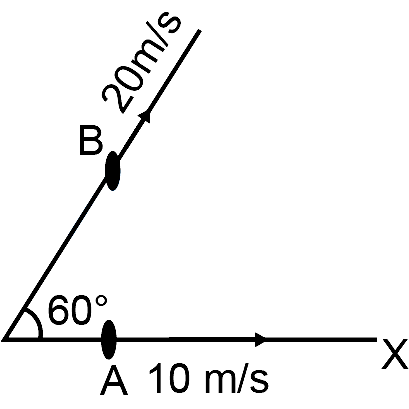
- A \(10 \mathrm{m} / \mathrm{s}\) along \(X\) -axis
- B \(10 \sqrt{3} \mathrm{m} / \mathrm{s}\) along \(Y\) -axis (perpendicular to \(X\) -axis)
- C \(10 \sqrt{5} \mathrm{m} / \mathrm{s}\) along the bisection of the velocities of A and \(B\)
- D \(30 \mathrm{m} / \mathrm{s}\) along negative \(X\) -axis
Answer & Solution
Correct Answer
(B) \(10 \sqrt{3} \mathrm{m} / \mathrm{s}\) along \(Y\) -axis (perpendicular to \(X\) -axis)
Step-by-step Solution
Detailed explanation
\begin{aligned} &\text { The component of velocity of } B \text { along } x \text { -direction }\\ &\begin{aligned} \mathbf{v}_{B x} &=20 \cos 60^{\circ}=20 \times \frac{1}{2}=10 \mathrm{m} / \mathrm{s} \\ \mathbf{v}_{A} &=10 \hat{\mathbf{i}} \\ \mathbf{v}_{B} &=10…
See the Complete Solution
Get step-by-step explanations for this and 2.5 Lakh+ more JEE, NEET & CET questions.
- Unlock all solutions
- Practice the full chapter
- Track accuracy across PYQs
4.8 rated on Google Play · 14,000+ reviews
More questions from Physics
- Consider the integral form of the Gaussian law in electrostatics.
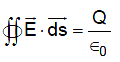
Which of the following statements are correct?WBJEE 2024 Medium -
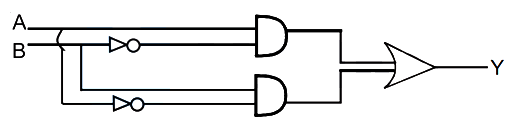
For the given logic circuit, the output \(Y\) for inputs \((A=0, B=1)\) and \((A=0, B=0)\) respectively areWBJEE 2021 Easy - The water equivalent of a calorimeter is \(10 \mathrm{g}\) and it contains \(50 \mathrm{g}\) of water at \(15^{\circ} \mathrm{C}\). Some amount of ice, initially at \(-10^{\circ} \mathrm{C}\) is dropped in it and half of the ice melts till equilibrium is reached. What was the initial amount of ice that was dropped (when specific heat of ice \(=0.5 \mathrm{cal} \mathrm{gm}^{-1}{ }^{\circ} \mathrm{C}^{-1},\) specific heat of water \(=1.0\)
cal \(\mathrm{gm}^{-1 \circ} \mathrm{C}^{-1}\) and latent heat of melting of ice \(=80\) cal \(\mathrm{gm}^{-1}\) )?WBJEE 2018 Medium - The height vertically above the earth's surface at which the acceleration due to gravity becomes \(1 \%\) of its value at the surface is ( \(\mathrm{R}\) is the radius of the Earth)WBJEE 2010 Medium
- A straight wire is placed in a magnetic field that varies with distance \(x\) from origin as \(\vec{B}=B_0\left(2-\frac{x}{a}\right) \hat{k}\). Ends of wire are at \((a, 0)\) and \((2 a, 0)\) and it carries a current \(\mathrm{I}\). If force on wire is \(\vec{F}=\mathrm{IB}_0\left(\frac{k a}{2}\right) \hat{\mathrm{j}}\), then value of \(k\) isWBJEE 2022 Medium
-
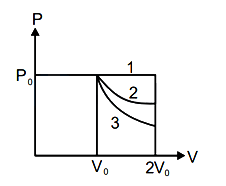
In the given figure, 1 represents isobaric, 2 represents isothermal and 3 represents adiabatic processes of an ideal gas. If \(\Delta \mathrm{U}_{1}, \Delta \mathrm{U}_{2}, \Delta \mathrm{U}_{3}\) be the changes in internal energy in these processes respectively, thenWBJEE 2021 Easy
More PYQs from WBJEE
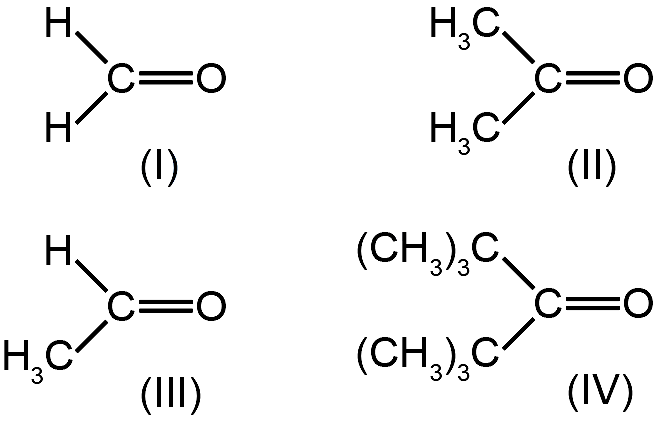
- The correct order of reactivity for the addition reaction of the following carbonyl compounds with ethylmagnesium iodide is
 WBJEE 2018 Medium
 - Let \(C_{1}\) and \(C_{2}\) denote the centres of the circles \(x^{2}+y^{2}=4\) and \((x-2)^{2}+y^{2}=1\) respectively and let \(P\) and \(Q\) be their points of intersection.Then, the areas of \(\Delta C_{1} P Q\) and \(C_{2} P Q\) are in the ratioWBJEE 2012 Medium
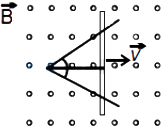
- Two straignt conducting plates form an angle \(\theta\) where their ends are joined. A conducting bar in contact with the plates and forming an isosceles triangle with them starts at the vertex at time \(t=0\) and moves with constant velocity \(\vec{v}\) to the right as shown in figure. A magnetic field \(\vec{B}\) points out of the page. The magnitude of emf induced at \(t=1\) second will be
 WBJEE 2024 Easy
 - If \(\omega \neq 1\) is a cube root of unity, then the sum of the series \(S=1+2 \omega+3 \omega^2+\ldots \ldots \ldots . .+3 n \omega^{3 n-1}\) isWBJEE 2011 Hard
- If \(M\) is any square matrix of order 3 over \(R\). and if \(M^{\prime}\) be the transpose of \(M\), then \(adj\left(M^{\prime}\right)-(\text { adj } M)^{\prime}\) is equal toWBJEE 2019 Easy
- When the frequency of the light used is changed from \(4 \times 10^{14} \mathrm{s}^{-1}\) to \(5 \times 10^{14} \mathrm{s}^{-1}\). the angular width of the principal (central) maximum in a single slit Fraunhoffer diffraction pattern changes by 0.6 radian. What is the width of the slit (assume that the experiment is performed in vacuumWBJEE 2019 Medium