


WBJEE · Physics · Electrostatics
A charge \(q\) is placed at one corner of a cube. The electric flux through any of the three faces adjacent to the charge is zero. The flux through any one of the other three faces is
- A \(q / 3 \varepsilon_{0}\)
- B \(q / 6 \varepsilon_{0}\)
- C \(q / 12 \varepsilon_{0}\)
- D \(q / 24 \varepsilon_{0}\)
Answer & Solution
Correct Answer
(D) \(q / 24 \varepsilon_{0}\)
Step-by-step Solution
Detailed explanation
Consider the diagram In above the flux coverage of three face is shown in figure. Which is like a quadrant in any plane. So, flux will be \[ \phi=\frac{1}{4} \times \frac{q}{6 \varepsilon_{0}}=\frac{q}{24 \varepsilon_{0}} \]
See the Complete Solution
Get step-by-step explanations for this and 2.5 Lakh+ more JEE, NEET & CET questions.
- Unlock all solutions
- Practice the full chapter
- Track accuracy across PYQs
4.8 rated on Google Play · 14,000+ reviews
More questions from Physics
- One \(\mathrm{Kg}\) of copper is drawn into a wire of \(1 \mathrm{~mm}\) diameter and a wire of \(2 \mathrm{~mm}\) diameter. The resistance of the two wires will be in the ratioWBJEE 2009 Medium
- A charged particle in a uniform magnetic field \(B=B_0 \hat{k}\) starts moving from the origin with velocity \(v=3 \hat{i}+4 \hat{k}\) m/s. The trajectory of the particle and the time \(t\) at which it reaches \(2 \mathrm{~m}\) above \(x-y\) plane are,WBJEE 2023 Medium
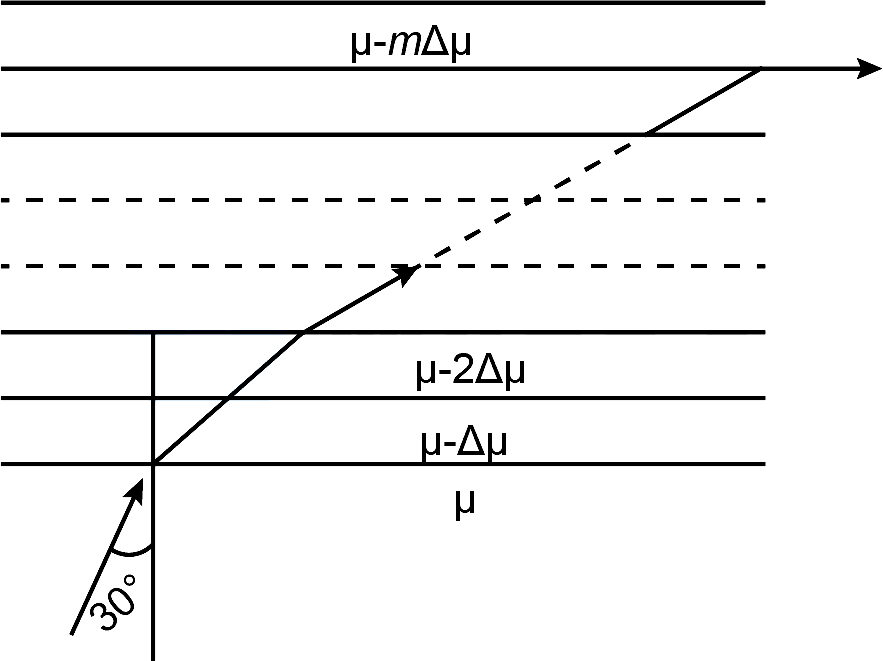
- A glass slab consists of thin uniform layers of progressively decreasing refractive indices RI (see figure) such that the RI of any layer is \(\mu-m \Delta \mu\). Here, \(\mu\) and \(\Delta \mu\) denote the \(\mathrm{RI}\) of 0 th layer and the difference in RI between any two consecutive layers, respectively. The integer \(m=0,1,2,3, \ldots\) denotes the numbers of the successive layers. A ray of light from the oth layer enters the 1st layer at an angle of incidence of \(30^{\circ}\). After undergoing the mth refraction, the ray emerges parallel to the interface. If \(\mu=1.5\) and \(\Delta \mu=0.015,\) the value of \(m\) is
 WBJEE 2014 Medium
 - Consider two particles of different masses, In which of the following situations the heavier of the two particles will have smaller de-Broglie wavelength?WBJEE 2015 Medium
- A NOR gate and a NAND gate are connected as shown in the figure. Two different sets of inputs are given to this setup. In the first case, the inputs to the gates are \(A=0, B=0\), \(C=0 .\) In the second case, the inputs are \(A=1, B=0, C=1 .\) The output \(D\) in the first case and second case respectively are
 WBJEE 2013 Easy
 - Given : The percentage error in the measurements of \(\mathrm{A}, \mathrm{B}, \mathrm{C}\) and \(\mathrm{D}\) are respectively, \(4 \%, 2 \%, 3 \%\) and \(1 \%\). The relative error in \(Z=\frac{A^4 B^{\frac{1}{3}}}{C D^{\frac{3}{2}}}\) isWBJEE 2022 Easy
More PYQs from WBJEE
- The integrating factor of the differential equation \(3 x \log _{e} x \frac{d y}{d x}+y=2 \log _{e} x\) is given byWBJEE 2012 Hard
- Equilibrium constants for the following reactions at \(1200 \mathrm{K}\) are given
\(2 \mathrm{H}_{2} \mathrm{O}(g) \rightleftharpoons 2 \mathrm{H}_{2}(g)+\mathrm{O}_{2}(g)\)
\(K_{1}=6.4 \times 10^{-8}\)
\(2 \mathrm{CO}_{2}(g) \rightleftharpoons 2 \mathrm{CO}(g)+\mathrm{O}_{2}(g)\)
\(K_{2}=1.6 \times 10^{-6}\)
The equilibrium constant for the reaction? \(\mathrm{H}_{2}(g)+\mathrm{CO}_{2}(g) \rightleftharpoons \mathrm{CO}(g)+\mathrm{H}_{2} \mathrm{O}(g)\)
at \(1200 \mathrm{K}\) will beWBJEE 2017 Medium - Eleven apples are distributed among a girl and a boy, Then, which one of the following statements is true?WBJEE 2013 Medium
- A Zener diode having break-down voltage \(5.6 \mathrm{V}\) is connected in reverse bias with a battery of emf \(10 \mathrm{V}\) and a resistance of \(100 \Omega\) in series. The current flowing through the Zener diode isWBJEE 2016 Medium
- Let \(f(x)\) be a differentiable function in \([2,7]\). If \(f(2)=3\) and \(f^{\prime}(x) \leq 5\) for all \(x\) in \((2,7),\) then the maximum posaible value of \(f(x)\) at \(x=7\) isWBJEE 2014 Medium
- Addition of excess potassium iodide solution to a solution of mereuric chloride gives the halide complexWBJEE 2013 Medium