


WBJEE · Maths · Functions
Let \(f: \mathbb{R} \rightarrow \mathbb{R}\) be a function defined by \(f(x)=\frac{e^{|x|}-e^{-x}}{e^x+e^{-x}}\), then
- A f is both one-one and onto
- B f is one-one but not onto
- C f is onto but not one-one
- D f is neither one-one nor onto
Answer & Solution
Correct Answer
(D) f is neither one-one nor onto
Step-by-step Solution
Detailed explanation
Hint: \(f: \mathbb{R} \rightarrow \mathbb{R}, f(x)=\frac{e^{|x|}-e^{-x}}{e^x+e^{-x}}\) Case I: If \(x \geq 0\) \(f(x)=\frac{e^x-e^{-x}}{e^x+e^{-x}}=1-\frac{2 e^{-x}}{e^x+e^{-x}}=1-\frac{2}{e^{2 x}+1}\gt-1\) Case II: \(x \lt 0\) \(f(x)=\frac{e^{-x}-e^{-x}}{e^x+e^{-x}}=0\)
See the Complete Solution
Get step-by-step explanations for this and 2.5 Lakh+ more JEE, NEET & CET questions.
- Unlock all solutions
- Practice the full chapter
- Track accuracy across PYQs
4.8 rated on Google Play · 14,000+ reviews
More questions from Maths
- A polygon has 44 diagonals. The number of its sides isWBJEE 2009 Medium
- \(\int \frac{\sin ^8 x-\cos ^8 x}{1-2 \sin ^2 x \cos ^2 x} d x\)WBJEE 2011 Hard
- If \(P(0,0), Q(1,0)\) and \(R\left(\frac{1}{2}, \frac{\sqrt{3}}{2}\right)\) are three given points, then the centre of the circle for which the lines \(P Q, Q R\) and \(R P\) are the tangents isWBJEE 2019 Medium
- If \(\mathrm{f}: \mathrm{S} \rightarrow \mathbb{R}\) where \(S\) is the set of all non-singular matrices of order 2 over \(\mathbb{R}\) and \(f\left[\left(\begin{array}{ll}a & b \\ c & d\end{array}\right)\right]=a d-b c\), thenWBJEE 2020 Easy
- If \(\cos (\theta+\phi)=\frac{3}{5}\) and \(\sin (\theta-\phi)=\frac{5}{13}, 0 \lt \theta, \phi \lt \frac{\pi}{4}\), then \(\cot (2 \theta)\) has the valueWBJEE 2025 Medium
- Let \(A=\left[\begin{array}{ccc}5 & 5 \alpha & \alpha \\ 0 & \alpha & 5 \alpha \\ 0 & 0 & 5\end{array}\right]\). If \(|\mathrm{A}|^2=25\), then \(|\alpha|\) equals toWBJEE 2025 Easy
More PYQs from WBJEE
- The equation of stationary wave along a stretched string is given by \(y=5 \sin \frac{\pi x}{3} \cos 40 \pi t\). Here x and y are in cm and t in second. The separation between two adjacent nodes isWBJEE 2025 Easy
- Find the equivalent capacitance between \(A\) and \(B\) of the following arrangement :
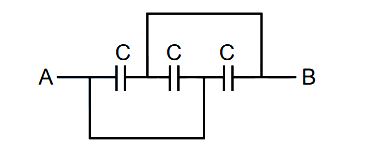 WBJEE 2022 Easy
 - Let \(f: R \rightarrow R\) be such that \(f(0)=0\) and \(\left|f^{\prime}(x)\right| \leq 5\) for all \(x\). Then \(f(1)\) is inWBJEE 2021 Medium
- The points of intersection of two ellipses \(x^{2}+2 y^{2}-6 x-12 y+20=0\) and \(2 x^{2}+y^{2}-10 x-6 y+15=0\) lie on a circle. The centre of the circle isWBJEE 2021 Hard
- If \(|z+i|-|z-1|=|z|-2=0\) for a complex number \(z\), then \(z=\)WBJEE 2021 Hard
- In Young's double slit experiment, light of wavelength \(\lambda\) passes through the double-slit and forms interference fringes on a screen \(1.2 \mathrm{~m}\) away. If the difference between 3 rd order maximum and 3 rd order minimum is \(0.18 \mathrm{~cm}\) and the slits are \(0.02 \mathrm{~cm}\) apart, then \(\lambda\) isWBJEE 2021 Easy