


WBJEE · Physics · Wave Optics
In Young's double slit experiment, light of wavelength \(\lambda\) passes through the double-slit and forms interference fringes on a screen \(1.2 \mathrm{~m}\) away. If the difference between 3 rd order maximum and 3 rd order minimum is \(0.18 \mathrm{~cm}\) and the slits are \(0.02 \mathrm{~cm}\) apart, then \(\lambda\) is
- A \(1200 \mathrm{~nm}\)
- B \(450 \mathrm{~nm}\)
- C \(600 \mathrm{~nm}\)
- D \(300 \mathrm{~nm}\)
Answer & Solution
Correct Answer
(C) \(600 \mathrm{~nm}\)
Step-by-step Solution
Detailed explanation
Distance between 3 rd order minima and 3 rd order maxima is \(\frac{\beta}{2}\) \( \begin{array}{l} \frac{\beta}{2}=0.18 \mathrm{~cm} \\ \beta=0.36 \mathrm{~cm} \\ \beta=\frac{\mathrm{D} \lambda}{\mathrm{d}} \\ \therefore \lambda=600 \mathrm{~nm} \end{array} \)
See the Complete Solution
Get step-by-step explanations for this and 2.5 Lakh+ more JEE, NEET & CET questions.
- Unlock all solutions
- Practice the full chapter
- Track accuracy across PYQs
4.8 rated on Google Play · 14,000+ reviews
More questions from Physics
- An infinite sheet carrying a uniform surface charge density \(\sigma\) lies on the \(x y\) -plane. The work done to carry a charge \(q\) from the point \(\mathbf{A}=a(\mathbf{i}+2 \hat{\mathbf{j}}+3 \hat{\mathbf{k}})\) to the point \(\mathbf{B}=a(\mathbf{i}-2 \hat{\mathbf{j}}+6 \hat{\mathbf{k}})\)
(where \(a\) is a constant with the dimension of length and \(\varepsilon_{0}\) is the permittivity of free space) isWBJEE 2014 Medium - The light beams of intensities in the ratio of \(9: 1\) are allowed to interfere. What will be the ratio of the intensities of maxima and minima?WBJEE 2010 Easy
- A particle is executing linear simple harmonic motion of amplitude A. At what displacement is the energy of the particle half potential and half kinetic?WBJEE 2010 Easy
- Two metal wires of identical dimensions are connected in series. If \(\sigma_{1}\) and \(\sigma_{2}\) are the electrical conductivities of the metal wires respectively, the effective conductivity of the combination isWBJEE 2021 Easy
- A particle moves along \(x\) -axis and its displacement at any time is given by \(x(t)=2 t^{3}-3 t^{2}+4 t\) in SI units. The velocity of the particle when its acceleration is zero, isWBJEE 2013 Easy
- A uniform magnetic field \(B\) exists in a region. An electron of charge \(q\) and mass \(m\) moving with velocity \(v\) enters the region in a direction perpendicular to the magnetic field. Considering Bohr angular momentum quantization, which of the following statement(s) is/are true?WBJEE 2023 Hard
More PYQs from WBJEE
- \(\mathrm{C}_6 \mathrm{H}_6(\mathrm{liq})+\frac{15}{2} \mathrm{O}_2(\mathrm{~g}) \rightarrow 6 \mathrm{CO}_2(\mathrm{~g})+3 \mathrm{H}_2 \mathrm{O}(\mathrm{liq})\)
Benzene burns in oxygen according to the above equation. What is the volume of oxygen (at STP) needed for complete combustion of 39 gram of liquid benzene?WBJEE 2022 Medium - A wire of resistance \(\mathrm{R}\) is elongated \(n\)-fold to make a new uniform wire. The resistance of new wireWBJEE 2010 Medium
- The Power \((P)\) radiated from an accelerated charged particle is given by \(P \propto \frac{(q a)^m}{c^n}\) where \(q\) is the charge, \(a\) is the acceleration of the particle and c is speed of light in vacuum. From dimensional analysis, the value of m and n respectively, areWBJEE 2024 Easy
- A solution of \(\mathrm{NaNO}_{3}\), when treated with a mixture of \(\mathrm{Zn}\) dust and ' \(\mathrm{A}\) ' yields ammonia. ' \(\mathrm{A}\) ' can beWBJEE 2021 Easy
- Consider the integral form of the Gaussian law in electrostatics.
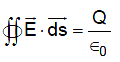
Which of the following statements are correct?WBJEE 2024 Medium - A point \(P\) lies on the circle \(x^{2}+y^{2}=169\). If \(Q=(5,12)\) and \(R=(-12,5),\) then the \(\angle Q P R\) isWBJEE 2013 Medium