


TS EAMCET · Physics · Units and Dimensions
If \(\mathrm{A}, \mathrm{B}\) and C are three different physical quantities with different dimensional formulae, then the combination which can never give a proper physical quantity is
- A \(\frac{\mathrm{A}}{\mathrm{BC}}\)
- B \(\frac{A B-C^2}{B C}\)
- C \(\frac{A-C}{B}\)
- D \(\mathrm{AC}-\mathrm{B}\)
Answer & Solution
Correct Answer
(C) \(\frac{A-C}{B}\)
Step-by-step Solution
Detailed explanation
Quantities can only be added or subtracted if they have the same dimensional formula. Given that A, B and C have different dimensional formulae, then \( [A] \neq [C] \). The term \( A-C \) is therefore dimensionally inconsistent and cannot be a proper physical quantity. Thus,…
See the Complete Solution
Get step-by-step explanations for this and 2.5 Lakh+ more JEE, NEET & CET questions.
- Unlock all solutions
- Practice the full chapter
- Track accuracy across PYQs
4.8 rated on Google Play · 14,000+ reviews
More questions from Physics
- Identify the correct option.TS EAMCET 2019 Easy
- A conducting circular coil is placed in uniform magnetic field with the magnetic field initially directed perpendicular to the plane of the coil. In step A, the coil is rotated from its initial position by \(60^{\circ}\) about its diameters in time ' \(t\) '. In step B, the coil is further rotated about the same axis in the same sense by another \(120^{\circ}\) in time ' \(2 \mathrm{t}\) '. Ratio of emf induced in the coil in step A to that in step B isTS EAMCET 2023 Hard
- The difference in the wavelength between the maximum and minimum of Balmer series [Use \(\mathrm{R}_{\mathrm{H}}=1 \times 10^7 \mathrm{~m}^{-1}\) ]TS EAMCET 2022 Easy
- A pendulum has a time period \(\mathrm{T}\) in air. When it is made to oscillate in water its time period is \(\sqrt{2} \mathrm{~T}\). Then the relative density of the material of the bob of the pendulum is (neglect damping)TS EAMCET 2023 Medium
- The lengths of four wires A, B, C and D made of same material are \(1 \mathrm{~m}, 2 \mathrm{~m}, 3 \mathrm{~m}\) and \(4 \mathrm{~m}\) respectively. The radii of the wires A, B, C and D are \(0.2 \mathrm{~mm}, 0.4 \mathrm{~mm}, 0.6 \mathrm{~mm}\) and \(0.8 \mathrm{~mm}\) respectively. For the same applied tension, the elongation is more in the wire.TS EAMCET 2023 Easy
- Two coherent point sources \(S_1\) and \(S_2\) vibrating in phase emit light of wavelength \(\lambda\). The separation between them is \(2 \lambda\) as shown in figure. The first bright fringe is formed at \(P\) due to interference on a screen placed at a distance \(D\) from \(S_1(D>>\lambda)\), then \(O P\) is
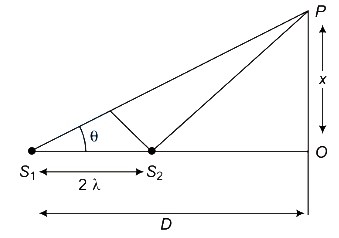 TS EAMCET 2012 Hard
More PYQs from TS EAMCET
- The time in seconds required to produce a potential difference of \(20 \mathrm{~V}\) across a capacitor of \(1000 \mu \mathrm{F}\) when it is charged at the steady rate of \(200 \mu \mathrm{C} / \mathrm{s}\) isTS EAMCET 2002 Easy
- Consider a particle on which constant forces \(\mathbf{F}_{\mathbf{1}}=\hat{\mathbf{i}}+2 \hat{\mathbf{j}}+3 \hat{\mathbf{k}} N\) and \(\mathbf{F}_{\mathbf{2}}=4 \hat{\mathbf{i}}-5 \hat{\mathbf{j}}-2 \hat{\mathbf{k}} N\) act together resulting in a displacement from position \(\mathbf{r}_1=20 \hat{\hat{i}}+15 \hat{\mathrm{j}} \mathrm{cm}\) to \(\mathbf{r}_2=7 \hat{\mathrm{k}} \mathrm{cm}\). The total work done on the particle isTS EAMCET 2017 Easy
- A small block of mass \(5 \mathrm{~g}\) and charge \(5 \mu \mathrm{C}\) is placed on insulated, frictionless, inclined plane of angle \(60^{\circ}\). An electric field is applied parallel to the inclined plane. If the block remains at rest then the magnitude of electric field is \(\left[\right.\) Take \(\mathrm{g}=10 \mathrm{~m} / \mathrm{s}^2\))TS EAMCET 2022 Easy
- A bullet of mass fired with a speed from passes through a block of wood whose centre is kept at a distance of from the origin as shown in figure. The retarding force on the bullet within the wooden block is . The minimum length of the block (upto one decimal digit) required to completely stop the bullet is (Assume )TS EAMCET 2019 Medium
- What would be the angular separation between the consecutive bright fringes in Young's double slit experiment with blue green light of wavelength The separation between the slits isTS EAMCET 2021 Hard
- The focal length of biconvex lens made of glass, of equal radii is \(f\). If the lens is dipped in the water, then the focal length becomes (Take, refractive index of glass and water as \(\frac{3}{2}\) and \(\frac{4}{3}\), respectively)TS EAMCET 2021 Hard