


TS EAMCET · Physics · Electrostatics
What would be the angular separation between the consecutive bright fringes in Young's double slit experiment with blue green light of wavelength The separation between the slits is
- A
- B
- C
- D
Answer & Solution
Correct Answer
(A)
Step-by-step Solution
Detailed explanation
Given, in Young's double-slit experiment, the wavelength of light(λ)=500nmthe separation between slits(d)=1·0×10-3mIn the above figure,θ=angles fringe widthsinceθis a small angle, thereforeθ≃tanθ=yD=λDdD=λdθ=4×10⁻⁷m1·0×10-3m=4×10⁻⁴rad.
See the Complete Solution
Get step-by-step explanations for this and 2.5 Lakh+ more JEE, NEET & CET questions.
- Unlock all solutions
- Practice the full chapter
- Track accuracy across PYQs
4.8 rated on Google Play · 14,000+ reviews
More questions from Physics
- In a meter bridge the balancing length from the left end is found to be \(25 \mathrm{~cm}\). The value of the unknown resistance is (assume, standard resistance of \(1 \Omega\) is in the right gap)TS EAMCET 2020 Easy
- Find the current in the three resistors as shown in the following figure?
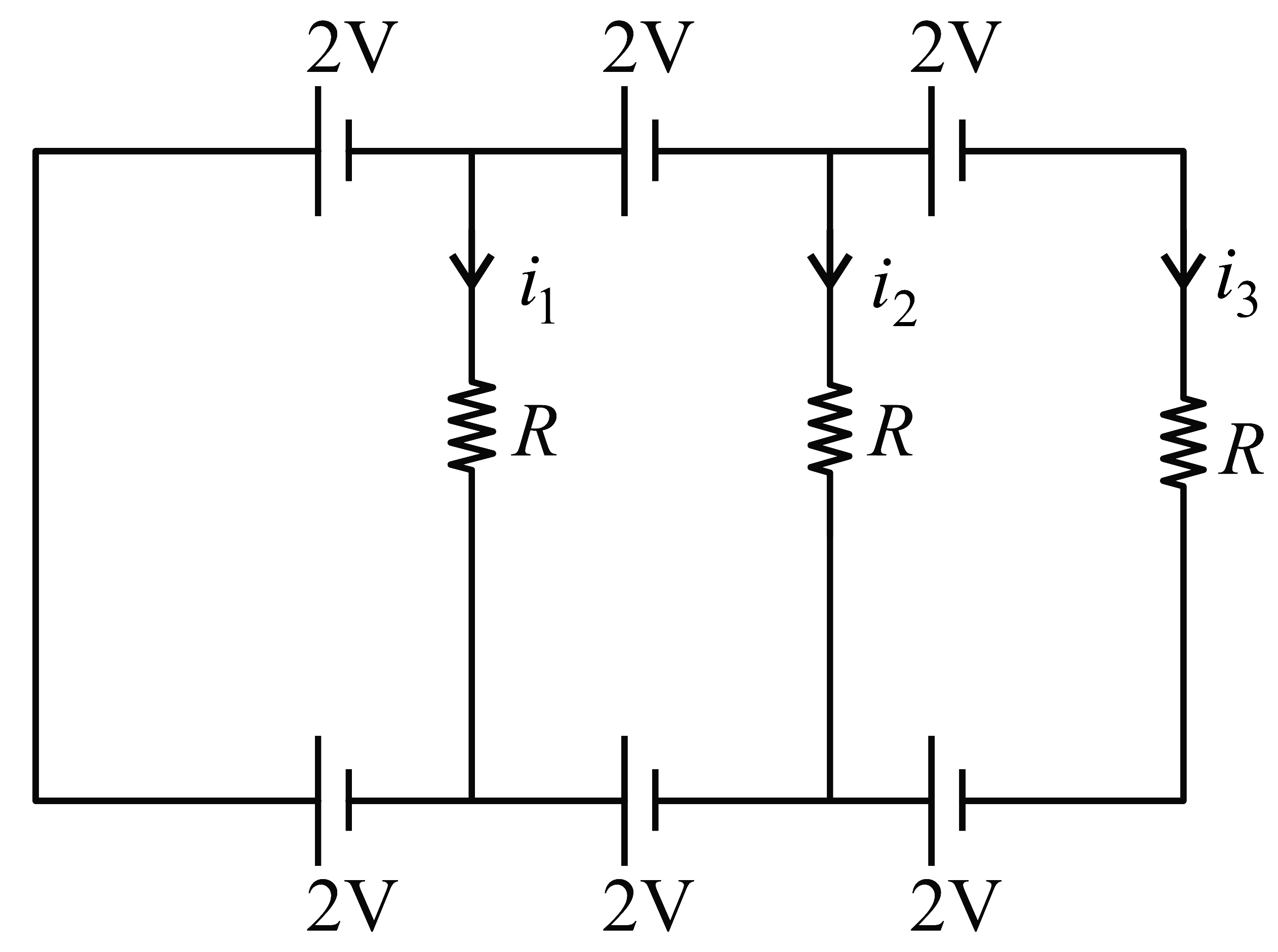 TS EAMCET 2022 Medium
 - From a height of ' \(h\) ' above the ground, a ball is projected up at an angle \(30^{\circ}\) with the horizontal. If the ball strikes the ground with a speed of 1.25 times its initial speed of \(40 \mathrm{~ms}^{-1}\), the value of ' \(h\) ' is (acceleration due to gravity \(=\) \(10 \mathrm{~ms}^{-2}\) )TS EAMCET 2024 Medium
- Statement (I) : An object subjected to velocities \(\overrightarrow{v_1}\) and \(\overrightarrow{v_2}\) has a resultant velocity with magnitude \(|\vec{v}|=\left|\overrightarrow{v_1}\right|+\left|\overrightarrow{v_2}\right|\).
Statement (II) : The magnitude of displacement is either less or equal to the path length of an object between two points.
Statement (III) : The instantaneous acceleration is the limiting value of the average acceleration as the time interval approaches zero.
Which of the following is correct?TS EAMCET 2022 Easy - What is the maximum wavelength of electromagnetic radiation that create a electron-hole pair in material with band gap \(0.7 \mathrm{eV}\) ? Planck's constant \(=4.136 \times 10^{15} \mathrm{eV}-\mathrm{s}\), velocity of light \(=3 \times 10^8 \mathrm{~m} / \mathrm{s}\).TS EAMCET 2021 Easy
- In uniform circular motion, which of the following statement is wrong?TS EAMCET 2021 Easy
More PYQs from TS EAMCET
- When a photosensitive material is illuminated by photons of energy 3.1 eV, the stopping potential of the photoelectrons is 1.7 V. When the same photosensitive material is illuminated by photons of energy 2.5 eV, the stopping potential of the photoelectrons isTS EAMCET 2025 Medium
- In the figure, the chamber A contains a gas, movable chamber B is placed on the top of the gas and it contains \(\mathrm{n}\) metal balls. The weight of chamber B is supported by the gas. Chamber \(\mathrm{C}\) has vacuum. Let the gas be in equilibrium at pressure \(\mathrm{P}\). Let \(\mathrm{P}^{\prime}\) be the pressure if one of the balls is taken away. Find \(\left(\mathrm{P}-\mathrm{P}^{\prime}\right) / \mathrm{P}\).
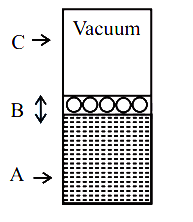 TS EAMCET 2022 Hard
 - A source of sound whose frequency is \(1000 \mathrm{~Hz}\) is moving with a speed \(33 \mathrm{~m} / \mathrm{s}\). The waves reflected by a fixed obstacle are registered by a receiver that moves together with the source. The speed of the sound waves is \(330 \mathrm{~m} / \mathrm{s}\), then the frequency registered by the receiver isTS EAMCET 2018 Easy
- When monochromatic light falls on a photo-sensitive metal, an electron is emitted with maximum velocity \(1.6 \times 10^6 \mathrm{~m} / \mathrm{s}\). Find the stopping potential. [charge of electron \(=1.6 \times 10^{-19} \mathrm{C}\), mass of electron \(\left.=9 \times 10^{-31} \mathrm{~kg}\right]\)TS EAMCET 2022 Hard
- The relation between time \(t\) and distance \(x\) of a particle is \(t=a x^2+b x\), where \(a\) and \(\mathrm{b}\) are constants.
If \(\mathrm{v}\) is the velocity of the particle, then its acceleration isTS EAMCET 2023 Easy - A microscope consists of an objective of focal length \(1.9 \mathrm{~cm}\) and eye piece of focal length \(5 \mathrm{~cm}\). The two lenses are kept at a distance of \(10.5 \mathrm{~cm}\). If the image is to be formed at the least distance of distinct vision, the distance at which the object is to be placed before the objective is (least distance of distinct vision is \(25 \mathrm{~cm}\) )TS EAMCET 2013 Easy