


TS EAMCET · Physics · Kinetic Theory of Gases
A molecule is travelling in air at \(300 \mathrm{~K}\) and \(1 \mathrm{~atm}\), and the radius of the molecule is \(0.6 \times 10^{-10} \mathrm{~m}\). Calculate the approx. mean free path of the molecule. (The number density is \(2.44 \times 10^{25}\) molecules \(/ \mathrm{m}^3\) )
- A \(\frac{0.2}{\pi} \times 10^{-5} \mathrm{~m}\)
- B \(\frac{0.3}{\pi} \times 10^{-5} \mathrm{~m}\)
- C \(\frac{0.4}{\pi} \times 10^{-5} \mathrm{~m}\)
- D \(\frac{0.1}{\pi} \times 10^{-5} \mathrm{~m}\)
Answer & Solution
Correct Answer
(A) \(\frac{0.2}{\pi} \times 10^{-5} \mathrm{~m}\)
Step-by-step Solution
Detailed explanation
Given that, temperature, \(T=300 \mathrm{~K}\) Pressure, \(p=1\) atm \(=1.01 \times 10^5 \mathrm{~N} / \mathrm{m}^2\) Radius, \(r=0.6 \times 10^{-10} \mathrm{~m}\), diameter \(d=1.2 \times 10^{-10} \mathrm{~m}\) Number density, \(\rho=2.44 \times 10^{25}\) molecules…
See the Complete Solution
Get step-by-step explanations for this and 2.5 Lakh+ more JEE, NEET & CET questions.
- Unlock all solutions
- Practice the full chapter
- Track accuracy across PYQs
4.8 rated on Google Play · 14,000+ reviews
More questions from Physics
- The current density in a circular wire is given by \(J(r)=\) \(\left(1 \times 10^5 \mathrm{~A} / \mathrm{m}^3\right) r\), where \(r\) is the radial distance and the wire's radius is \(2 \mathrm{~mm}\). If the potential applied across the wire is 70 \(\mathrm{V}\), then the energy consumed by the wire in 1000 seconds isTS EAMCET 2022 Easy
- In an experiment on photoelectric emission from a metallic surface, wavelength of incident light is \(2 \times 10^{-7} \mathrm{~m}\) and stopping potential is \(2.5 \mathrm{~V}\). The threshold frequency of the metal (in \(\mathrm{Hz}\) ) approximately (charge of electron \(e=1.6 \times 10^{-19} \mathrm{C}\), Planck's constant \(\left.h=6.6 \times 10^{-34} \mathrm{~J}-\mathrm{s}\right)\)TS EAMCET 2007 Easy
- A pendulum has a time period \(\mathrm{T}\) in air. When it is made to oscillate in water its time period is \(\sqrt{2} \mathrm{~T}\). Then the relative density of the material of the bob of the pendulum is (neglect damping)TS EAMCET 2023 Medium
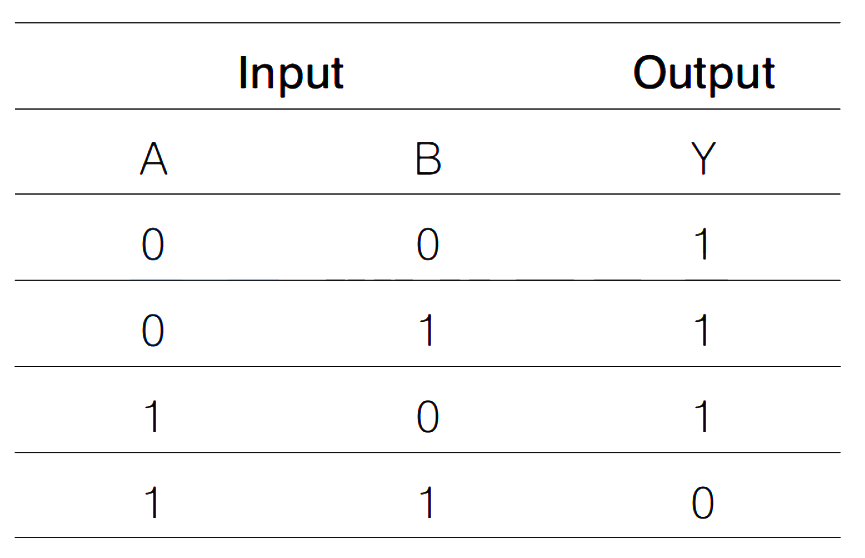
- The truth table of a logic gate is given below. then identify the gate.
 TS EAMCET 2019 Easy
 - A copper wire of cross-sectional area is under a tension of . Find the percentage change in the cross-sectional area (Young's modulus of copper and Poisson ratio )TS EAMCET 2019 Medium
- A conducting wire of cross-sectional area \(1 \mathrm{~cm}^2\) has \(3 \times 10^{23}\) charge carriers per \(\mathrm{m}^3\). If wire carries a current of \(24 \mathrm{~mA}\), then drift velocity of carriers isTS EAMCET 2020 Easy
More PYQs from TS EAMCET
- A steel pendulum clock manufactured at \(32^{\circ} \mathrm{C}\) and working at \(47^{\circ} \mathrm{C}\) is nearly (Coefficient of linear expansion of steel \(=12 \times 10^{-6} /{ }^{\circ} \mathrm{C}\) )TS EAMCET 2025 Medium
- When the temperature of a wire is increased from 303 K to 356 K , the resistance of the wire increases by \(10 \%\). The temperature coefficient of resistance of the material of the wire isTS EAMCET 2024 Easy
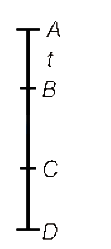
- A body is falling freely from a point \(A\) at a certain height from the ground and passes through points \(B, C\) and \(D\) (vertically as shown below) so that \(B C=C D\). The time taken by the particle to move from \(B\) to \(C\) is \(2 \mathrm{~s}\) and from \(C\) to \(D\) is 1 s. Time taken to move from \(A\) to \(B\) in seconds is
 TS EAMCET 2016 Medium
 - A charged particle moves with some initial velocity along the direction of external magnetic field \(B\). Now, if we apply uniform field perpendicular to the magnetic field, then the trajectory of the charged particle will beTS EAMCET 2018 Easy
- At a given instant of time two particles are having the position vectors \(4 \hat{\mathbf{i}}+4 \hat{\mathbf{j}}+57 \hat{\mathbf{k}}\) metres and \(2 \hat{\mathbf{i}}+2 \hat{\mathbf{j}}+5 \hat{\mathbf{k}}\) respectively. If the velocity of the first particle be \(0.4 \hat{\mathbf{i}} \mathrm{ms}^{-1}\), the velocity of second particle in metre per second if they collide after \(10 \mathrm{sec}\) isTS EAMCET 2004 Medium
- Consider a \(p-n\) junction as a capacitor, formed with \(p\) and \(n\)-materials acting as thin metal electrodes and depletion layer width acting as separation between them. Basing on this, assume that a \(n-p-n\) transistor is working as an amplifier in CE configuration. If \(C_1\) and \(C_2\) are the base-emitter and collector-emitter junction capacitances, then :TS EAMCET 2006 Medium