


TS EAMCET · Physics · Mechanical Properties of Fluids
A cylinder of mass and material density \(\rho\) hanging from a string is lowered into a vessel of cross-sectional area A containing a liquid of density \(\sigma( < \rho)\) until it is fully immersed. The increase in pressure at the bottom of the vessel is
- A Zero
- B \(\frac{\mathrm{mg}}{\mathrm{A}}\)
- C \(\frac{m g \rho}{\sigma \mathrm{A}}\)
- D \(\frac{\mathrm{m} \sigma \mathrm{g}}{\rho \mathrm{A}}\)
Answer & Solution
Correct Answer
(D) \(\frac{\mathrm{m} \sigma \mathrm{g}}{\rho \mathrm{A}}\)
Step-by-step Solution
Detailed explanation
From newton third law, excess force acting on the liquid is equal to force of buoyancy acting on the cylinder. The increase in pressure…
See the Complete Solution
Get step-by-step explanations for this and 2.5 Lakh+ more JEE, NEET & CET questions.
- Unlock all solutions
- Practice the full chapter
- Track accuracy across PYQs
4.8 rated on Google Play · 14,000+ reviews
More questions from Physics
- A circular hoop of radius and mass rotating with an angular velocity is placed on a rough horizontal surface. The initial velocity of the centre of the hoop is zero. Let be the velocity of the centre of the hoop when it ceases to slip. The ratio will beTS EAMCET 2021 Easy
- A \(6 \mathrm{~V}\) cell with \(0.5 \Omega\) internal resistance, a \(10 \mathrm{~V}\) cell with \(1 \Omega\) internal resistance and a \(12 \Omega\) external resistance are connected in parallel. The current (in ampere) through the \(10 \mathrm{~V}\) cell isTS EAMCET 2005 Medium
- A copper wire of cross-sectional area is under a tension of . Find the percentage change in the cross-sectional area (Young's modulus of copper and Poisson ratio )TS EAMCET 2019 Medium
- Consider a metal ball of radius \(r\) moving at a constant velocity \(v\) in a wiform magnetic field of induction \(\bar{B}\). Assuming that the direction of velocity forms an angle \(\alpha\) with the direction of \(\bar{B}\), the maximum potential difference between points on the ball isTS EAMCET 2017 Hard
- A ring has a mass \(M\) and radius \(R\). The distance of the point on its geometric axis from its centre at which the gravitational field is strongest isTS EAMCET 2023 Easy
- A cylindrical tube open at both ends has a fundamental frequency 'f' in air. The tube is dipped vertically in water so that half of it is in water. The new fundamental frequency isTS EAMCET 2022 Easy
More PYQs from TS EAMCET
- With a standard rectangular bar magnet of length (l), breadth \((b ; b< < l)\) and magnetic moment \(M\), the time period of the magnet in a vibration magnetometer is \(4 \mathrm{~s}\). If the magnet is cut normal to its length into four equal pieces, the time period (in seconds) with one of the pieces isTS EAMCET 2005 Medium
- The work function of a metal is \(2 \mathrm{eV}\). If a radiation of wavelength \(3000 Å\) is incident on it, the maximum kinetic energy of the emitted photoelectrons is (Planck's constant \(h=6.6 \times 10^{-34} \mathrm{Js}\); velocity of light \(\left.c=3 \times 10^8 \mathrm{~m} / \mathrm{s} ; 1 \mathrm{eV}=1.6 \times 10^{-19} \mathrm{~J}\right)\)TS EAMCET 2013 Medium
- In a series LCR circuit, if the current leads the source voltage, thenTS EAMCET 2024 Easy
- A long solenoid with 10.0 turn/cm and a radius of 8 cm carries a current of 7 mA. A current carrying straight conductor is located along the central axis of the solenoid. If the direction of resulting magnetic field is \(60^{\circ}\) to axial direction at a point \(5 \mathrm{~cm}\) from the axis of the solenoid along the radial direction, then the current in the conductor is [Take \(\sqrt{2}=1.4, \sqrt{3}=1.7\) ]TS EAMCET 2022 Hard
- A lamp of power \(942 \mathrm{~W}\) radiates energy uniformly in all direction. The wavelength of radiation is \(660 \mathrm{~nm}\). The photon flux on a small screen \(5.0 \mathrm{~m}\) from the lamp in units of \(\frac{\text { photon }}{m^2 \cdot s}\) is [Take Planck's constant \(h=6.6 \times 10^{-34}\) SI unit)TS EAMCET 2022 Medium
- The block starts from rest as shown in the figure. Find the work done by force of \(10 \mathrm{I}\) and friction in the time 0 to \(4 \mathrm{~s}\). [Take, \(g=10 \mathrm{~m} / \mathrm{s}^2\) ]
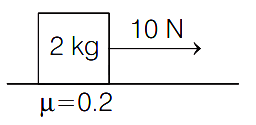 TS EAMCET 2020 Easy