


KCET · Physics · Wave Optics
A \(20 \mathrm{~cm}\) length of a certain solution causes right handed rotation of \(38^{\circ}\). A \(30 \mathrm{~cm}\) length of another solution causes left handed rotation of \(24^{\circ}\). The optical rotation caused by \(30 \mathrm{~cm}\) length of a mixture of the above solutions in the volume ratio \(1: 2\) is
- A left handed rotation of \(14^{\circ}\)
- B right handed rotation of \(14^{\circ}\)
- C left handed rotation of \(3^{\circ}\)
- D right handed rotation of \(3^{\circ}\)
Answer & Solution
Correct Answer
(D) right handed rotation of \(3^{\circ}\)
Step-by-step Solution
Detailed explanation
For liquid \(\mathrm{A}\)
\(L_{1}=20 \mathrm{~cm}, \theta_{1}=38^{\circ}\); concentration \(=C_{1}\)
\(\begin{aligned} \text { Specific rotation } \alpha_{1} &=\frac{\theta_{1}}{L_{1} C_{1}} \\ &=\frac{38^{\circ}}{20 \times C_{1}} \end{aligned}\)
Similarly, for liquid \(B\)
\(L_{2}=30 \mathrm{~cm} \theta_{2}=-24^{\circ}\), concentration \(=C_{2}\)
Specific rotation \(\alpha_{2}=\frac{\theta_{2}}{L_{2} C_{2}}\)
\[
=\frac{\left(-24^{\circ}\right)}{30 \times C_{2}}
\]
The mixture has 1 part of liquid \(A\) and 2 parts of liquid \(B\).
\[
\begin{aligned}
\therefore \quad C_{1}^{\prime} &: C_{2}^{\prime}=1: 2 \\
\theta &=\left[\alpha_{1} C_{1}^{\prime}+\alpha_{2} C_{2}^{\prime}\right] l \\
&=\left\{\frac{38^{\circ}}{20 \times C_{1}} \times \frac{C_{1}}{3}+\frac{\left(-24^{\circ}\right)}{30 \times C_{2}} \times \frac{2 C_{2}}{3}\right\} \times 30 \\
&=19^{\circ}-16^{\circ}=3^{\circ}
\end{aligned}
\]
Thus, the optical rotation of mixture is \(+3^{\circ}\) in right hand direction
\(L_{1}=20 \mathrm{~cm}, \theta_{1}=38^{\circ}\); concentration \(=C_{1}\)
\(\begin{aligned} \text { Specific rotation } \alpha_{1} &=\frac{\theta_{1}}{L_{1} C_{1}} \\ &=\frac{38^{\circ}}{20 \times C_{1}} \end{aligned}\)
Similarly, for liquid \(B\)
\(L_{2}=30 \mathrm{~cm} \theta_{2}=-24^{\circ}\), concentration \(=C_{2}\)
Specific rotation \(\alpha_{2}=\frac{\theta_{2}}{L_{2} C_{2}}\)
\[
=\frac{\left(-24^{\circ}\right)}{30 \times C_{2}}
\]
The mixture has 1 part of liquid \(A\) and 2 parts of liquid \(B\).
\[
\begin{aligned}
\therefore \quad C_{1}^{\prime} &: C_{2}^{\prime}=1: 2 \\
\theta &=\left[\alpha_{1} C_{1}^{\prime}+\alpha_{2} C_{2}^{\prime}\right] l \\
&=\left\{\frac{38^{\circ}}{20 \times C_{1}} \times \frac{C_{1}}{3}+\frac{\left(-24^{\circ}\right)}{30 \times C_{2}} \times \frac{2 C_{2}}{3}\right\} \times 30 \\
&=19^{\circ}-16^{\circ}=3^{\circ}
\end{aligned}
\]
Thus, the optical rotation of mixture is \(+3^{\circ}\) in right hand direction
See the Complete Solution
Get step-by-step explanations for this and 2.5 Lakh+ more JEE, NEET & CET questions.
- Unlock all solutions
- Practice the full chapter
- Track accuracy across PYQs
4.8 rated on Google Play · 14,000+ reviews
More questions from Physics
- Pressure of ideal gas at constant volume is proportional toKCET 2023 Easy
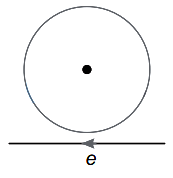
- Near a circular loop of conducting wire as shown in the figure an electron moves along a straight line. The direction of the induced current if any in the loop is
 KCET 2009 Medium
 - Consider an electrical conductor connected across a potential difference \(V\). Let \(\Delta q\) be a small charge moving through it in time \(\Delta t\). If \(I\) is the electric current through it,
I. the kinetic energy of the charge increases by \(I V \Delta t\).
II. the electric potential energy of the charge decreases by \(I V \Delta t\).
III. the thermal energy of the conductor increases by IV \(\Delta t\).
Choose the correct option.KCET 2021 Easy - A period of geostationary satellite isKCET 2014 Medium
- The Vernicr scale of a travelling microscope has 50 divisions which coincides with 49 main scale divisions. If each main scale division is \(0.5 \mathrm{~mm}\), then the least count of the microscope isKCET 2022 Hard
- A certain current on passing through a galvanometer produces a deflection of 100 divisions. When a shunt of one ohm is connected, the deflection reduces to 1 division. The galvanometer resistance isKCET 2008 Easy
More PYQs from KCET
- If \(A=\left|\begin{array}{ll}x & 1 \\ 1 & x\end{array}\right|\) and \(B=\left|\begin{array}{lll}x & 1 & 1 \\ 1 & x & 1 \\ 1 & 1 & x\end{array}\right|\), then \(\frac{d B}{d x}\) isKCET 2024 Easy
- MnO exhibitsKCET 2024 Easy
- A line passes through \( (2,2) \) and is perpendicular in the line \( 3 x+y=3 \) its \( y \)-intercepts isKCET 2015 Hard
- In a permanent magnet at room temperatureKCET 2020 Easy
- Area lying between the curves \( y^{2}=2 x \) and \( y=x \)KCET 2016 Easy
- Match the following:
In the following, \([\mathrm{x}]\) denotes the greatest integer less than or equal to x .
\begin{array}{|l|l|l|l|}\hline & \text{Column - I} & & \text{Column - II} \\\hline \text{a}. & \mathrm{x}|\mathrm{x}| & \text{(i)} & \text {continuous in (-1, 1)} \\\hline \text{b.} & \sqrt{|\mathrm{x}|} & \text{(ii)} & \text{differentiable in (-1, 1)} \\\hline \text{c.} & \mathrm{x}+[\mathrm{x}] & \text{(iii)} & \text{strictly increasing in (-1, 1)} \\\hline \text{d.} & |\mathrm{x}-1|+|\mathrm{x}+1| & \text{(iv)} & \text{not differentiable at, at least one point in (-1, 1)} \\\hline\end{array}KCET 2025 Medium