


KCET · Physics · Electrostatics
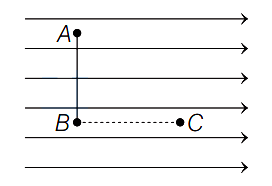
Figure shows three points \(A, B\) and \(C\) in a region of uniform electric field \(\mathbf{E}\). The line \(A B\) is perpendicular and \(B C\) is parallel to the field lines. Then, which of the following holds good ? \(\left(V_{A}, V_{B}\right.\) and \(V_{C}\) represent the electric potential at points \(A, B\) and \(C\), respectively)
- A \(V_{A}=V_{B}=V_{C}\)
- B \(V_{A}=V_{B}>V_{C}\)
- C \(V_{A}=V_{B} < V_{C}\)
- D \(V_{A}>V_{B}=V_{C}\)
Answer & Solution
Correct Answer
(B) \(V_{A}=V_{B}>V_{C}\)
Step-by-step Solution
Detailed explanation
According to given figure, line \(A B\) is perpendicular to direction of electric field lines. Hence, surface passing through line \(A B\) and perpendicular to electric field lines behaves like a equipotential surface, therefore
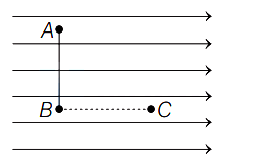
\(V_{A}=V_{B}...(i)\)
Electric field and electric potential are related as
\(E=-\frac{d V}{d x} \Rightarrow V=-\int E d x\)
Which indicates that electric potential decreases in the direction of electric field, i.e.
\(V_{B}>V_{C}...(ii)\)
From Eqs. (i) and (ii), we have
\(V_{A}=V_{B}>V_{C}\)
\(V_{A}=V_{B}...(i)\)
Electric field and electric potential are related as
\(E=-\frac{d V}{d x} \Rightarrow V=-\int E d x\)
Which indicates that electric potential decreases in the direction of electric field, i.e.
\(V_{B}>V_{C}...(ii)\)
From Eqs. (i) and (ii), we have
\(V_{A}=V_{B}>V_{C}\)
See the Complete Solution
Get step-by-step explanations for this and 2.5 Lakh+ more JEE, NEET & CET questions.
- Unlock all solutions
- Practice the full chapter
- Track accuracy across PYQs
4.8 rated on Google Play · 14,000+ reviews
More questions from Physics
- A metallic rod of length \(1 \mathrm{~m}\) held along east-west direction is allowed to fall down freely. Given horizontal component of earth's magnetic field \(B_H=3 \times 10^{-5} \mathrm{~T}\). the emf induced in the rod at an instant \(t=2 \mathrm{~s}\) after it is released is
(Take, \(g=10 \mathrm{~ms}^{-2}\) )KCET 2023 Medium - All components of the electromagnetic spectrum in vacuum have the sameKCET 2007 Easy
- A proton and an alpha particle are accelerated under the same potential difference. The ratio of de-Broglie wavelengths of the proton and the alpha particle isKCET 2012 Medium
- The susceptibility of a ferromagnetic substance isKCET 2017 Medium
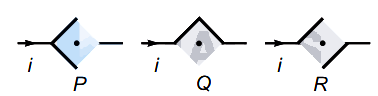
- Two thick wires and two thin wires, all of same material and same length, form a square in three different ways \(\mathrm{P}, \mathrm{Q}\) and \(\mathrm{R}\) as shown in the figure. With correct connections shown, the magnetic field due to the current flow, at the centre of the loop will be zero in case of
 KCET 2010 Medium
 - Water is heated from \( 0^{\circ} \mathrm{C} \) to \( 10^{\circ} \mathrm{C} \). then its volumeKCET 2015 Easy
More PYQs from KCET
- In Structural gene, the template DNA strand has nucleotide sequences
3'-ATGCATGCATGCATGC-5'.
Find the correct and complimentary nucleotide sequence on coding strand.KCET 2024 Medium - Let the functions " f " and " g " be \(\mathrm{f}:\left[0, \frac{\pi}{2}\right] \rightarrow \mathrm{R}\) given by \(\mathrm{f}(\mathrm{x})=\sin \mathrm{x}\) and \(\mathrm{g}:\left[0, \frac{\pi}{2}\right] \rightarrow \mathrm{R}\) given by \(g(x)=\cos x\), where \(R\) is the set of real numbers
Consider the following statements:
Statement (I): f and g are one-one
Statement (II): \(\mathrm{f}+\mathrm{g}\) is one-one
Which of the following is correct?KCET 2025 Medium - What is the nature of Gaussian surface involved in Gauss law of electrostatic ?KCET 2014 Easy
- Lines \( \frac{x-2}{1}+\frac{y-3}{1}=\frac{z-4}{-K} \) and \( \frac{x-1}{K}=\frac{y-4}{2}=\frac{z-5}{1} \) are co-planar ifKCET 2014 Medium
- A function is \(f(x)=\left\{\begin{array}{cc}\frac{e^{\frac{1}{x}}-1}{e^{\frac{1}{x}}+1}, & \text { if } x \neq 0 \\ 0, & \text { if } x=0\end{array}\right.\)KCET 2025 Medium
- If \(y=\sin x \cdot \sin 2 x \cdot \sin 3 x \ldots \sin n x\), then \(y^{\prime}\) isKCET 2011 Medium