


KCET · Physics · Electrostatics
An infinitely long thin straight wire has uniform charge density of \(\frac{1}{4} \times 10^{-2} \mathrm{~cm}^{-1}\).
What is the magnitude of electric field at a distance \(20 \mathrm{~cm}\) from the axis of the wire?
- A \(1.12 \times 10^{10} \mathrm{NC}^{-1}\)
- B \(4.5 \times 10^{10} \mathrm{NC}^{-1}\)
- C \(2.25 \times 10^{10} \mathrm{NC}^{-1}\)
- D \(9 \times 10^{10} \mathrm{NC}^{-1}\)
Answer & Solution
Correct Answer
(C) \(2.25 \times 10^{10} \mathrm{NC}^{-1}\)
Step-by-step Solution
Detailed explanation
Given, charge density of uniformly long thin wire,
\(\begin{aligned}
\lambda &=\frac{1}{4} \times 10^{-2} \mathrm{~cm}^{-1} \\
&=\frac{1}{4} \times 10^{-2} \times 10^{2} \mathrm{~m}^{-1}=\frac{1}{4} \mathrm{~m}^{-1} \\
r &=20 \mathrm{~cm}=0.2 \mathrm{~m}
\end{aligned}\)
Electric field at a distance \(r\) from the axis of wire is given as
\(\begin{aligned}
E &=\frac{\lambda}{2 \pi \varepsilon_{0} r}=\frac{2 \lambda}{4 \pi \varepsilon_{0} r} \\
&=\frac{9 \times 10^{9} \times 2 \times \frac{1}{4}}{0.2} \\
&=2.25 \times 10^{10} \mathrm{NC}^{-1}
\end{aligned}\)
\(\begin{aligned}
\lambda &=\frac{1}{4} \times 10^{-2} \mathrm{~cm}^{-1} \\
&=\frac{1}{4} \times 10^{-2} \times 10^{2} \mathrm{~m}^{-1}=\frac{1}{4} \mathrm{~m}^{-1} \\
r &=20 \mathrm{~cm}=0.2 \mathrm{~m}
\end{aligned}\)
Electric field at a distance \(r\) from the axis of wire is given as
\(\begin{aligned}
E &=\frac{\lambda}{2 \pi \varepsilon_{0} r}=\frac{2 \lambda}{4 \pi \varepsilon_{0} r} \\
&=\frac{9 \times 10^{9} \times 2 \times \frac{1}{4}}{0.2} \\
&=2.25 \times 10^{10} \mathrm{NC}^{-1}
\end{aligned}\)
See the Complete Solution
Get step-by-step explanations for this and 2.5 Lakh+ more JEE, NEET & CET questions.
- Unlock all solutions
- Practice the full chapter
- Track accuracy across PYQs
4.8 rated on Google Play · 14,000+ reviews
More questions from Physics
- The four bands of a colour coded resistor are of the colours gray, red, gold and gold. The value of the resistance of the resistor isKCET 2023 Easy
- The working of magnetic braking of trains is based onKCET 2017 Medium
- The \(X\) and \(Y\) components of a force \(F\) acting at \(30^{\circ}\) to \(x\)-axis are respectivelyKCET 2012 Easy
- A prism of a certain angle deviates the red and blue rays by \(8^{\circ}\) and \(12^{\circ}\) respectively. Another prism of the same angle deviates the red and blue rays by \(10^{\circ}\) and \(14^{\circ}\) respectively. The prisms are small angled and made of different materials. The dispersive powers of the materials of the prisms are in the ratioKCET 2007 Hard
- In the three parts of a transistor, 'Emitter' is ofKCET 2017 Medium
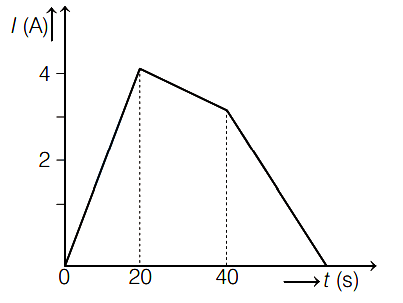
- The current following through an inductance coil of self-inductance \(6 \mathrm{mH}\) at different time instants is as shown. The emf induced between \(t=20 \mathrm{~s}\) and \(t=40 \mathrm{~s}\) is nearly
 KCET 2021 Hard
More PYQs from KCET
- Consider the nuclear fission reaction \({ }_0^1 n+{ }_{92}^{235} \mathrm{U} \longrightarrow{ }_{56}^{144} \mathrm{Ba}+{ }_{36}^{89} \mathrm{Kr}+3{ }_0^1 n\). Assuming all the kinetic energy is carried away by the fast neutrons only and total binding energies of \({ }_{92}^{235} \mathrm{U},{ }_{56}^{144} \mathrm{Ba}\) and \({ }_{36}^{89} \mathrm{Kr}\) to be \(1800 \mathrm{MeV}, 1200\) MeV and 780 MeV respectively, the average kinetic energy carried by each fast neutron is (in MeV )KCET 2024 Medium
- Stanley Miller simulated the conditions of pre - biotic earth using spark - discharge apparatus. Which organic compounds were observed by him on analysing the end product of his experiment?KCET 2024 Medium
- The S.I. unit of specific heat capacity isKCET 2017 Medium
- The opening and closing of stomata is controlled by the 3. activity ofKCET 2013 Easy
- The value of \(\int_{-\pi / 2}^{\pi / 2} \frac{\cos x}{1+e^{x}} d x\) isKCET 2020 Easy
- The activation energy of a chemical reaction can be determined by,KCET 2016 Medium