


KCET · Physics · Electrostatics
An \(\alpha\)-particle of mass \(6.4 \times 10^{-27} \mathrm{~kg}\) and charge \(3.2 \times 10^{-19} \mathrm{C}\) is situated in a uniform electric field of \(1.6 \times 10^{5} \mathrm{Vm}^{-1}\). The velocity of the particle at the end of \(2 \times 10^{-2} \mathrm{~m}\) path when it starts from rest is
- A \(2 \sqrt{3} \times 10^{5} \mathrm{~ms}^{-1}\)
- B \(8 \times 10^{5} \mathrm{~ms}^{-1}\)
- C \(16 \times 10^{5} \mathrm{~ms}^{-1}\)
- D \(4 \sqrt{2} \times 10^{5} \mathrm{~ms}^{-1}\)
Answer & Solution
Correct Answer
(D) \(4 \sqrt{2} \times 10^{5} \mathrm{~ms}^{-1}\)
Step-by-step Solution
Detailed explanation
Given, \(m_{\alpha}=6.4 \times 10^{-27} \mathrm{~kg}\),
\(\mathrm{q}_{\alpha}=3.2 \times 10^{-19} \mathrm{C}, \mathrm{E}=1.6 \times 10^{5} \mathrm{Vm}^{-1}\)
Force on \(\alpha\)-particle
\(\begin{gathered}\mathrm{F}=\mathrm{q}_{\alpha} \mathrm{E}=3.2 \times 10^{-19} \times 1.6 \times 10^{5} \\=51.2 \times 10^{-15} \mathrm{~N}
\end{gathered}\)
Now, acceleration of the particle
\(\alpha=\frac{\mathrm{F}}{\mathrm{m}_{\alpha}}=\frac{51.2 \times 10^{-15}}{6.4 \times 10^{-27}}\)
\(=0.8 \times 10^{13} \mathrm{~ms}^{-2}\)
\(\because\) Initial velocity, \(\mathrm{u}=0\)
\(\mathrm{v}^{2}=2 \alpha \mathrm{S}\)
\(=2 \times 8 \times 10^{12} \times 2 \times 10^{-2}\)
\(=32 \times 10^{10}\)
or
\(\mathrm{v}=4 \sqrt{2} \times 10^{5} \mathrm{~ms}^{-1}\)
\(\mathrm{q}_{\alpha}=3.2 \times 10^{-19} \mathrm{C}, \mathrm{E}=1.6 \times 10^{5} \mathrm{Vm}^{-1}\)
Force on \(\alpha\)-particle
\(\begin{gathered}\mathrm{F}=\mathrm{q}_{\alpha} \mathrm{E}=3.2 \times 10^{-19} \times 1.6 \times 10^{5} \\=51.2 \times 10^{-15} \mathrm{~N}
\end{gathered}\)
Now, acceleration of the particle
\(\alpha=\frac{\mathrm{F}}{\mathrm{m}_{\alpha}}=\frac{51.2 \times 10^{-15}}{6.4 \times 10^{-27}}\)
\(=0.8 \times 10^{13} \mathrm{~ms}^{-2}\)
\(\because\) Initial velocity, \(\mathrm{u}=0\)
\(\mathrm{v}^{2}=2 \alpha \mathrm{S}\)
\(=2 \times 8 \times 10^{12} \times 2 \times 10^{-2}\)
\(=32 \times 10^{10}\)
or
\(\mathrm{v}=4 \sqrt{2} \times 10^{5} \mathrm{~ms}^{-1}\)
See the Complete Solution
Get step-by-step explanations for this and 2.5 Lakh+ more JEE, NEET & CET questions.
- Unlock all solutions
- Practice the full chapter
- Track accuracy across PYQs
4.8 rated on Google Play · 14,000+ reviews
More questions from Physics
- A plane electromagnetic wave of frequency \( 20 \mathrm{MHz} \) travels through a space along \( x \) direction. If the electric field vector at a certain point in space is \( 6 \mathrm{~V} \mathrm{~m}^{-1} \), what is the magnetic field vector at that point?KCET 2014 Medium
- The effective resistance between \( \mathrm{P} \) and \( \mathrm{Q} \) for the following network is
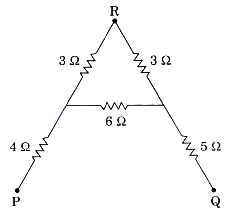 KCET 2018 Medium
 - An antenna uses electromagnetic waves of frequency \( 5 \mathrm{MHz} \). For proper working, the size of
the antenna should be :KCET 2019 Easy - A transformer is used to light \( 100 \mathrm{~W}-110 \mathrm{~V} \) lamp from \( 220 \mathrm{~V} \) mains. If the main current is \( 0.5 \) A, the efficiency of the transformer isKCET 2015 Medium
- Two cells of internal resistance \( r_{1} \) and \( r_{2} \) and of same emf are connected in series across a resistor of resistance \( R \). If the terminal potential difference across the cells of internal resistance \( r_{1} \) is zero, then the value of \( \mathrm{R} \) isKCET 2018 Easy
- A body of mass \(4 \mathrm{~kg}\) is accelerated upon by a constant force, travels a distance of \(5 \mathrm{~m}\) in the first second and a distance of \(2 \mathrm{~m}\) in the third second. The force acting on the body isKCET 2008 Easy
More PYQs from KCET
- What is a period of revolution of earth satellite ? Ignore the height of satellite above the surface of earth.
Given :
(1) The value of gravitational acceleration \( g=10 \mathrm{~ms}^{-2} \).
(2) Radius of earth \( R_{E}=6400 \mathrm{~km} \). Take \( \Pi=3.14 \).KCET 2014 Medium - All capacitors used in the diagram are identical and each is of capacitance C. Then the effective capacitance between the point \(A\) and \(B\) is
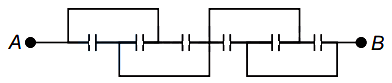 KCET 2010 Medium
 - Identify the 'order' from the following.KCET 2017 Easy
- Arrange the following compounds in the increasing order of their acidic strength :
i. m-nitrophenol
ii. m-cresol
iii. phenol
iv. m-chlorophenolKCET 2015 Hard - Maximum number of molecules of \(\mathrm{CH}_{3} \mathrm{I}\) that can react with a molecule of \(\mathrm{CH}_{3} \mathrm{NH}_{2}\) areKCET 2007 Medium
- If the volume of the parallelopiped formed by three non-coplanar vectors \(\mathbf{a}, \mathbf{b}\) and \(\mathbf{c}\) is 4 cu units, then \([\mathbf{a} \times \mathbf{b} \mathbf{b} \times \mathbf{c} \mathbf{c} \times \mathbf{a}]\) is equal toKCET 2012 Medium