


KCET · Physics · Oscillations
\(L C\)-oscillations are similar and analogous to the mechanical oscillations of a block attached to a spring. The electrical equivalent of the force constant of the spring is
- A reciprocal of capacitive reactance
- B capacitive reactance
- C reciprocal of capacitance
- D capacitance
Answer & Solution
Correct Answer
(C) reciprocal of capacitance
Step-by-step Solution
Detailed explanation
For LC-oscillations,
\(L \frac{d i}{d t}+\frac{q}{C}=0\)
Differentiating further it w.r.t \(t\), we get
\(L \frac{d^{2} i}{d t^{2}}+\frac{I}{C}=0...(i)\)
Similarly, for spring-block system,
\(m \frac{d^{2} x}{d t^{2}}+k x=0...(ii)\)
Comparing Eqs. (i) and (ii), we get
\(m \propto L \text { and } k \propto \frac{1}{C}\)
\(L \frac{d i}{d t}+\frac{q}{C}=0\)
Differentiating further it w.r.t \(t\), we get
\(L \frac{d^{2} i}{d t^{2}}+\frac{I}{C}=0...(i)\)
Similarly, for spring-block system,
\(m \frac{d^{2} x}{d t^{2}}+k x=0...(ii)\)
Comparing Eqs. (i) and (ii), we get
\(m \propto L \text { and } k \propto \frac{1}{C}\)
See the Complete Solution
Get step-by-step explanations for this and 2.5 Lakh+ more JEE, NEET & CET questions.
- Unlock all solutions
- Practice the full chapter
- Track accuracy across PYQs
4.8 rated on Google Play · 14,000+ reviews
More questions from Physics
- In alpha particle scattering experiment, if \(v\) is the initial velocity of the particle, then the distance of closest approach is \(d\). If the velocity is doubled, then the distance of closest approach changes to:KCET 2024 Medium
- A nucleus of mass \( 20 \mathrm{u} \) emits a \( \mathrm{y} \) photon of energy \( 6 \mathrm{MeV} \). If the emission assume to occur
when nucleus is free and rest, then the nucleus will have kinetic energy nearest to
(take \( 1 \mathrm{u}=1.6 \times 10^{-27} \mathrm{~kg} \) )KCET 2016 Hard - In which of the processes, does the internal energy of the system remain constant?KCET 2008 Easy
- A graph of pressure versus volume for an ideal gas for different processes is as shown. In the graph curve \(O C\) represents
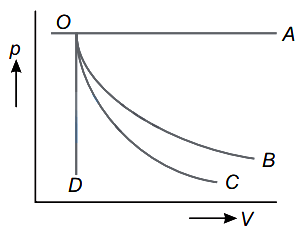 KCET 2009 Easy
 - In a radioactive decay, an element \(\mathrm{z}^{\mathrm{X}}\) emits four \(\alpha\)-particles, three \(\beta\)-particles and eight gamma photons. The atomic number and mass number of the resulting final nucleus areKCET 2012 Medium
- A \(2 \mathrm{~g}\) object, located in a region of uniform electric field \(\mathbf{E}=\left(300 \mathrm{NC}^{-1}\right) \hat{\mathbf{i}}\) carries a charge \(Q\). The object released from rest at \(x=0\), has a kinetic energy of \(0.12 \mathrm{~J}\) at \(x=0.5 \mathrm{~m}\). Then, \(Q\) isKCET 2021 Medium
More PYQs from KCET
- A carnot engine takes \( 300 \) calories of heat from a source at \( 500 \mathrm{~K} \) and rejects \( 150 \) calories of
heat to the sink. The temperature of the sink isKCET 2018 Easy - The genotype of a husband and wife are \(I ^{ A } I ^{ B }\) and \(I ^{ A } I ^{ O }\) Among the blood types of their children, how many different genotypes and phenotypes are possible?KCET 2021 Medium
- Consider the Born-Haber cycle for the formation of an ionic compound given below and identify the compound ( ) formed.
\[
\left[\begin{array}{l}
\mathrm{M}(\mathrm{s}) \stackrel{\Delta \mathrm{H}_{1}}{\longrightarrow} \mathrm{M}(\mathrm{g}) \stackrel{\Delta \mathrm{H}_{2}}{\longrightarrow} \mathrm{M}^{+}(\mathrm{g}) \\
\frac{1}{2} \mathrm{X}_{2}(\mathrm{~g}) \stackrel{\Delta \mathrm{H}_{3}}{\longrightarrow} \mathrm{X}(\mathrm{g}) \stackrel{\Delta \mathrm{H}_{4}}{\longrightarrow} \mathrm{X}^{-}(\mathrm{g})
\end{array}\right] \stackrel{\Delta \mathrm{H}_{5}}{\longrightarrow} \mathrm{Z}
\]KCET 2008 Medium - A particle of mass \( 1 \mathrm{gm} \) and charge \( 1 \mu \mathrm{C} \) is held at rest on a frictionless horizontal surface at distance \( 1 \mathrm{~m} \) from the fixed charge \( 2 \mathrm{mC} \). If the particle is released, it will be repelled. The speed of the particle when it is at a distance of \( 10 \mathrm{~m} \) from the fixed chargeKCET 2016 Medium
- \(\Lambda^0_{m(\text{NH}_4\text{OH})}\) is equal to ____KCET 2026 Easy
- Which of the following species does not exert a resonance effect?KCET 2008 Easy