


KCET · Physics · Electrostatics
A particle of mass \( 1 \mathrm{gm} \) and charge \( 1 \mu \mathrm{C} \) is held at rest on a frictionless horizontal surface at distance \( 1 \mathrm{~m} \) from the fixed charge \( 2 \mathrm{mC} \). If the particle is released, it will be repelled. The speed of the particle when it is at a distance of \( 10 \mathrm{~m} \) from the fixed charge
- A \( 60 m s^{-1} \)
- B \( 100 \mathrm{~ms}^{-1} \)
- C \( 90 m s^{-1} \)
- D \( 180 \mathrm{~ms}^{-1} \)
Answer & Solution
Correct Answer
(D) \( 180 \mathrm{~ms}^{-1} \)
Step-by-step Solution
Detailed explanation
Force between two particles is given as
\( F=\frac{1}{4 \Pi \varepsilon_{0}} \frac{q_{1} q_{2}}{r^{2}} \) Now, work done by force \( =\int_{1}^{10} F d r=\int_{1}^{10} \frac{1}{4 \Pi \varepsilon_{0}} \frac{q_{1} q_{2}}{r^{2}} d r \) \( =\frac{1}{4 \Pi \varepsilon_{0}} q_{1} q_{2} \int_{1}^{10} \frac{1}{r^{2}} d r=\frac{1}{4 \Pi \varepsilon_{0}} q_{1} q_{2}\left(\left.\cdot \frac{-1}{4}\right|_{1} ^{10}\right) \) \( =\frac{1}{4 \Pi \varepsilon_{0}} q_{1} q_{2}\left(1-\frac{1}{10}\right)=\frac{1}{4 \Pi \varepsilon_{0}} q_{1} q_{2} \times \frac{9}{10} \rightarrow(1) \)
This work is stored in form of kinetic energy. Therefore,
\(W=\frac{1}{2} m v^{2} \)
\(\Rightarrow v^{2}=\frac{2 W}{m}=\frac{2}{1 \times 10^{-3}} \frac{1}{4 \Pi \varepsilon_{0}} q_{1} q_{2} \times \frac{9}{10}[\text { [Using Eq. (1)] } \)
\(\Rightarrow v^{2}=\frac{2}{1 \times 10^{-3}} \times 9 \times 10^{9} \times\left(1 \times 10^{-6} \times 2 \times 10^{-3}\right) \times \frac{9}{10} \)
\(=2 \times 2 \times 9 \times 9 \times 100 \)
\(\Rightarrow v=2 \times 9 \times 10=180 \mathrm{~ms}^{-1}\)
\( F=\frac{1}{4 \Pi \varepsilon_{0}} \frac{q_{1} q_{2}}{r^{2}} \) Now, work done by force \( =\int_{1}^{10} F d r=\int_{1}^{10} \frac{1}{4 \Pi \varepsilon_{0}} \frac{q_{1} q_{2}}{r^{2}} d r \) \( =\frac{1}{4 \Pi \varepsilon_{0}} q_{1} q_{2} \int_{1}^{10} \frac{1}{r^{2}} d r=\frac{1}{4 \Pi \varepsilon_{0}} q_{1} q_{2}\left(\left.\cdot \frac{-1}{4}\right|_{1} ^{10}\right) \) \( =\frac{1}{4 \Pi \varepsilon_{0}} q_{1} q_{2}\left(1-\frac{1}{10}\right)=\frac{1}{4 \Pi \varepsilon_{0}} q_{1} q_{2} \times \frac{9}{10} \rightarrow(1) \)
This work is stored in form of kinetic energy. Therefore,
\(W=\frac{1}{2} m v^{2} \)
\(\Rightarrow v^{2}=\frac{2 W}{m}=\frac{2}{1 \times 10^{-3}} \frac{1}{4 \Pi \varepsilon_{0}} q_{1} q_{2} \times \frac{9}{10}[\text { [Using Eq. (1)] } \)
\(\Rightarrow v^{2}=\frac{2}{1 \times 10^{-3}} \times 9 \times 10^{9} \times\left(1 \times 10^{-6} \times 2 \times 10^{-3}\right) \times \frac{9}{10} \)
\(=2 \times 2 \times 9 \times 9 \times 100 \)
\(\Rightarrow v=2 \times 9 \times 10=180 \mathrm{~ms}^{-1}\)
See the Complete Solution
Get step-by-step explanations for this and 2.5 Lakh+ more JEE, NEET & CET questions.
- Unlock all solutions
- Practice the full chapter
- Track accuracy across PYQs
4.8 rated on Google Play · 14,000+ reviews
More questions from Physics
- When two tuning forks \( A \) and \( B \) are sounded together. \( 4 \) beats per second are heard. The
frequency of the fork \( \mathrm{B} \) is \( 384 \mathrm{~Hz} \). When one of the prongs of the fork \( \mathrm{A} \) is filed and sounded
with \( B \), the beat frequency increases, then the frequency of the fork \( A \) isKCET 2015 Easy - Two equal and opposite charges of masses \( \mathrm{m}_{1} \) and \( \mathrm{m}_{2} \) are accelerated in an uniform electric field through the same distance. What is the ratio of their accelerations if their mi ratio of masses is \( \frac{\mathrm{m}_{1}}{\mathrm{~m}_{2}}=0.5 \) ?KCET 2014 Medium
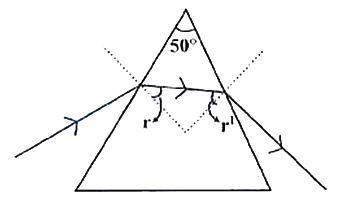
- If \(r\) and \(r^1\) denotes the angles inside the prism having angle of prism \(50^{\circ}\) considering that during interval of time from \(\mathrm{t}=0\) to \(\mathrm{t}=\mathrm{t}, \mathrm{r}\) varies with time as \(\mathrm{r}=10^{\circ}+\mathrm{t}^2\). During the time \(\mathrm{r}^1\) will vary with time as
 KCET 2025 Medium
 - Two fixed charges A and B of \(5 \mu \mathrm{C}\) each are separated by a distance of \(6 \mathrm{~m}\). \(\mathrm{C}\) is the mid point of the line joining \(A\) and \(B\). A charge \(Q\) of \(-5 \mu \mathrm{C}\) is shot perpendicular to the line joining A and \(B\) through \(C\) with a kinetic energy of \(0.06 \mathrm{~J}\). The charge \(\mathrm{Q}\) comes to rest at a point D. The distance \(C D\) isKCET 2012 Hard
- Under electrostatic condition of a charged conductor, which among the following statements is true?KCET 2024 Hard
- The correct Biot- Savart law in vector form isKCET 2018 Easy
More PYQs from KCET
- The s-block element used as a catalyst in the manufacture of Buna-S rubber isKCET 2012 Easy
- Benzene reacts with chlorine in sunlight to give a final productKCET 2007 Easy
- Which of the following polymer has strongest intermolecular forces of attraction?KCET 2020 Easy
- Assisted Reproductive Technology does not includeKCET 2015 Hard
- Match the plant growth hormones of Column-I with suit-able chemical derivatives present Column-II and choose the correct option given below:
Column-I Column-II A. Abscisic acid (i) Adenine derivative B. Gibberellins (ii) Indole acetic acid C. Kinetin (iii) Carotenoid derivative D. Auxin (iv) Terpenes KCET 2025 Easy - During the extraction of gold the following reactions take place
\[
\begin{aligned}
\mathrm{Au}+\mathrm{CN}^{-}+\mathrm{H}_{2} \mathrm{O} \stackrel{\mathrm{O}_{2}}{\longrightarrow}[X] \\
{[X]+\mathrm{Zn} \longrightarrow[Y]+\mathrm{Au} }
\end{aligned}
\]
\(X\) and \(Y\) are respectivelyKCET 2007 Medium