


KCET · Physics · Nuclear Physics
A nucleus of mass \( 20 \mathrm{u} \) emits a \( \mathrm{y} \) photon of energy \( 6 \mathrm{MeV} \). If the emission assume to occur
when nucleus is free and rest, then the nucleus will have kinetic energy nearest to
(take \( 1 \mathrm{u}=1.6 \times 10^{-27} \mathrm{~kg} \) )
- A \( 10 \mathrm{KeV} \)
- B \( 1 \mathrm{KeV} \)
- C \( 0.1 \mathrm{KeV} \)
- D \( 100 \mathrm{KeV} \)
Answer & Solution
Correct Answer
(B) \( 1 \mathrm{KeV} \)
Step-by-step Solution
Detailed explanation
Given, nucleus of mass \( 20 \mathrm{u} \) emits a \( \mathrm{y} \) photon of energy \( 6 \mathrm{MeV} \)
Now, Momentum of photon
\( p_{p}=\frac{E}{C}=\frac{6 \times 1.6 \times 10^{-19} \times 10^{6}}{3 \times 10^{8}}=3.2 \times 10^{-21} \mathrm{kgms}^{-1} \)
Kinetic energy of nucleus
\( =\frac{\text { Momentum of photon }}{2 \times m}=\frac{3.2 \times 10^{-21}}{2 \times 20 \times 1.6 \times 10^{-27}} \)
\( =1.6 \times 10^{-16} \mathrm{~J} \)
\( =\frac{1.6 \times 10^{-16}}{1.6 \times 10^{-19}} \mathrm{eV}=10^{3} \mathrm{eV}=1 \mathrm{keV} \)
Therefore, nucleus will have kinetic energy nearest to \( 1 \mathrm{keV} \)
Now, Momentum of photon
\( p_{p}=\frac{E}{C}=\frac{6 \times 1.6 \times 10^{-19} \times 10^{6}}{3 \times 10^{8}}=3.2 \times 10^{-21} \mathrm{kgms}^{-1} \)
Kinetic energy of nucleus
\( =\frac{\text { Momentum of photon }}{2 \times m}=\frac{3.2 \times 10^{-21}}{2 \times 20 \times 1.6 \times 10^{-27}} \)
\( =1.6 \times 10^{-16} \mathrm{~J} \)
\( =\frac{1.6 \times 10^{-16}}{1.6 \times 10^{-19}} \mathrm{eV}=10^{3} \mathrm{eV}=1 \mathrm{keV} \)
Therefore, nucleus will have kinetic energy nearest to \( 1 \mathrm{keV} \)
See the Complete Solution
Get step-by-step explanations for this and 2.5 Lakh+ more JEE, NEET & CET questions.
- Unlock all solutions
- Practice the full chapter
- Track accuracy across PYQs
4.8 rated on Google Play · 14,000+ reviews
More questions from Physics
- A coin placed on a rotating turn table just slips if it is placed at a distance of \(4 \mathrm{~cm}\) from the centre. If the angular velocity of the turn table is doubled it will just slip at a distance ofKCET 2021 Easy
- If \( A=1 \) and \( B=0 \), then in terms of Boolean algebra, \( \bar{A}+B= \)KCET 2018 Easy
- Rain is falling vertically with a speed of \(12 \mathrm{~ms}^{-1}\). A woman rides a bicycles with a speed of \(12 \mathrm{~ms}^{-1}\) in east to west direction. What is the direction in which she should hold her umbrella?KCET 2020 Easy
- A planet revolves around the sun in an elliptical orbit. The linear speed of the planet will be maximum at
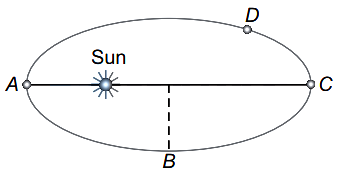 KCET 2009 Easy
 - A battery of emf \(E\) has an internal resistance r. A variable resistance \(R\) is connected to the terminals of the battery. A current \(i\) is drawn from the battery. \(V\) is the terminal potential difference. If \(R\) alone is gradually reduced to zero, which of the following best describes \(i\) and \(V\) ?KCET 2010 Medium
- Maximum diffraction takes place in a given slit forKCET 2008 Easy
More PYQs from KCET
- If the area of the parallelogram with \(\mathbf{a}\) and \(\mathbf{b}\) as two adjacent sides is 15 sq units, then the area of the parallelogram having \(3 \mathbf{a}+2 \mathbf{b}\) and \(\mathbf{a}+3 \mathbf{b}\) as two adjacent sides in sq units isKCET 2021 Medium
- Pick out the WRONG statements about magnetic substances.
(\(\chi\) = magnetic susceptibility)
(\(\mu_r\) = relative permeability).
I. Substances with \(-1 \leq \chi < 0\) are diamagnetic.
II. Substances with \(\chi \gg 1\) are paramagnetic.
III. Substances with \(\chi \ll 1\) are ferromagnetic.
IV. Substances with \(\mu_r \gg 1\) are ferromagnetic.KCET 2026 Medium - A balloon which always remains spherical is being inflated by pumping in \( 10 \) cubic centimeters
of gas per second. Find the rate at which the radius of the balloon is increasing when the
radius is \( 15 \mathrm{cms} \).KCET 2015 Medium - If \(\cos x+\cos ^2 x=1\), then the value of \(\sin ^2 x+\sin ^4 x\) isKCET 2025 Easy
- \( 100 \mathrm{~cm}^{3} \) of \( 1 \mathrm{M} \mathrm{CH}_{3} \mathrm{COOH} \) was mixed with \( 100 \mathrm{~cm}^{3} \) of \( 2 \mathrm{MCH}_{3} \mathrm{OH} \) to form an ester. The
change in the initial rate if each solution is diluted with equal volume of water would beKCET 2015 Medium - A straight current carrying conductor is kept along the axis of circular loop carrying current. The force exerted by the straight conductor on the loop isKCET 2012 Easy