


KCET · Chemistry · Thermodynamics (C)
Consider the Born-Haber cycle for the formation of an ionic compound given below and identify the compound ( ) formed.
\[
\left[\begin{array}{l}
\mathrm{M}(\mathrm{s}) \stackrel{\Delta \mathrm{H}_{1}}{\longrightarrow} \mathrm{M}(\mathrm{g}) \stackrel{\Delta \mathrm{H}_{2}}{\longrightarrow} \mathrm{M}^{+}(\mathrm{g}) \\
\frac{1}{2} \mathrm{X}_{2}(\mathrm{~g}) \stackrel{\Delta \mathrm{H}_{3}}{\longrightarrow} \mathrm{X}(\mathrm{g}) \stackrel{\Delta \mathrm{H}_{4}}{\longrightarrow} \mathrm{X}^{-}(\mathrm{g})
\end{array}\right] \stackrel{\Delta \mathrm{H}_{5}}{\longrightarrow} \mathrm{Z}
\]
- A \(\mathrm{M}^{+} \mathrm{X}^{-}\)
- B \(\mathrm{M}^{+} \mathrm{X}^{-}(\mathrm{s})\)
- C MX
- D \(\mathbf{M}^{+} \mathrm{X}^{-}(\mathrm{g})\)
Answer & Solution
Correct Answer
(B) \(\mathrm{M}^{+} \mathrm{X}^{-}(\mathrm{s})\)
Step-by-step Solution
Detailed explanation
The Born-Haber cycle takes place as follows
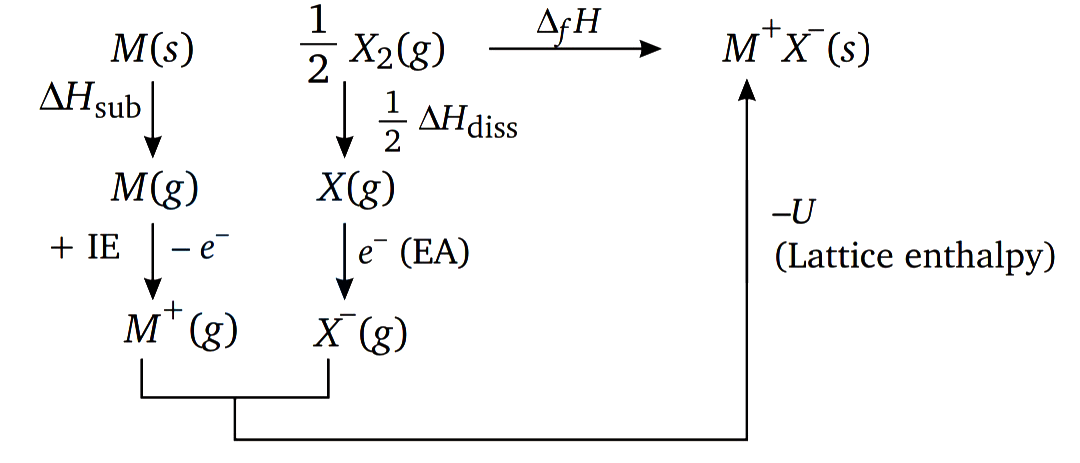
Hence, \(\mathrm{Z}\) is \(\mathrm{M}^{+} \mathrm{X}^{-}\)(s).
Hence, \(\mathrm{Z}\) is \(\mathrm{M}^{+} \mathrm{X}^{-}\)(s).
See the Complete Solution
Get step-by-step explanations for this and 2.5 Lakh+ more JEE, NEET & CET questions.
- Unlock all solutions
- Practice the full chapter
- Track accuracy across PYQs
4.8 rated on Google Play · 14,000+ reviews
More questions from Chemistry
- For the equilibrium :
\( \mathrm{CaCO}_{3}(s) \rightleftharpoons \mathrm{CaO}(s)+\mathrm{CO}_{2}(g) ; \mathrm{K}_{p}=1.64 \mathrm{~atm} \)
at \( 1000 \mathrm{~K} \)
\( 50 \mathrm{~g} \) of \( \mathrm{CaCO}_{3} \) in a \( 10 \) litre closed vessel is heated to \( 1000 \mathrm{~K} \). Percentage of \( \mathrm{CaCO}_{3} \) that
remains unreacted at equilibrium is
(Given \( \mathrm{R}=0.082 \mathrm{~L} \mathrm{~atm} K^{-1} \mathrm{~mol}^{-1} \) )KCET 2014 Medium - Acidity of \( \mathrm{BF}_{3} \) can be explained on which of the following concepts?KCET 2018 Medium
- The vapour pressure of pure liquids \(A\) and \(B\) are 450 and \(700 \mathrm{~mm}\) of \(\mathrm{Hg}\) at \(350 \mathrm{~K}\) respectively. If the total vapour pressure of the mixture is \(600 \mathrm{~mm}\) of \(\mathrm{Hg}\), the composition of the mixture in the solution isKCET 2021 Easy
- An aqueous solution containing \(6.5 \mathrm{~g}\) of \(\mathrm{NaCl}\) of \(90 \%\) purity was subjected to electrolysis. After the complete electrolysis, the solution was evaporated to get solid \(\mathrm{NaOH}\). The volume of \(1 \mathrm{M}\) acetic acid required to neutralise \(\mathrm{NaOH}\) obtained above isKCET 2009 Medium
- The product formed when hydroxylamine condenses with a carbonyl compound is calledKCET 2007 Hard
- Phenol can be distinguished from ethanol by the reagentKCET 2018 Easy
More PYQs from KCET
- The energy stored in an inductor of self inductance \(L\) henry carrying a current of \(I\) ampere isKCET 2011 Easy
- The charge required for the reduction of \( 1 \) mole of \( \mathrm{MnO}_{4}{ }^{-} \)to \( \mathrm{MnO}_{2} \) isKCET 2018 Medium
- An electromagnetic wave is travelling in \( x \)-direction with electric field vector given by, \( \vec{E}_{y}=E_{0} \sin (k x-\omega t) \hat{j} \). The correct expression for magnetic field vector isKCET 2019 Easy
- Match the storage products listed under Column-I with the organisms given under Column-II. Choose the appropriate option from the given choices.
Column I Column II A. Glycogen p. Sargassum B. Pyrenoids q. Nostoc C. Laminarin and mannitol r. Polysiphonia D. Floridean starch s. Spirogyra t. Agaricus KCET 2014 Hard - If \(A=\left[\begin{array}{cc}\alpha & 2 \\ 2 & \alpha\end{array}\right]\) and \(\left|A^{3}\right|=125\), then \(\alpha\) is equal toKCET 2013 Easy
- Three conductors draw currents of \(1 \mathrm{~A}, 2 \mathrm{~A}\) and 3 A respectively, when connected in turn across a battery. If they are connected in series and the combination is connected across the same battery, the current drawn will beKCET 2013 Medium