


KCET · Physics · Nuclear Physics
In a radioactive decay, an element \(\mathrm{z}^{\mathrm{X}}\) emits four \(\alpha\)-particles, three \(\beta\)-particles and eight gamma photons. The atomic number and mass number of the resulting final nucleus are
- A \(\mathrm{Z}-8, \quad \mathrm{~A}-13\)
- B \(Z-11, A-16\)
- C \(\mathrm{Z}-5, \quad \mathrm{~A}-13\)
- D \(\mathrm{Z}-5, \quad \mathrm{~A}-16\)
Answer & Solution
Correct Answer
(D) \(\mathrm{Z}-5, \quad \mathrm{~A}-16\)
Step-by-step Solution
Detailed explanation
After \(\mathrm{n}_{\alpha} \quad \alpha\)-decays and \(\mathrm{n}_{\beta} \beta\)-decays, the respective atomic number and mass number of resulting nucleus are given by and \(\quad \mathrm{Z}^{\prime}=\mathrm{Z}-2 \mathrm{n}_{\alpha}+\mathrm{n}_{\beta}=\mathrm{Z}-8+3=\mathrm{Z}-5\) We have, \(\quad \mathrm{A}-4 \mathrm{n}_{\alpha}=\mathrm{A}-16\)
See the Complete Solution
Get step-by-step explanations for this and 2.5 Lakh+ more JEE, NEET & CET questions.
- Unlock all solutions
- Practice the full chapter
- Track accuracy across PYQs
4.8 rated on Google Play · 14,000+ reviews
More questions from Physics
- A transparent medium shows relation between \( i \) and \( r \) as shown. If the speed of light in vacuum
is \( c \) the Brewster angle for the medium is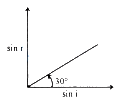 KCET 2019 Easy
 - Which of the following expression can be deduced on the basis of dimensional analysis? (All symbols have their usual meanings)KCET 2025 Medium
- In an adiabatic expansion of an ideal gas the product of pressure and volumeKCET 2020 Easy
- If \( P, Q \) and \( R \) are physical quantities having different dimensions, which of the following
combinations can never be a meaningful quantity?KCET 2019 Easy - In domestic electric mains supply, the voltage and the current areKCET 2025 Easy
- Pick out the correct statement from the following.KCET 2010 Easy
More PYQs from KCET
- Find the nucleotide sequence of mRNA which codes for the sequence of amino acids. 'Met-Leu-Val-Arg' and choose the correct option from below:-KCET 2018 Medium
- If \(\int f(x) \sin x \cdot \cos x d x\)
\(=\frac{1}{2\left(b^{2}-a^{2}\right)} \log f(x)+c,\)
where \(c\) is the constant of integration, then \(f(x)\) isKCET 2010 Hard - The branch of biology that deals with study of fossil animals is known asKCET 2013 Medium
- An electron is moving in a circle of radius \( r \) in a magnetic field B. Suddenly the field is reduced to \( \frac{B}{2} \). The radius of the circular path isKCET 2018 Easy
- The enzymes which are absolutely necessary for recombinant DNA technology areKCET 2012 Medium
- A convex and a concave lens separated by distance are then put in contact. The focal length of the combinationKCET 2008 Medium