


KCET · Physics · Thermodynamics
In thermodynamic processes, which of the following statements is not true?
- A In an isothermal process, the temperature remains constant
- B In an isobaric process, the volume remains constant
- C In an adiabatic process, the system is insulated from the surroundings
- D In an adiabatic process, \(PV^\gamma = \) a constant
Answer & Solution
Correct Answer
(B) In an isobaric process, the volume remains constant
Step-by-step Solution
Detailed explanation
In an isothermal process, the temperature of the system remains constant.
In an isobaric process, the pressure of the system remains constant, not the volume. A process in which the volume remains constant is called an isochoric process.
In an adiabatic process, there is no heat exchange between the system and the surroundings (\(dQ = 0\)), which means the system is thermally insulated. For an ideal gas undergoing a reversible adiabatic process, the relation \(PV^{\gamma} = \text{constant}\) holds true.
Therefore, the statement regarding the isobaric process is incorrect.
Answer: In an isobaric process, the volume remains constant
In an isobaric process, the pressure of the system remains constant, not the volume. A process in which the volume remains constant is called an isochoric process.
In an adiabatic process, there is no heat exchange between the system and the surroundings (\(dQ = 0\)), which means the system is thermally insulated. For an ideal gas undergoing a reversible adiabatic process, the relation \(PV^{\gamma} = \text{constant}\) holds true.
Therefore, the statement regarding the isobaric process is incorrect.
Answer: In an isobaric process, the volume remains constant
See the Complete Solution
Get step-by-step explanations for this and 2.5 Lakh+ more JEE, NEET & CET questions.
- Unlock all solutions
- Practice the full chapter
- Track accuracy across PYQs
4.8 rated on Google Play · 14,000+ reviews
More questions from Physics
- Which one of the following is not correct?KCET 2013 Easy
- The principle of LASER action involvesKCET 2007 Easy
- The ratio of area of first excited state to ground state of orbit of hydrogen atom'isKCET 2024 Easy
- A \(1 \mathrm{~kg}\) ball moving at \(12 \mathrm{~ms}^{-1}\) collides with a \(2 \mathrm{~kg}\) ball moving in opposite direction at \(24 \mathrm{~ms}^{-1}\). If the coefficient of restitution is \(2 / 3\), then their velocities after the collision areKCET 2021 Hard
- In a Fraunhofer diffraction experiment at a single slit using a light of wavelength \(400 \mathrm{~nm}\), the first minimum is formed at an angle of \(30^{\circ}\). The direction \(\theta\) of the first secondary maximum is given byKCET 2008 Hard
- Consider an electrical conductor connected across a potential difference \(V\). Let \(\Delta q\) be a small charge moving through it in time \(\Delta t\). If \(I\) is the electric current through it,
I. the kinetic energy of the charge increases by \(I V \Delta t\).
II. the electric potential energy of the charge decreases by \(I V \Delta t\).
III. the thermal energy of the conductor increases by IV \(\Delta t\).
Choose the correct option.KCET 2021 Easy
More PYQs from KCET
- In humans, common cold is caused byKCET 2017 Easy
- Two luminous point sources separated by a certain distance are at \(10 \mathrm{~km}\) from an observer. If the aperture of his eye is \(2.5 \times 10^{-3} \mathrm{~m}\) and the wavelength of light used is \(500 \mathrm{~nm}\), the distance of separation between the point sources just seen to be resolved isKCET 2009 Hard
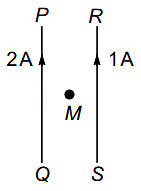
- \(\mathrm{PQ}\) and RS are long parallel conductors separated by certain distance. \(M\) is the midpoint between them (see the figure). The net magnetic field at \(M\) is B. Now, the current 2 A is switched off. The field at \(M\) now becomes
 KCET 2010 Medium
 - The power of a equi-concave lens is \(-4.5 \mathrm{D}\) and is made of a material of refractive index 1.6, the radii of curvature of the lens isKCET 2022 Easy
- The complex formed by a pair of synapsed homologous chromosomes is called,KCET 2023 Easy
- The angle of minimum deviation for an incident light ray on an equilateral prism is equal to its refracting angle. The refractive index of its material isKCET 2009 Medium