


KCET · Physics · Magnetic Effects of Current
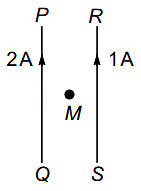
\(\mathrm{PQ}\) and RS are long parallel conductors separated by certain distance. \(M\) is the midpoint between them (see the figure). The net magnetic field at \(M\) is B. Now, the current 2 A is switched off. The field at \(M\) now becomes
- A \(2 \mathrm{~B}\)
- B \(\mathrm{B}\)
- C \(\frac{\mathrm{B}}{2}\)
- D \(3 B\)
Answer & Solution
Correct Answer
(B) \(\mathrm{B}\)
Step-by-step Solution
Detailed explanation
Magnetic field at midpoint \(M\) in first case is
\(\mathrm{B}=\mathrm{B}_{\mathrm{PQ}}-\mathrm{B}_{\mathrm{RS}}\)
\(\left(\because \mathrm{B}_{\mathrm{PQ}}\right.\) and \(\mathrm{B}_{\mathrm{RS}}\) are in opposite directions)
\(=\frac{4 \mu_{0}}{4 \pi \mathrm{d}}-\frac{2 \mu_{0}}{4 \pi \mathrm{d}}\)
\(=\frac{2 \mu_{0}}{4 \pi \mathrm{d}}\)
When the current \(2 \mathrm{~A}\) is switched off, the net magnetic field at \(\mathrm{M}\) is due to current \(1 \mathrm{~A}\)
\(\mathrm{B}^{\prime}=\frac{\mu_{0} \times 2 \times 1}{4 \pi \mathrm{d}}=\mathrm{B}\)
\(\mathrm{B}=\mathrm{B}_{\mathrm{PQ}}-\mathrm{B}_{\mathrm{RS}}\)
\(\left(\because \mathrm{B}_{\mathrm{PQ}}\right.\) and \(\mathrm{B}_{\mathrm{RS}}\) are in opposite directions)
\(=\frac{4 \mu_{0}}{4 \pi \mathrm{d}}-\frac{2 \mu_{0}}{4 \pi \mathrm{d}}\)
\(=\frac{2 \mu_{0}}{4 \pi \mathrm{d}}\)
When the current \(2 \mathrm{~A}\) is switched off, the net magnetic field at \(\mathrm{M}\) is due to current \(1 \mathrm{~A}\)
\(\mathrm{B}^{\prime}=\frac{\mu_{0} \times 2 \times 1}{4 \pi \mathrm{d}}=\mathrm{B}\)
See the Complete Solution
Get step-by-step explanations for this and 2.5 Lakh+ more JEE, NEET & CET questions.
- Unlock all solutions
- Practice the full chapter
- Track accuracy across PYQs
4.8 rated on Google Play · 14,000+ reviews
More questions from Physics
- Three polaroid sheets \(P_{1}, P_{2}\) and \(P_{3}\) are kept parallel to each other such that the angle between pass axes of \(P_{1}\) and \(P_{2}\) is \(45^{\circ}\) and that between \(P_{2}\) and \(P_{3}\) is \(45^{\circ}\). If unpolarised beam of light of intensity \(128 \mathrm{Wm}^{-2}\) is incident on \(P_{1}\). What is the intensity of light coming out of \(P_{3}\) ?KCET 2020 Easy
- The speed of light in media \(M_{1}\) and \(M_{2}\) are \(1.5 \times 10^{8} \mathrm{~ms}^{-1}\) and \(2 \times 10^{8} \mathrm{~ms}^{-1}\) respectively. A ray travels from medium \(M_{1}\) to the medium \(M_{2}\) with an angle of incidence \(\theta\). The ray suffers total internal reflection. Then the value of the angle of incidence \(\theta\) isKCET 2013 Medium
- A particle is projected with a velocity \( v \) so that its horizontal range twice the greatest height
attained. The horizontal range isKCET 2015 Hard - The physical quantity which is measure in the unit of wb \(\mathrm{A}^{-1}\) isKCET 2021 Easy
- Eight equal drops of water are falling through air with a steady velocity of \(10 \mathrm{~cm} \mathrm{~s}^{-1}\). If the drops combine to form a single drop big in size, then the terminal velocity of this big drop isKCET 2011 Hard
- A mass ' \( m \) ' on the surface of the Earth is shifted to a target equal to the radius of the Earth. If
' \( R \) ' is the radius and ' \( M \) ' is the mass of the Earth, then work done in this process isKCET 2018 Medium
More PYQs from KCET
- Pneumonia is caused byKCET 2021 Medium
- Area of the region bounded by two parabolas \( y=x^{2} \) and \( x=y^{2} \) isKCET 2014 Hard
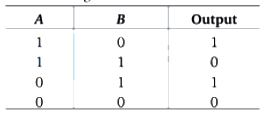
- The following truth table with \(\mathrm{A}\) and \(\mathrm{B}\) as inputs is for ........ gate.
 KCET 2012 Easy
 - The Set A has \( 4 \) elements and the Set B has \( 5 \) elements then the number of injective mappings
that can be defined from A to B isKCET 2016 Medium - Copper is extracted from copper pyrites byKCET 2020 Easy
- Decay constants of two radio-active samples A and \(\mathrm{B}\) are \(15 \mathrm{x}\) and \(3 \mathrm{x}\) respectively. They have equal number of initial nuclei. The ratio of the number of nuclei left in \(\mathrm{A}\) and \(\mathrm{B}\) after a time \(\frac{1}{6 \mathrm{x}}\) isKCET 2012 Medium