


KCET · Physics · Semiconductors
The principle of LASER action involves
- A amplification of particular frequency emitted by the system
- B population inversion
- C stimulated emission
- D All of the above
Answer & Solution
Correct Answer
(D) All of the above
Step-by-step Solution
Detailed explanation
Laser action involves all the given phenomenon
(i) Amplification of particular frequency
(ii) Population inversion
(iii) Stimulated emission
(i) Amplification of particular frequency
(ii) Population inversion
(iii) Stimulated emission
See the Complete Solution
Get step-by-step explanations for this and 2.5 Lakh+ more JEE, NEET & CET questions.
- Unlock all solutions
- Practice the full chapter
- Track accuracy across PYQs
4.8 rated on Google Play · 14,000+ reviews
More questions from Physics
- The power dissipated in \( 3 \Omega \) resistance in the following circuit is
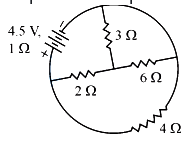 KCET 2017 Easy
 - A paramagnetic sample shows a net magnetisation of \(8 \mathrm{Am}^{-1}\) when placed in an external magnetic field of \(0.6 \mathrm{~T}\) at a temperature of \(4 \mathrm{~K}\). When the same sample is placed in an external magnetic field of \(0.2 \mathrm{~T}\) at a temperature of \(16 \mathrm{~K}\), the magnetisation will beKCET 2020 Medium
- The half life of a radioactive substance is \( 20 \) minutes. The time taken between \( 50 \% \) decay and
\( 87.5 \% \) decay of the substance will beKCET 2015 Hard - A focal length of a lens is \( 10 \mathrm{~cm} \). What is power of a lens in dioptre ?KCET 2014 Medium
- A point object is moving at a constant speed of \(1 \mathrm{~ms}^{-1}\) along the principal axis of a convex lens of focal length \(10 \mathrm{~cm}\). The speed of the image is also \(1 \mathrm{~ms}^{-1}\), when the object is at \(\mathrm{cm}\) from the optical centre of the lens.KCET 2023 Hard
- A parallel beam of light is incident on a converging lens parallel to its principal axis. As one moves away from the lens on the other side of the principal axis, the intensity of lightKCET 2009 Easy
More PYQs from KCET
- Two tangent galvanometers \(A\) and \(B\) have coils of radii \(8 \mathrm{~cm}\) and \(16 \mathrm{~cm}\) respectively and resistance \(8 \Omega\) each. They are connected in parallel with a cell of emf \(4 \mathrm{~V}\) and negligible internal resistance. The deflections produced in the tangent galvanometers \(A\) and \(B\) are \(30°\) and \(60°\) respectively. If A has 2 turns, then B must haveKCET 2007 Hard
- A certain charge 2Q is divided at first into two parts \( q_{1} \) and \( q_{2} . \) Later the charges are placed at a certain distance. If the force of interaction between two charges is maximum then \( \frac{Q}{q_{1}} \)KCET 2019 Medium
- In the following diagrammatic representation of a standard ECG, the 'T' represents.
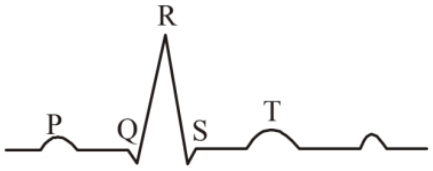 KCET 2017 Hard
 - In cloning vectors, antibiotic resistant genes are helpful forKCET 2019 Medium
- The S.I. unit of specific heat capacity isKCET 2017 Medium
- Coersivity of a magnet where the ferromagnet gets completely demagnetized is \( 3 \times 10^{3} \mathrm{Am}^{-1} \)
The minimum current required to be passed in a solenoid having \( 1000 \) turns per metre, so
that the magnet gets completely demagnetized when placed inside the solenoid isKCET 2019 Hard