


KCET · Physics · Wave Optics
In a Fraunhofer diffraction experiment at a single slit using a light of wavelength \(400 \mathrm{~nm}\), the first minimum is formed at an angle of \(30^{\circ}\). The direction \(\theta\) of the first secondary maximum is given by
- A \(\sin ^{-1}\left(\frac{2}{3}\right)\)
- B \(\sin ^{-1}\left(\frac{3}{4}\right)\)
- C \(\sin ^{-1}\left(\frac{1}{4}\right)\)
- D \(\tan ^{-1}\left(\frac{2}{3}\right)\)
Answer & Solution
Correct Answer
(B) \(\sin ^{-1}\left(\frac{3}{4}\right)\)
Step-by-step Solution
Detailed explanation
For first diffraction minimum
\[
\Rightarrow \quad \begin{aligned}
a \sin \theta &=\lambda \\
a &=\frac{\lambda}{\sin \theta}
\end{aligned}
\]
For first secondary maximum
\[
a \sin \theta^{\prime}=\frac{3 \lambda}{2}
\]
or \(\sin \theta^{\prime}=\frac{3 \lambda}{2} \times \frac{1}{a}=\frac{3 \lambda}{2} \times \frac{\sin \theta}{\lambda}=\frac{3}{2} \times \sin 30^{\circ}=\frac{3}{4}\)
or
\[
\theta^{\prime}=\sin ^{-1}\left(\frac{3}{4}\right)
\]
\[
\Rightarrow \quad \begin{aligned}
a \sin \theta &=\lambda \\
a &=\frac{\lambda}{\sin \theta}
\end{aligned}
\]
For first secondary maximum
\[
a \sin \theta^{\prime}=\frac{3 \lambda}{2}
\]
or \(\sin \theta^{\prime}=\frac{3 \lambda}{2} \times \frac{1}{a}=\frac{3 \lambda}{2} \times \frac{\sin \theta}{\lambda}=\frac{3}{2} \times \sin 30^{\circ}=\frac{3}{4}\)
or
\[
\theta^{\prime}=\sin ^{-1}\left(\frac{3}{4}\right)
\]
See the Complete Solution
Get step-by-step explanations for this and 2.5 Lakh+ more JEE, NEET & CET questions.
- Unlock all solutions
- Practice the full chapter
- Track accuracy across PYQs
4.8 rated on Google Play · 14,000+ reviews
More questions from Physics
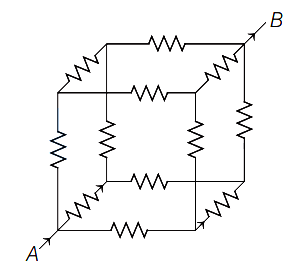
- Each resistance in the given cubical network has resistance of \(1 \Omega\) and equivalent resistance between \(A\) and \(B\) is
 KCET 2020 Medium
 - Two identical metal spheres charged with \(+12 \mu \mathrm{F}\) and \(-8 \mu \mathrm{F}\) are kept at certain distance in air. They are brought into contact and then kept at the same distance. The ratio of the magnitudes of electrostatic forces between them before and after contact isKCET 2008 Medium
- A transformer works on the principle ofKCET 2011 Easy
- In a CE amplifier, the input ac signal to be amplified is applied acrossKCET 2018 Medium
- \(0.1 \mathrm{~m}^{3}\) of water at \(80^{\circ} \mathrm{C}\) is mixed with \(0.3 \mathrm{~m}^{3}\) of water at \(60^{\circ} \mathrm{C}\). The final temperature of the mixture isKCET 2009 Hard
- Two slabs are of the thicknesses \(d_{1}\) and \(d_{2}\). Their thermal conductivities are \(\mathrm{K}_{1}\) and \(\mathrm{K}_{2}\) respectively. They are in series. The free ends of the combination of these two slabs are kept at temperatures \(\theta_{1}\) and \(\theta_{2}\). Assume \(\theta_{1}>\theta_{2}\). The temperature \(\theta\) of their common junction isKCET 2010 Hard
More PYQs from KCET
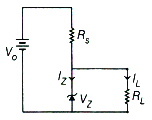
- In the diagram shown, the Zener diode has a reverse breakdown voltage of \(V_Z\). The current through the load resistance \(R_L\) is \(I_L\). The current through the Zener diode is
 KCET 2024 Medium
 - Dimensional formula for activity of radioactive substance isKCET 2024 Easy
- During the adsorption of krypton on activated charcoal at low temperatureKCET 2010 Easy
- If \(\int f(x) \sin x \cdot \cos x d x\)
\(=\frac{1}{2\left(b^{2}-a^{2}\right)} \log f(x)+c,\)
where \(c\) is the constant of integration, then \(f(x)\) isKCET 2010 Hard - The minimum value of \(27^{\cos 2 x} 81^{\sin 2 x}\) isKCET 2009 Medium
- Which of the following is the most stable complex ion?KCET 2026 Medium