


KCET · Physics · Ray Optics
The power of a equi-concave lens is \(-4.5 \mathrm{D}\) and is made of a material of refractive index 1.6, the radii of curvature of the lens is
- A \(36.6 \mathrm{~cm}\)
- B \(-266 \mathrm{~cm}\)
- C \(115.44 \mathrm{~cm}\)
- D \(-26.6 \mathrm{~cm}\)
Answer & Solution
Correct Answer
(D) \(-26.6 \mathrm{~cm}\)
Step-by-step Solution
Detailed explanation
Power of equi-concave lens, \(P=-4.5 \mathrm{D}\)
Refractive index, \(\mu=1.6\)
Focal length of lens,
\[
f=\frac{1}{P}=\left(\frac{1}{-4.5}\right) \mathrm{m}=\left(\frac{100}{-4.5}\right) \mathrm{cm}=\left(\frac{-200}{9}\right) \mathrm{cm}
\]
By lens Maker's formula, we get
\[
\frac{1}{f}=(\mu-1)\left(\frac{1}{R_1}-\frac{1}{R_2}\right)
\]
For equi-concave lens,
\[
R_1=-R \text { and } R_2=R
\]
Putting these values in Eq. (i), we get
\[
\begin{aligned}
& \frac{1}{200 / 9}=(1.6-1)\left(\frac{1}{-R}-\frac{1}{R}\right) \Rightarrow \frac{9}{200}=0.6\left(\frac{-2}{R}\right) \\
& \Rightarrow \quad R=\frac{-0.6 \times 2 \times 200}{9}=-26.6 \mathrm{~cm}
\end{aligned}
\]
Refractive index, \(\mu=1.6\)
Focal length of lens,
\[
f=\frac{1}{P}=\left(\frac{1}{-4.5}\right) \mathrm{m}=\left(\frac{100}{-4.5}\right) \mathrm{cm}=\left(\frac{-200}{9}\right) \mathrm{cm}
\]
By lens Maker's formula, we get
\[
\frac{1}{f}=(\mu-1)\left(\frac{1}{R_1}-\frac{1}{R_2}\right)
\]
For equi-concave lens,
\[
R_1=-R \text { and } R_2=R
\]
Putting these values in Eq. (i), we get
\[
\begin{aligned}
& \frac{1}{200 / 9}=(1.6-1)\left(\frac{1}{-R}-\frac{1}{R}\right) \Rightarrow \frac{9}{200}=0.6\left(\frac{-2}{R}\right) \\
& \Rightarrow \quad R=\frac{-0.6 \times 2 \times 200}{9}=-26.6 \mathrm{~cm}
\end{aligned}
\]
See the Complete Solution
Get step-by-step explanations for this and 2.5 Lakh+ more JEE, NEET & CET questions.
- Unlock all solutions
- Practice the full chapter
- Track accuracy across PYQs
4.8 rated on Google Play · 14,000+ reviews
More questions from Physics
- In an unbiased junctionKCET 2008 Easy
- A small town with a demand of \(900\text{ kW}\) of electric power at \(220\text{ V}\) is situated \(20\text{ km}\) away from an electric power generating station. Each wire of the two-wire transmission line has a resistance per unit length of \(5 \times 10^{-4} \, \Omega\text{ m}^{-1}\). The town gets power from the line through a \(45000\text{ V}\) to \(220\text{ V}\) step-down transformer at a substation in the town. The line power loss in the form of heat is:KCET 2026 Medium
- \(L C\)-oscillations are similar and analogous to the mechanical oscillations of a block attached to a spring. The electrical equivalent of the force constant of the spring isKCET 2021 Hard
- The half life of a radioactive substance is \( 20 \) minutes. The time taken between \( 50 \% \) decay and
\( 87.5 \% \) decay of the substance will beKCET 2015 Hard - A stone of mass \( 0.05 \mathrm{~kg} \) is thrown vertically upwards. What is the direction and magnitude of
net force on the stone during its upward motion?KCET 2015 Easy - The thermonuclear reaction of hydrogen inside the stars is taking place by a cycle of operations. The particular element which acts as a catalyst isKCET 2011 Easy
More PYQs from KCET
- Which of the following staements is not true for Nostoc?KCET 2012 Medium
- The ratio of angular speed of a second-hand to the hour-hand of a watch isKCET 2015 Medium
- An engine moving towards a wall with a velocity \(50 \mathrm{~ms}^{-1}\) emits a note of \(1.2 \mathrm{kHz}\). Speed of sound in air is \(350 \mathrm{~ms}^{-1}\). The frequency of the note after reflection from the wall as heard by the driver of the engine isKCET 2007 Hard
- If \( A=\frac{1}{\Pi}\left[\begin{array}{ll}\sin ^{-1}(\Pi x) & \tan ^{-1}\left(\frac{x}{I I}\right) \\ \tan ^{-1}\left(\frac{x}{I I}\right) & \cot ^{-1}(\Pi x)\end{array}\right] \) then \( A-B \) isKCET 2017 Medium
- Butylated hydroxy toluene as a food additive acts asKCET 2014 Medium
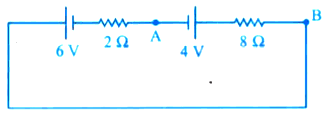
- Potential difference between \( A \) and \( B \) in the following circuit
 KCET 2016 Medium