


KCET · Physics · Alternating Current
In \(R-L-C\) series circuit, the potential differences across each element is \(20 \mathrm{~V}\). Now the value of the resistance alone is doubled, then P.D. across \(R, L\) and \(C\) respectively.
- A \(20 \mathrm{~V}, 10 \mathrm{~V}, 10 \mathrm{~V}\)
- B \(20 \mathrm{~V}, 20 \mathrm{~V}, 20 \mathrm{~V}\)
- C \(20 \mathrm{~V}, 40 \mathrm{~V}, 40 \mathrm{~V}\)
- D \(10 \mathrm{~V}, 20 \mathrm{~V}, 20 \mathrm{~V}\)
Answer & Solution
Correct Answer
(A) \(20 \mathrm{~V}, 10 \mathrm{~V}, 10 \mathrm{~V}\)
Step-by-step Solution
Detailed explanation
Given, the potential difference across each element is same i.e., \(20 \mathrm{~V}\), so, the circuit is at resonance and we have
\(V=V_{R}=20 \mathrm{~V}\)
If the value of \(R\) is doubled, then value of / reduced to half \(\therefore\)
\(V_{L}=V_{C}=\frac{I X_{L}}{2}=\frac{I X_{C}}{2}=\frac{20}{2}=10 \mathrm{~V}\)
\((\because\) circuit is at resonance) and \(\quad V_{R}=V=20 \mathrm{~V}\)
\(V=V_{R}=20 \mathrm{~V}\)
If the value of \(R\) is doubled, then value of / reduced to half \(\therefore\)
\(V_{L}=V_{C}=\frac{I X_{L}}{2}=\frac{I X_{C}}{2}=\frac{20}{2}=10 \mathrm{~V}\)
\((\because\) circuit is at resonance) and \(\quad V_{R}=V=20 \mathrm{~V}\)
See the Complete Solution
Get step-by-step explanations for this and 2.5 Lakh+ more JEE, NEET & CET questions.
- Unlock all solutions
- Practice the full chapter
- Track accuracy across PYQs
4.8 rated on Google Play · 14,000+ reviews
More questions from Physics
- A pan filled with hot food cools from \( 94^{\circ} \mathrm{C} \) to \( 86^{\circ} \mathrm{C} \) in \( 2 \) minutes. When the room
temperature'is \( 20^{\circ} \mathrm{C} \). How long will it cool from \( 74^{\circ} \mathrm{C} \) to \( 66{ }^{\circ} \mathrm{C} \) ?KCET 2016 Medium - When a piece of metal is illuminated by a monochromatic light of wavelength \(\lambda\), then stopping potential is \(3 \mathrm{~V}_{\mathrm{s}}\). When same surface is illuminated by light of wavelength \(2 \lambda\), then stopping potential becomes \(\mathrm{V}_{\mathrm{s}}\). The value of threshold wavelength for photoelectric emission will beKCET 2008 Medium
- A circular coil of radius \( 10 \mathrm{~cm} \) and \( 100 \) turns carries a current \( 1 \mathrm{~A} \). What is the magnetic moment of the coil ?KCET 2014 Medium
- In the following combinations of logic gates, the outputs of \(A, B\) and \(C\) are respectively
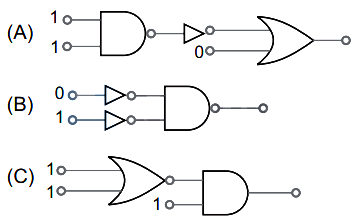 KCET 2009 Medium
 - Two fixed charges A and B of \(5 \mu \mathrm{C}\) each are separated by a distance of \(6 \mathrm{~m}\). \(\mathrm{C}\) is the mid point of the line joining \(A\) and \(B\). A charge \(Q\) of \(-5 \mu \mathrm{C}\) is shot perpendicular to the line joining A and \(B\) through \(C\) with a kinetic energy of \(0.06 \mathrm{~J}\). The charge \(\mathrm{Q}\) comes to rest at a point D. The distance \(C D\) isKCET 2012 Hard
- Two resistors of resistances \( 2 \Omega \) and \( 6 \Omega \) are connected in parallel. This combination is then connected to a battery of emf \( 2 \mathrm{~V} \) and internal resistance \( 0.5 \Omega \). What is the current flowing through the battery?KCET 2014 Easy
More PYQs from KCET
- The shaded region in the figure given is the solution of which of the inequations?
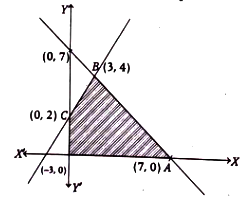 KCET 2023 Easy
 - A box has \( 100 \) pens of which \( 10 \) are defective. The probability that out of a sample of \( 5 \) pens
drawn one by one with replacement and at most one is defective isKCET 2017 Easy - This sides of a triangle are \(6+2 \sqrt{3}, 4 \sqrt{3}\) and \(\sqrt{24}\). The tangent of the smallest angle of the triangle isKCET 2010 Easy
- The relationship between \( \mathrm{K}_{\mathrm{p}} \) and \( \mathrm{K}_{\mathrm{c}} \) is \( \mathrm{K}_{\mathrm{p}}=\mathrm{K}_{\mathrm{c}} \) (RT) \( ^{\Delta n_{g}} \). What would be the value of \( \Delta n_{g} \) for
the reaction
\( \mathrm{NH}_{4} \mathrm{Cl}(\mathrm{s}) \rightleftharpoons \mathrm{NH}_{3}(\mathrm{~g})+\mathrm{HCl}(\mathrm{g}) ? \)KCET 2018 Easy - The efficiency of Carnot's heat engine is \(0.5\) when the temperature of the source is \(\mathrm{T}_{1}\) and that of \(\operatorname{sink}\) is \(\mathrm{T}_{2}\). The efficiency of another Carnot's heat engine is also 0.5. The temperatures of source and sink of the second engine are respectivelyKCET 2010 Medium
- Read the statements given below and identify the incorrect statement.KCET 2012 Easy