


KCET · Maths · Area Under Curves
A box has \( 100 \) pens of which \( 10 \) are defective. The probability that out of a sample of \( 5 \) pens
drawn one by one with replacement and at most one is defective is
- A \( \frac{9}{10} \)
- B \( \frac{1}{2}\left(\frac{9}{10}\right)^{4} \)
- C \( \left(\frac{9}{10}\right)^{5}+\frac{1}{2}\left(\frac{9}{10}\right)^{4} \)
- D \( \frac{1}{2}\left(\frac{9}{10}\right)^{5} \)
Answer & Solution
Correct Answer
(C) \( \left(\frac{9}{10}\right)^{5}+\frac{1}{2}\left(\frac{9}{10}\right)^{4} \)
Step-by-step Solution
Detailed explanation
Given that, probability of defective pens is
\[
P=\frac{10}{100}=\frac{1}{10}
\]
So, probability of non-defective pens is
\[
\begin{array}{l}
Q=1-P=\frac{9}{10} \\
\text { Since, } n=5, x \leq 1 \text {. So, } \\
P(x \leq 1)=P(x=0)+P(x=1) \\
={ }^{5} C_{0}\left(\frac{1}{10}\right)^{0}\left(\frac{9}{10}\right)^{5}+{ }^{5} C_{1}\left(\frac{1}{10}\right)^{1}\left(\frac{9}{10}\right)^{4} \\
=\left(\frac{9}{10}\right)^{5}+\frac{1}{2}\left(\frac{9}{10}\right)^{4}
\end{array}
\]
\[
P=\frac{10}{100}=\frac{1}{10}
\]
So, probability of non-defective pens is
\[
\begin{array}{l}
Q=1-P=\frac{9}{10} \\
\text { Since, } n=5, x \leq 1 \text {. So, } \\
P(x \leq 1)=P(x=0)+P(x=1) \\
={ }^{5} C_{0}\left(\frac{1}{10}\right)^{0}\left(\frac{9}{10}\right)^{5}+{ }^{5} C_{1}\left(\frac{1}{10}\right)^{1}\left(\frac{9}{10}\right)^{4} \\
=\left(\frac{9}{10}\right)^{5}+\frac{1}{2}\left(\frac{9}{10}\right)^{4}
\end{array}
\]
See the Complete Solution
Get step-by-step explanations for this and 2.5 Lakh+ more JEE, NEET & CET questions.
- Unlock all solutions
- Practice the full chapter
- Track accuracy across PYQs
4.8 rated on Google Play · 14,000+ reviews
More questions from Maths
- If \( \left|\begin{array}{ll}3 & x \\ x & 1\end{array}\right|=\left|\begin{array}{ll}3 & 2 \\ 4 & 1\end{array}\right| \) then \( x \) is equal toKCET 2017 Easy
- The inverse of 2010 in the group \(\mathrm{Q}^{+}\)of all positive rational under the binary operation * defined by \(\mathrm{a}\) * \(\mathrm{b}=\frac{\mathrm{ab}}{2010}, \forall \mathrm{a}, \mathrm{b} \in \mathrm{Q}^{+}\), isKCET 2010 Easy
- \( \int x^{3} \sin 3 x d x= \)KCET 2019 Hard
- Equation of circle with center \( (-a,-b) \) and radius \( \sqrt{a^{2}-b^{2}} \) isKCET 2014 Medium
- \(\tan^{-1}\left(\dfrac{1}{1 + 1 \cdot 2}\right) + \tan^{-1}\left(\dfrac{1}{1 + 2 \cdot 3}\right) + \ldots + \tan^{-1}\left(\dfrac{1}{1 + n(n+1)}\right) = \)KCET 2026 Medium
- A man takes a step forward with probability \( 0.4 \) and one step backward with probability \( 0.6 \),
then the probability that at the end of eleven steps he is one step away from the starting point
isKCET 2015 Hard
More PYQs from KCET
- If the function is \(f(x)=\frac{1}{x+2}\), then the point of discontinuity of the composite function \(y=f(f(x))\) isKCET 2023 Easy
- Eight drops of mercury of equal radii combine to form a big drop. The capacitance of a bigger drop as compared to each smaller drop isKCET 2021 Easy
- The number \(\left(49^{2}-4\right)\left(49^{3}-49\right)\) is divisible byKCET 2010 Medium
- A train is approaching towards a platform with a speed of \( 10 \mathrm{~ms}^{-1} \) while blowing a whistle of
frequency \( 340 \mathrm{~Hz} \). What is the frequency of whistle heard by a stationary observer on the
platform ? Given speed of sound \( =340 \mathrm{~ms}^{-1} \).KCET 2014 Easy - During the electrolysis of brine, by using inert electrodes,KCET 2023 Medium
- From the diagram
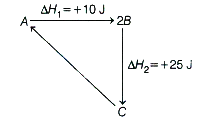
\(\Delta_r H\) for the reaction, \(C \rightarrow A\) isKCET 2024 Medium