


KCET · Physics · Dual Nature of Matter
When a piece of metal is illuminated by a monochromatic light of wavelength \(\lambda\), then stopping potential is \(3 \mathrm{~V}_{\mathrm{s}}\). When same surface is illuminated by light of wavelength \(2 \lambda\), then stopping potential becomes \(\mathrm{V}_{\mathrm{s}}\). The value of threshold wavelength for photoelectric emission will be
- A \(4 \lambda\)
- B \(8 \lambda\)
- C \(\frac{4}{3} \lambda\)
- D \(6 \lambda\)
Answer & Solution
Correct Answer
(A) \(4 \lambda\)
Step-by-step Solution
Detailed explanation
According to Einstein's photoelectric equation
\[
\mathrm{eV}=\mathrm{hc}\left[\frac{1}{\lambda}-\frac{1}{\lambda_{0}}\right]
\]
Ist case
\[
3 \mathrm{eV}_{\mathrm{s}}=\mathrm{hc}\left[\frac{1}{\lambda}-\frac{1}{\lambda_{0}}\right]
\]
IInd case
\[
\mathrm{eV}_{\mathrm{s}}=\mathrm{hc}\left[\frac{1}{2 \lambda}-\frac{1}{\lambda_{0}}\right]
\]
Dividing Eq. (i) by Eq. (ii), we get
\[
\lambda_{0}=4 \lambda
\]
\[
\mathrm{eV}=\mathrm{hc}\left[\frac{1}{\lambda}-\frac{1}{\lambda_{0}}\right]
\]
Ist case
\[
3 \mathrm{eV}_{\mathrm{s}}=\mathrm{hc}\left[\frac{1}{\lambda}-\frac{1}{\lambda_{0}}\right]
\]
IInd case
\[
\mathrm{eV}_{\mathrm{s}}=\mathrm{hc}\left[\frac{1}{2 \lambda}-\frac{1}{\lambda_{0}}\right]
\]
Dividing Eq. (i) by Eq. (ii), we get
\[
\lambda_{0}=4 \lambda
\]
See the Complete Solution
Get step-by-step explanations for this and 2.5 Lakh+ more JEE, NEET & CET questions.
- Unlock all solutions
- Practice the full chapter
- Track accuracy across PYQs
4.8 rated on Google Play · 14,000+ reviews
More questions from Physics
- In the series LCR, circuit the power dissipation is throughKCET 2018 Easy
- A current of \(2 \mathrm{~A}\) is passing through a metal wire of cross-sectional area \(2 \times 10^{-6} \mathrm{~m}^{2}\). If the number density of free electrons in the wire is \(5 \times 10^{26} \mathrm{~m}^{-3}\), the drift speed of electrons is (Given, \(\mathrm{e}=1.6 \times 10^{-19} \mathrm{C}\) )KCET 2012 Medium
- Water rises in plant fibres due toKCET 2007 Medium
- An ideal resistance \(\mathrm{R}\), ideal inductance \(\mathrm{L}\), ideal capacitance \(\mathrm{C}\) and \(\mathrm{AC}\) voltmeters \(\mathrm{V}_{1}, \mathrm{~V}_{3}\) and \(\mathrm{V}_{4}\) are connected to an AC sources as shown in figure. At resonance,
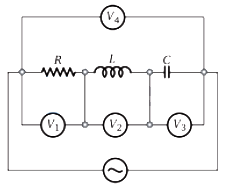 KCET 2012 Medium
 - A solid cylinder of radius \(R\) made of a material of thermal conductivity \(K_{1}\) is surrounded by a cylindrical shell of inner radius \(R\) and outer radius \(2 R\) made of a material of thermal conductivity \(K_{2}\).
The two ends of the combined system are maintained at two different temperatures. Then there is no loss of heat across the cylindrical surface and the system is in steady state. The effective thermal conductivity of the system isKCET 2013 Hard - If a charge on the body is \( 1 \mathrm{nC} \), then how many electrons are present on the body?KCET 2014 Hard
More PYQs from KCET
- Which of the following is not true for \(\mathrm{S}_{\mathrm{N}}\) l reaction?KCET 2012 Medium
- Dalda is prepared from oils byKCET 2008 Easy
- What is the role of competitive inhibitor during enzyme action?KCET 2016 Easy
- In which type of vascular bundles are xylem and phloem present at the same radius?KCET 2018 Hard
- The source of electromagnetic wave can be a chargeKCET 2021 Easy
- If \(\int_{0}^{1} f(x) d x=5\), then the value of ...+100 \(\int_{0}^{1} \mathrm{x}^{9} \mathrm{f}\left(\mathrm{x}^{10}\right) \mathrm{dx}\) is equal toKCET 2009 Medium