


KCET · Physics · Electromagnetic Induction
A wheel with \( 10 \) spokes each of length ' \( L \) ' \( m \) is rotated with a uniform angular velocity ' \( \omega \) ' in a
plane normal to the magnetic field 'B'. The emf induced between the axle and the rim of the
wheel.
- A \( \frac{1}{2} N \omega B L^{2} \)
- B \( \frac{1}{2} \omega B L^{2} \)
- C \( \omega B L^{2} \)
- D \( N \omega B L^{2} \)
Answer & Solution
Correct Answer
(B) \( \frac{1}{2} \omega B L^{2} \)
Step-by-step Solution
Detailed explanation
Given, number of spokes \( =10 \); length of each spoke \( =L ; \) angular velocity \( =\omega \); angular field = B
Therefore, emf induced between axle and rim is given as
\( E=B l v_{\mathrm{avg}}=\frac{B l v}{2}=B L \frac{r \omega}{2} \)
Now, here \( r=L \)
\( \Rightarrow E=\frac{B L^{2} \omega}{2} \)
Thus, emf induced between the axle and rim of the wheel is \( \frac{1}{2} B L^{2} \omega \)
Therefore, emf induced between axle and rim is given as
\( E=B l v_{\mathrm{avg}}=\frac{B l v}{2}=B L \frac{r \omega}{2} \)
Now, here \( r=L \)
\( \Rightarrow E=\frac{B L^{2} \omega}{2} \)
Thus, emf induced between the axle and rim of the wheel is \( \frac{1}{2} B L^{2} \omega \)
See the Complete Solution
Get step-by-step explanations for this and 2.5 Lakh+ more JEE, NEET & CET questions.
- Unlock all solutions
- Practice the full chapter
- Track accuracy across PYQs
4.8 rated on Google Play · 14,000+ reviews
More questions from Physics
- A beam of fast moving alpha particles were directed towards a thin film of gold. The parts \(A, B\) and \(C\) of the transmitted and reflected beams corresponding to the incident parts \(A, B\) and \(C\) of the beam are shown in the adjoining diagram. The number of alpha particles in
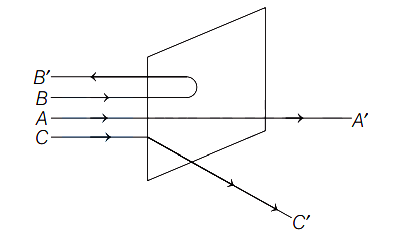 KCET 2020 Medium
 - Imagine a new planet having the same density as that of the earth, but it is two times bigger than the earth in size. If the acceleration due to gravity on the surface of the earth is \(g\) and that on the surface of the new planet is \(g'\), thenKCET 2026 Medium
- Consider the nuclear fission reaction \({ }_0^1 n+{ }_{92}^{235} \mathrm{U} \longrightarrow{ }_{56}^{144} \mathrm{Ba}+{ }_{36}^{89} \mathrm{Kr}+3{ }_0^1 n\). Assuming all the kinetic energy is carried away by the fast neutrons only and total binding energies of \({ }_{92}^{235} \mathrm{U},{ }_{56}^{144} \mathrm{Ba}\) and \({ }_{36}^{89} \mathrm{Kr}\) to be \(1800 \mathrm{MeV}, 1200\) MeV and 780 MeV respectively, the average kinetic energy carried by each fast neutron is (in MeV )KCET 2024 Medium
- A linear object of height \( 10 \mathrm{~cm} \) is kept in front of a concave mirror of radius of curvature \( 15 \mathrm{~cm} \),
at a distance of \( 10 \mathrm{~cm} \). The image formed isKCET 2017 Medium - The kinetic energy of an electron gets tripled, then the de-Broglie wavelength associated with it changes by a factorKCET 2009 Medium
- A charged particle is moving in an electric field of \(3 \times 10^{-10} \mathrm{Vm}^{-1}\) with mobility \(2.5 \times 10^6 \mathrm{~m}^2 / \mathrm{V}\)-s, its drift velocity isKCET 2022 Easy
More PYQs from KCET
- An equiconvex lens of radius of curvature 14 cm is made up of two different materials. Left half and right half of vertical portion is made up of material of refractive index 1.5 and 1.2 respectively as shown in the figure. If a point object is placed at a distance of 40 cm , calculate the image distance.
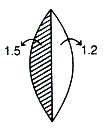 KCET 2024 Medium
 - The reaction in which \( \Delta \mathrm{H}>\Delta \mathrm{U} \) isKCET 2019 Easy
- \(v_{1}\) is the frequency of the series limit of Lyman series, \(v_{2}\) is the frequency of the first line of Lyman series and \(v_{3}\) is the frequency of the series limit of the Balmer series. ThenKCET 2010 Medium
- The family of curves whose \(x\) and \(y\) intercepts of a tangent at any point are respectively double the \(x\) and \(y\) coordinates of that point isKCET 2024 Hard
- A unit vector perpendicular to both \(\mathbf{i}+\mathbf{j}+\mathbf{k}\) and \(2 \mathbf{i}+\mathbf{j}+3 \mathbf{k}\) isKCET 2011 Hard
- A body of mass \(x \mathrm{~kg}\) is moving with a velocity of \(100 \mathrm{~ms}^{-1}\). Its de-Broglie wavelength is \(6.62 \times 10^{-35} \mathrm{~m}\). Hence, \(\mathrm{x}\) is \(\left(\mathrm{h}=6.62 \times 10^{-34} \mathrm{Js}\right.\) )KCET 2009 Medium