


KCET · Physics · Ray Optics
An equiconvex lens of radius of curvature 14 cm is made up of two different materials. Left half and right half of vertical portion is made up of material of refractive index 1.5 and 1.2 respectively as shown in the figure. If a point object is placed at a distance of 40 cm , calculate the image distance.
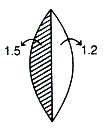
- A 25 cm
- B 50 cm
- C 35 cm
- D 40 cm
Answer & Solution
Correct Answer
(D) 40 cm
Step-by-step Solution
Detailed explanation
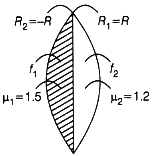
From the diagram,
\(\frac{1}{f_1}=\left(\mu_1-1\right)\left(\frac{1}{R_1}-\frac{1}{R_2}\right)=\left(\mu_1-1\right)\left(\frac{1}{R}-\frac{1}{\infty}\right)\)
\(\frac{1}{f_1}=\frac{\mu_1-1}{R}\) and \(\frac{1}{f_2}=\left(\mu_2-1\right)\left(\frac{1}{\infty}-\frac{1}{-R}\right)\)
\(\frac{1}{f_2}=\frac{\mu_2-1}{R}\)
\(\therefore\) Combined focal length,
\(\frac{1}{f}=\frac{1}{f_1}+\frac{1}{f_2}=\frac{\mu_1-1}{R}+\frac{\mu_2-1}{R}\)
\(=\frac{\mu_1+\mu_2-2}{R}=\frac{1.5+1.2-2}{14}\)
\(\frac{1}{f}=\frac{0.7}{14}\)
\(\Rightarrow \quad f=20 \mathrm{~cm}\)
Again, \(v=-40 \mathrm{~cm}, v=\) ?
\(\therefore\) Using lens formula,
\(\frac{1}{f}=\frac{1}{v}-\frac{1}{u}\)
\(\therefore \quad \frac{1}{20}=\frac{1}{v}-\frac{1}{(-40)} \Rightarrow \frac{1}{v}=\frac{1}{20}-\frac{1}{40}=\frac{1}{40}\)
\(\Rightarrow \quad v=40 \mathrm{~cm}\)
See the Complete Solution
Get step-by-step explanations for this and 2.5 Lakh+ more JEE, NEET & CET questions.
- Unlock all solutions
- Practice the full chapter
- Track accuracy across PYQs
4.8 rated on Google Play · 14,000+ reviews
More questions from Physics
- A substance of mass \( 49.53 \mathrm{~g} \) occupies \( 1.5 \mathrm{~cm}^{3} \) of volume. The density of the substance (in \( \mathrm{g} \) \( \left.\mathrm{cm}^{-3}\right) \) with correct number of significant figures isKCET 2017 Easy
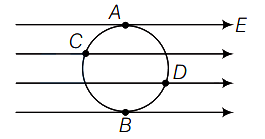
- A uniform electric field in the plane of the paper as shown. Here \(A, B, C\) and \(D\) are the ponits on the circle. \(V_{1}, V_{2}, V_{3}\) and \(V_{4}\) are the potentials at those points respectively. Then
 KCET 2013 Easy
 - The size of the image of an object, which is at infinity, as formed by a convex lens of focal length \(30 \mathrm{~cm}\) is \(2 \mathrm{~cm}\). If a concave lens of focal length \(20 \mathrm{~cm}\) is placed between the convex lens and the image at a distance of \(26 \mathrm{~cm}\) from the lens, the new size of the image isKCET 2021 Easy
- Which one of the following is not correct?KCET 2013 Easy
- Two thin long parallel wires separated by a distance ' \(r\) ' from each other in vacuum carry a current of I ampere in opposite directions. Then, they willKCET 2025 Easy
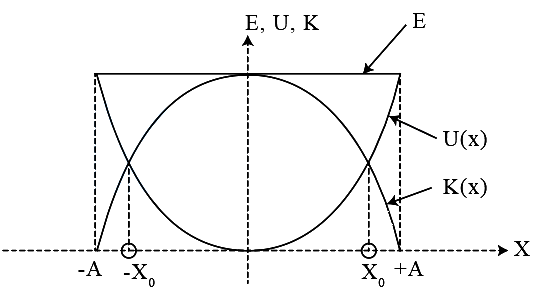
- The variations of kinetic energy \(\mathrm{K}(\mathrm{x})\), potential energy \(\mathrm{U}(\mathrm{x})\) and total energy as a function of displacement of a particle in SHM is as shown in the figure. The value of \(\left|x_0\right|\) is
 KCET 2025 Medium
More PYQs from KCET
- A period of geostationary satellite isKCET 2014 Medium
- For alkali metals, which one of the following trends is incorrect?KCET 2010 Medium
- Identify from the following, a characteristic pigment assoicated with chlorophyll-b molecules.KCET 2005 Easy
- The resistance of \(0.01 \mathrm{~m} \mathrm{KCl}\) solution at \(298 \mathrm{~K}\) is \(1500 \Omega\). If the conductivity of \(0.01 \mathrm{~m} \mathrm{KCl}\) solution at \(298 \mathrm{~K}\) is \(0.1466 \times 10^{-3} \mathrm{~S} \mathrm{~cm}^{-1}\). The cell constant of the conductivity cell in \(\mathrm{cm}^{-1}\) isKCET 2021 Hard
- Due to Doppler's effect the shift in wavelength observed is \( 0.1 Å \) for a star producing wavelength \( 6000 Å \). Velocity of recession of the star will beKCET 2019 Hard
- If \(f(x)\) is a function such that \(f^{\prime \prime}(x)+f(x)=0\) and \(g(x)=[f(x)]^{2}+\left[f^{\prime}(x)\right]^{2}\) and \(g(3)=8\), then \(g(8)\) is equal toKCET 2013 Hard