


KCET · Physics · Gravitation
Imagine a new planet having the same density as that of the earth, but it is two times bigger than the earth in size. If the acceleration due to gravity on the surface of the earth is \(g\) and that on the surface of the new planet is \(g'\), then
- A \(g' = \dfrac{g}{4}\)
- B \(g' = 8g\)
- C \(g' = 2g\)
- D \(g' = 4g\)
Answer & Solution
Correct Answer
(C) \(g' = 2g\)
Step-by-step Solution
Detailed explanation
The acceleration due to gravity on the surface of a planet is given by \(g = \dfrac{GM}{R^2}\).
Substituting the mass of the planet \(M = \dfrac{4}{3}\pi R^3 \rho\), we get:
\(g = \dfrac{G}{R^2} \left(\dfrac{4}{3}\pi R^3 \rho\right) = \dfrac{4}{3}\pi G R \rho\)
This shows that \(g \propto R \rho\).
For the new planet, the density is the same as Earth (\(\rho' = \rho\)) and the size (radius) is twice that of Earth (\(R' = 2R\)).
Therefore, the acceleration due to gravity on the new planet is:
\(g' = \dfrac{4}{3}\pi G R' \rho'\)
\(g' = \dfrac{4}{3}\pi G (2R) \rho = 2 \left(\dfrac{4}{3}\pi G R \rho\right)\)
\(g' = 2g\)
Answer: \(g' = 2g\)
Substituting the mass of the planet \(M = \dfrac{4}{3}\pi R^3 \rho\), we get:
\(g = \dfrac{G}{R^2} \left(\dfrac{4}{3}\pi R^3 \rho\right) = \dfrac{4}{3}\pi G R \rho\)
This shows that \(g \propto R \rho\).
For the new planet, the density is the same as Earth (\(\rho' = \rho\)) and the size (radius) is twice that of Earth (\(R' = 2R\)).
Therefore, the acceleration due to gravity on the new planet is:
\(g' = \dfrac{4}{3}\pi G R' \rho'\)
\(g' = \dfrac{4}{3}\pi G (2R) \rho = 2 \left(\dfrac{4}{3}\pi G R \rho\right)\)
\(g' = 2g\)
Answer: \(g' = 2g\)
See the Complete Solution
Get step-by-step explanations for this and 2.5 Lakh+ more JEE, NEET & CET questions.
- Unlock all solutions
- Practice the full chapter
- Track accuracy across PYQs
4.8 rated on Google Play · 14,000+ reviews
More questions from Physics
- The magnetic field at the centre ' \( \mathrm{O} \) ' in the given figure is
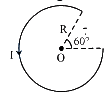 KCET 2019 Medium
 - The component of a vector \( \vec{r} \) along \( x \) - axis will have a maximum value ifKCET 2016 Easy
- The magnitude of point charge due to which the electric field \( 30 \mathrm{~cm} \) away has the magnitude \( 2 \mathrm{~N} C^{-1} \) will beKCET 2018 Easy
- A paramagnetic sample shows a net magnetisation of \(8 \mathrm{Am}^{-1}\) when placed in an external magnetic field of \(0.6 \mathrm{~T}\) at a temperature of \(4 \mathrm{~K}\). When the same sample is placed in an external magnetic field of \(0.2 \mathrm{~T}\) at a temperature of \(16 \mathrm{~K}\), the magnetisation will beKCET 2020 Medium
- 1 curie representsKCET 2011 Easy
- An electric bulb of \(60 \mathrm{~W}, 120 \mathrm{~V}\) is to be connected to 220 V source. What resistance should be connected in series with the bulb, so that the bulb glows properly?KCET 2024 Medium
More PYQs from KCET
- Two tangent galvanometers \(A\) and \(B\) have coils of radii \(8 \mathrm{~cm}\) and \(16 \mathrm{~cm}\) respectively and resistance \(8 \Omega\) each. They are connected in parallel with a cell of emf \(4 \mathrm{~V}\) and negligible internal resistance. The deflections produced in the tangent galvanometers \(A\) and \(B\) are \(30°\) and \(60°\) respectively. If A has 2 turns, then B must haveKCET 2007 Hard
- Which one of the following observations is correct for the features of logarithm function to any base \(b\gt1\) ?KCET 2024 Easy
- Which of the following gives positive Fehling's solution test?KCET 2016 Easy
- If \( A=\left[\begin{array}{cc}\cos 2 \theta & -\sin 2 \theta \\ \sin 2 \theta & \cos 2 \theta\end{array}\right] \) and \( A+A^{T}=I \),
where \( \mathrm{I} \) is the unit matrix of \( 2 \times 2 \& \mathrm{~A}^{\mathrm{T}} \) is the transpose of \( \mathrm{A} \), then the value of \( \theta \) is equal toKCET 2016 Hard - An electron isKCET 2007 Easy
- Identify the correct statements/regarding class aves.
I. Forelimbs are modified into wings and hindlimbs are modified for walking and swimming.
II. Heart is completely four chambered.
III. They are homeotherms.
IV. They are oviparous and development is direct.KCET 2021 Hard