


KCET · Physics · Atomic Physics
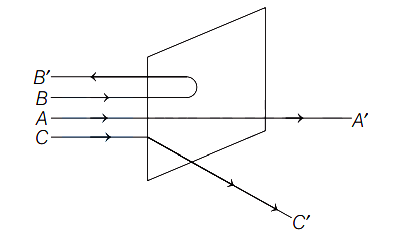
A beam of fast moving alpha particles were directed towards a thin film of gold. The parts \(A, B\) and \(C\) of the transmitted and reflected beams corresponding to the incident parts \(A, B\) and \(C\) of the beam are shown in the adjoining diagram. The number of alpha particles in
- A \(B^{\prime}\) will be minimum and in \(C^{\prime}\) maximum
- B \(A^{\prime}\) will be maximum and in \(B^{\prime}\) minimum
- C \(A^{\prime}\) will be minimum and in \(B^{\prime}\) maximum
- D \(C^{\prime}\) will be minimum and in \(B^{\prime}\) maximum
Answer & Solution
Correct Answer
(B) \(A^{\prime}\) will be maximum and in \(B^{\prime}\) minimum
Step-by-step Solution
Detailed explanation
According to Rutherford's \(\alpha\)-particles scattering experiment, following observations are made
(i) Most of the \(\alpha\)-particles passed through the gold foil undeflected.
(ii) Only about \(0.14 \%\) of the incident \(\alpha\)-particles scattered by an angle greater than \(1^{\circ}\).
(iii) About one \(\alpha\)-particle in every \(8000 \alpha\)-particles deflects by angle more than \(90^{\circ}\).
So, from above observation, we can conclude about the number of \(\alpha\)-particle in given figure as,
\(n_{A^{\prime}}>n_{C^{\prime}}>n_{B^{\prime}}\)
i.e., number of \(\alpha\)-particle will be maximum in \(A^{\prime}\) and minimum in \(B^{\prime}\).
(i) Most of the \(\alpha\)-particles passed through the gold foil undeflected.
(ii) Only about \(0.14 \%\) of the incident \(\alpha\)-particles scattered by an angle greater than \(1^{\circ}\).
(iii) About one \(\alpha\)-particle in every \(8000 \alpha\)-particles deflects by angle more than \(90^{\circ}\).
So, from above observation, we can conclude about the number of \(\alpha\)-particle in given figure as,
\(n_{A^{\prime}}>n_{C^{\prime}}>n_{B^{\prime}}\)
i.e., number of \(\alpha\)-particle will be maximum in \(A^{\prime}\) and minimum in \(B^{\prime}\).
See the Complete Solution
Get step-by-step explanations for this and 2.5 Lakh+ more JEE, NEET & CET questions.
- Unlock all solutions
- Practice the full chapter
- Track accuracy across PYQs
4.8 rated on Google Play · 14,000+ reviews
More questions from Physics
- Two identical capacitors each of capacitance \(5 \mu \mathrm{F}\) are charged to potentials \(2 \mathrm{kV}\) and \(1 \mathrm{kV}\) respectively, Their -ve ends are connected together. When the +ve ends are also connected together, the loss of energy of the system isKCET 2007 Hard
- Block \(A\) of mass of \(2 \mathrm{~kg}\) is placed over block \(B\) of mass \(8 \mathrm{~kg}\). The combination is placed over a rough horizontal surface. Coefficient of friction between \(B\) and the floor is \(0.5\). Coefficient of friction between blocks \(A\) and \(B\) is \(0.4\). A horizontal force of \(10 \mathrm{~N}\) is applied on
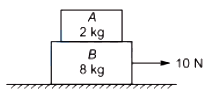
block \(B\). The force of friction between blocks
\(A\) and \(B\) is \(\left(g=10 \mathrm{~ms}^{-2}\right)\)KCET 2011 Hard - In Young's double slit experiment, a third slit is made in between the double slits. ThenKCET 2008 Medium
- Solar spectrum is an example forKCET 2008 Easy
- Which of the following is not made by quarks?KCET 2013 Easy
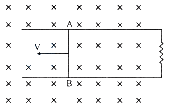
- Consider the situation given in figure. The wire \( A B \) is slid on the fixed rails with a constant velocity. If the wire \( A B \) is replaced by a semicircular wire, the magnitude of the induced current will
 KCET 2019 Hard
More PYQs from KCET
- An organic compound \(X\) is oxidised by using acidified \(\mathrm{K}_{2} \mathrm{Cr}_{2} \mathrm{O}_{7}\). The product obtained reacts with phenyl hydrazine but does not answer silver mirror test. The possible structure of \(X\) isKCET 2009 Medium
- A polarized light of intensity \( I_{0} \) is passed through another polarizer whose pass axis makes an
angle of \( 60^{\circ} \) with the pass axis of the former. What is the intensity of emergent polarized light
from second polarizer?KCET 2014 Easy - The sum of the reciprocals of focal distances of a focal chord \(P Q\) of \(y^{2}=4 a x\) isKCET 2011 Easy
- If \( Z=\frac{(\sqrt{3}+i)^{3}(3 i+4)^{2}}{(8+6 i)^{2}} \), then \( |Z| \) is equal toKCET 2015 Easy
- Focal length of a convex lens will be maximum forKCET 2022 Easy
- Which of the following is not related to drug-enzyme interaction?KCET 2020 Easy