


KCET · Physics · Nuclear Physics
Consider the nuclear fission reaction \({ }_0^1 n+{ }_{92}^{235} \mathrm{U} \longrightarrow{ }_{56}^{144} \mathrm{Ba}+{ }_{36}^{89} \mathrm{Kr}+3{ }_0^1 n\). Assuming all the kinetic energy is carried away by the fast neutrons only and total binding energies of \({ }_{92}^{235} \mathrm{U},{ }_{56}^{144} \mathrm{Ba}\) and \({ }_{36}^{89} \mathrm{Kr}\) to be \(1800 \mathrm{MeV}, 1200\) MeV and 780 MeV respectively, the average kinetic energy carried by each fast neutron is (in MeV )
- A \(200\)
- B \(180\)
- C \(67\)
- D \(60\)
Answer & Solution
Correct Answer
(D) \(60\)
Step-by-step Solution
Detailed explanation
Binding energy \({ }_{92}^{235} \mathrm{U}, B E_1=1800 \mathrm{MeV}\)
Binding energy of \({ }_{56}^{144} \mathrm{Ba}, B E_2=1200 \mathrm{MeV}\)
Binding energy of \({ }_{36}^{89} \mathrm{Kr}, B E_3=780 \mathrm{MeV}\)
\(\therefore\) Binding energy of reactants \(=B E_1=1800 \mathrm{MeV}\)
Binding energy of products \(=B E_2=B E_2+B E_3\)
\(=1200+780\)
\(=1980 \mathrm{MeV}\)
\(\therefore\) Average kinetic energy carried by each fast neutron
Binding energy of products
\(=\frac{- \text { Binding energy of reactants }}{3}\)
\(=\frac{1980-1800}{3}=60 \mathrm{MeV}\)
Binding energy of \({ }_{56}^{144} \mathrm{Ba}, B E_2=1200 \mathrm{MeV}\)
Binding energy of \({ }_{36}^{89} \mathrm{Kr}, B E_3=780 \mathrm{MeV}\)
\(\therefore\) Binding energy of reactants \(=B E_1=1800 \mathrm{MeV}\)
Binding energy of products \(=B E_2=B E_2+B E_3\)
\(=1200+780\)
\(=1980 \mathrm{MeV}\)
\(\therefore\) Average kinetic energy carried by each fast neutron
Binding energy of products
\(=\frac{- \text { Binding energy of reactants }}{3}\)
\(=\frac{1980-1800}{3}=60 \mathrm{MeV}\)
See the Complete Solution
Get step-by-step explanations for this and 2.5 Lakh+ more JEE, NEET & CET questions.
- Unlock all solutions
- Practice the full chapter
- Track accuracy across PYQs
4.8 rated on Google Play · 14,000+ reviews
More questions from Physics
- The source of electromagnetic wave can be a chargeKCET 2021 Easy
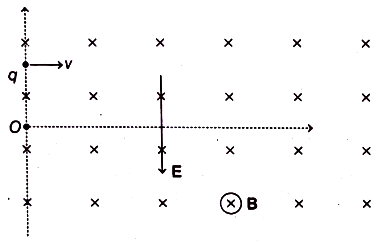
- A positively charged particle \(q\) of mass \(m\) is passed through a velocity selector. It moves horizontally righward without deviation along the line \(y=\frac{2 m v}{q B}\) with a speed \(v\). The electric field is vertically downwards and magnetic field is into the plane of paper. Now, the electric field is. switched off at \(t=0\). The angular momentum of the charged particle about origin \(O\) at \(t=\frac{\pi m}{q B}\) is
 KCET 2023 Hard
 - The resistance of the bulb filament is \( 100 \Omega \) at a temperature of \( 100^{\circ} \mathrm{C} \). If its temperature co-
efficient of resistance be \( 0.005 \) per \( { }^{\circ} \mathrm{C} \), its resistance will become \( 200 \Omega \) at a temperatureKCET 2015 Easy - In anomalous expansion of water, at what temperature, the density of water is maximum ?KCET 2014 Medium
- Which one of the following is not correct?KCET 2013 Medium
- The kinetic energy of a body of mass \( 4 \mathrm{~kg} \) and momentum \( 6 \mathrm{Ns} \) will beKCET 2015 Easy
More PYQs from KCET
- If \(\mathrm{x} \neq \mathrm{n} \pi, \mathrm{x} \neq(2 \mathrm{n}+1) \frac{\pi}{2}, \mathrm{n} \in \mathrm{Z}, \quad\) then \(\frac{\sin ^{-1}(\cos x)+\cos ^{-1}(\sin x)}{\tan ^{-1}(\cot x)+\cot ^{-1}(\tan x)}\) isKCET 2010 Hard
- Some multinational companies have exploited the traditional knowledge of the indigenous people to produce commercially important bioproducts, without their consent. This is an example forKCET 2019 Easy
- For a projectile motion, the angle between the velocity and acceleration is minimum and acute atKCET 2021 Easy
- The complex number \(\frac{1+2 \mathrm{i}}{1-\mathrm{i}}\) lies inKCET 2009 Easy
- \(50 \mathrm{~cm}^{3}\) of \(0.2 \mathrm{~N} \mathrm{HCl}\) is titrated against \(0.1 \mathrm{~N}\) \(\mathrm{NaOH}\) solution. The titration was discontinued after adding \(50 \mathrm{~cm}^{3}\) of \(\mathrm{NaOH}\). The remaining titration is completed by adding \(0.5 \mathrm{~N} \mathrm{KOH}\). The volume of \(\mathrm{KOH}\) required for completing the titration isKCET 2011 Medium
- Match List-I with List-II
Choose the correct answer from the options given below.List-I (Complex) List-II (Geometry) (a) \([\text{Co(NH}_3\text{)}_6]^{3+}\) (i) Trigonal bipyramidal (b) \([\text{NiCl}_4]^{2-}\) (ii) Octahedral (c) \([\text{Ni(CN)}_4]^{2-}\) (iii) Tetrahedral (d) \([\text{Fe(CO)}_5]\) (iv) Square planar KCET 2026 Medium