


KCET · Maths · Hyperbola
If \( x=a \cos ^{3} \theta, y=a \sin ^{3} \theta \), then \( 1+\left(\frac{d y}{d x}\right)^{2} \) is
- A \( \tan \theta \)
- B \( \tan ^{2} \theta \)
- C \( \sec ^{2} \theta \)
- D \( 11 \)
Answer & Solution
Correct Answer
(C) \( \sec ^{2} \theta \)
Step-by-step Solution
Detailed explanation
Given that \(x=a \cos ^{3} \theta\) and \(y=a \sin ^{3} \theta\)
Now, \(\frac{d x}{d \theta}=a\left(3 \cos ^{2} \theta\right)(-\sin \theta)\)
and \(\frac{d y}{d \theta}=a\left(3 \sin ^{2} \theta\right)(\cos \theta)\)
Thus, \(\frac{d y}{d x}=\frac{d y}{d \theta} \times \frac{d \theta}{d x}\)
\(=\frac{3 a \sin ^{2} \theta \cos \theta}{-3 a \cos ^{2} \theta \sin \theta}=\frac{-\sin \theta}{\cos \theta}\)
\(\Rightarrow \frac{d y}{d x}=-\tan \theta \rightarrow(1)\)
So, \(1+\left(\frac{d y}{d x}\right)^{2}=1+\left(-\tan ^{2} \theta\right)\)
\(=1+\tan ^{2} \theta=\sec ^{2} \theta\)
Now, \(\frac{d x}{d \theta}=a\left(3 \cos ^{2} \theta\right)(-\sin \theta)\)
and \(\frac{d y}{d \theta}=a\left(3 \sin ^{2} \theta\right)(\cos \theta)\)
Thus, \(\frac{d y}{d x}=\frac{d y}{d \theta} \times \frac{d \theta}{d x}\)
\(=\frac{3 a \sin ^{2} \theta \cos \theta}{-3 a \cos ^{2} \theta \sin \theta}=\frac{-\sin \theta}{\cos \theta}\)
\(\Rightarrow \frac{d y}{d x}=-\tan \theta \rightarrow(1)\)
So, \(1+\left(\frac{d y}{d x}\right)^{2}=1+\left(-\tan ^{2} \theta\right)\)
\(=1+\tan ^{2} \theta=\sec ^{2} \theta\)
See the Complete Solution
Get step-by-step explanations for this and 2.5 Lakh+ more JEE, NEET & CET questions.
- Unlock all solutions
- Practice the full chapter
- Track accuracy across PYQs
4.8 rated on Google Play · 14,000+ reviews
More questions from Maths
- \(\int \frac{\mathrm{dx}}{\mathrm{x}^2\left(\mathrm{x}^4+1\right)^{3 / 4}}\) equalsKCET 2025 Medium
- The area of the region bounded by the curve \( y=\cos x \) between \( x=0 \) and \( x=\pi \) isKCET 2018 Easy
- Area of a triangle formed by tangent and normal to the curve \(\frac{x^{2}}{a^{2}}+\frac{y^{2}}{b^{2}}=1\) at \(p\left(\frac{a}{\sqrt{2}}, \frac{b}{\sqrt{2}}\right)\) with the \(x\)-axis isKCET 2011 Hard
- \(\int_0^\pi \frac{x \tan x}{\sec x \cdot \operatorname{cosec} x} d x\) is equals toKCET 2023 Medium
- The maximum value of \(\frac{\log x}{x}\) in \((2, \infty)\) isKCET 2008 Medium
- The tangent to the curve \( y=x^{3}+1 \) at \( (1,2) \) makes an angle \( \theta \) with y axis, then the value of \( \tan \theta \) isKCET 2014 Medium
More PYQs from KCET
- The highest oxidation state of manganese in fluoride is \(+4\) (\(\text{MnF}_4\)), but the highest oxidation state in oxides is \(+7\) (\(\text{Mn}_2\text{O}_7\)), becauseKCET 2026 Medium
- \(\int \mathrm{e}^{\tan ^{-1} \mathrm{x}}\left(1+\frac{\mathrm{x}}{1+\mathrm{x}^{2}}\right) \mathrm{dx}\) is equal toKCET 2009 Easy
- Write the set builder form \( A=\{-1,1\}: \)KCET 2015 Medium
- A particle shows distance - time curve as shown in the figure. the maximum instantaneous velocity of the particle is around the point
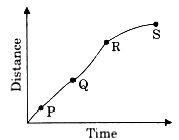 KCET 2018 Easy
 - The hydrolysis of optically active \( 2 \)-bromobutane with aqueous \( \mathrm{NaOH} \) result in the formation ofKCET 2015 Easy
- Blue colour of sea water is due toKCET 2008 Easy