


KCET · Maths · Application of Derivatives
The maximum value of \(\frac{\log x}{x}\) in \((2, \infty)\) is
- A 1
- B \(\frac{2}{\mathrm{e}}\)
- C \(\frac{1}{\mathrm{e}}\)
- D None of the above
Answer & Solution
Correct Answer
(C) \(\frac{1}{\mathrm{e}}\)
Step-by-step Solution
Detailed explanation
\[
\text { Let } y=\frac{\log x}{x}
\]
On differentiating w.r.t. x, we get
\[
\frac{d y}{d x}=\frac{x \cdot \frac{1}{x}-\log x \cdot 1}{x^{2}}=\frac{1-\log x}{x^{2}}
\]
For maxima, put \(\frac{d y}{d x}=0\)
\(\begin{array}{lc}\Rightarrow & \frac{1-\log x}{x^{2}}=0 \\ \Rightarrow & \log x=1 \\ \Rightarrow & x=e\end{array}\)
Now, \(\frac{d^{2} y}{d x^{2}}=\frac{x^{2}\left(-\frac{1}{x}\right)-(1-\log x) 2 x}{\left(x^{2}\right)^{2}}\)
At \(\mathrm{x}=\mathrm{e}, \frac{\mathrm{d}^{2} \mathrm{y}}{\mathrm{dx^{2 }} \leq 0, \text { maxima }}\)
\(\therefore\) The maximum value at \(\mathrm{x}=\mathrm{e}\) is
\[
\mathrm{y}=\frac{\log \mathrm{e}}{\mathrm{e}}=\frac{1}{\mathrm{e}}
\]
\text { Let } y=\frac{\log x}{x}
\]
On differentiating w.r.t. x, we get
\[
\frac{d y}{d x}=\frac{x \cdot \frac{1}{x}-\log x \cdot 1}{x^{2}}=\frac{1-\log x}{x^{2}}
\]
For maxima, put \(\frac{d y}{d x}=0\)
\(\begin{array}{lc}\Rightarrow & \frac{1-\log x}{x^{2}}=0 \\ \Rightarrow & \log x=1 \\ \Rightarrow & x=e\end{array}\)
Now, \(\frac{d^{2} y}{d x^{2}}=\frac{x^{2}\left(-\frac{1}{x}\right)-(1-\log x) 2 x}{\left(x^{2}\right)^{2}}\)
At \(\mathrm{x}=\mathrm{e}, \frac{\mathrm{d}^{2} \mathrm{y}}{\mathrm{dx^{2 }} \leq 0, \text { maxima }}\)
\(\therefore\) The maximum value at \(\mathrm{x}=\mathrm{e}\) is
\[
\mathrm{y}=\frac{\log \mathrm{e}}{\mathrm{e}}=\frac{1}{\mathrm{e}}
\]
See the Complete Solution
Get step-by-step explanations for this and 2.5 Lakh+ more JEE, NEET & CET questions.
- Unlock all solutions
- Practice the full chapter
- Track accuracy across PYQs
4.8 rated on Google Play · 14,000+ reviews
More questions from Maths
- If \(\log _{2}\left(9^{x-1}+7\right)-\log _{2}\left(3^{x-1}+1\right)=2\), then \(x\) values areKCET 2012 Hard
- If \( |x-2| \leq 1 \), thenKCET 2017 Hard
- The distance of the point \( (1,2,1) \) from the line \( \frac{x-1}{2}=\frac{y-2}{1}=\frac{z-3}{2} \) isKCET 2019 Easy
- The negation of \(p \wedge(q \rightarrow \sim r)\) isKCET 2009 Easy
- The locus of the mid points of the chords of the circle \(x^{2}+y^{2}=4\) which subtend a right angle at the origin isKCET 2009 Hard
- The order and degree of the differential equation \(y=\frac{d p}{d x} x=\sqrt{a^{2} p^{2}+b^{2}}, \quad\) where \(\mathrm{p}=\frac{\mathrm{dy}}{\mathrm{dx}}\) (here \(\mathrm{a}\) and \(\mathrm{b}\) are arbitrary constants) respectively areKCET 2010 Easy
More PYQs from KCET
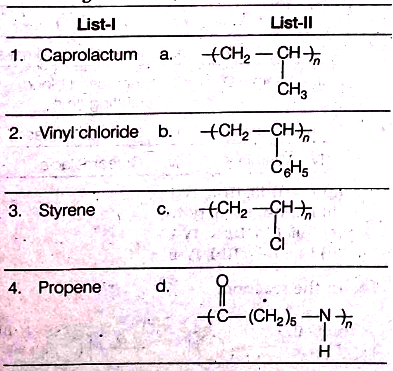
- Match the List-I with List-II in the following.
 KCET 2023 Medium
 - If the rate constant for a first order reaction is \(k\), the time \((t)\) required for the completion of \(99 \%\) of the reaction is given byKCET 2021 Medium
- An inductor of inductance \( L \) and resistor \( R \) are joined together in series and connected by a source of frequency \( \omega \). The power dissipated in the circuit isKCET 2019 Easy
- With reference to human sperm, match the List-I with List-II.
Choose the correct option from the following:List I List II 1. Head p. Filled with enzyme 2. Acrosome q. Contains mitochondria 3. Middle piece r. Sperm motility 4. Tail s. Contains haploid nucleus KCET 2024 Easy - The period of revolution of an electron revolving in nth orbit of H-atom is proportional toKCET 2020 Easy
- What range of electromagnetic spectrum is considered as light?KCET 2026 Easy