


KCET · Chemistry · d and f Block Elements
The highest oxidation state of manganese in fluoride is \(+4\) (\(\text{MnF}_4\)), but the highest oxidation state in oxides is \(+7\) (\(\text{Mn}_2\text{O}_7\)), because
- A Fluorine is more electronegative than oxygen
- B Fluorine possesses d-orbitals
- C Fluorine stabilises lower oxidation state
- D In covalent compounds, fluorine can form single bond only, while oxygen forms double bond
Answer & Solution
Correct Answer
(D) In covalent compounds, fluorine can form single bond only, while oxygen forms double bond
Step-by-step Solution
Detailed explanation
The ability of oxygen to stabilize the highest oxidation states of transition metals (such as \(+7\) for \(\text{Mn}\) in \(\text{Mn}_2\text{O}_7\)) is due to its ability to form multiple bonds (double bonds) with the metal atoms.
Fluorine can only form single bonds. To achieve a \(+7\) oxidation state with fluorine, a single manganese atom would have to accommodate seven fluorine atoms around it, which is sterically highly unfavorable and thus \(\text{MnF}_7\) does not exist.
In \(\text{Mn}_2\text{O}_7\), manganese forms double bonds with oxygen atoms, requiring fewer ligands around the central metal atom and thereby reducing steric hindrance.
Answer: In covalent compounds, fluorine can form single bond only, while oxygen forms double bond
Fluorine can only form single bonds. To achieve a \(+7\) oxidation state with fluorine, a single manganese atom would have to accommodate seven fluorine atoms around it, which is sterically highly unfavorable and thus \(\text{MnF}_7\) does not exist.
In \(\text{Mn}_2\text{O}_7\), manganese forms double bonds with oxygen atoms, requiring fewer ligands around the central metal atom and thereby reducing steric hindrance.
Answer: In covalent compounds, fluorine can form single bond only, while oxygen forms double bond
See the Complete Solution
Get step-by-step explanations for this and 2.5 Lakh+ more JEE, NEET & CET questions.
- Unlock all solutions
- Practice the full chapter
- Track accuracy across PYQs
4.8 rated on Google Play · 14,000+ reviews
More questions from Chemistry
- Which metal has a greater tendency to form metal oxide?KCET 2008 Easy
- The equilibrium constant of the reaction \(\mathrm{A}(\mathrm{s})+2 \mathrm{~B}^{2+}(\mathrm{aq}) \rightleftharpoons \mathrm{A}^{2+}(\mathrm{aq})+2 \mathrm{~B}(\mathrm{~s})\)
\(\mathrm{F}_{\text {cell }}^{\circ}=0.0295 \mathrm{~V}\) is \(\left[\frac{2.303 \mathrm{RT}}{\mathrm{F}}=0.059\right]\)KCET 2012 Medium - Methoxy methane and ethanol areKCET 2008 Easy
- Excess of \(\mathrm{PCl}_{5}\) reacts with conc \(\mathrm{H}_{2} \mathrm{SO}_{4}\) givingKCET 2008 Medium
- In equilibrium state the value of \(\Delta G\) isKCET 2007 Easy
- \( \left[\mathrm{Fe}\left(\mathrm{NO}_{2}\right)_{3} \mathrm{Cl}_{3}\right] \) and \( \left[\mathrm{Fe}(\mathrm{O}-\mathrm{NO})_{} \mathrm{Cl}_{3}\right] \) showsKCET 2018 Easy
More PYQs from KCET
- In a lift moving up with an acceleration of \(5 \mathrm{~ms}^{-2}\), a ball is dropped from a height of \(1.25 \mathrm{~m}\). The time taken by the ball to reach the floor of the lift is ... (nearly) \(\left(g=10 \mathrm{~ms}^{-2}\right)\)KCET 2013 Medium
- The range of electrical conductivity \((\sigma)\) and resistivity \((\rho)\) for metals, among the following, isKCET 2025 Easy
- \(G=\left\{\left[\begin{array}{ll}x & x \\ x & x\end{array}\right], x\right.\) is a non-zero real number \(\}\) is a group with respect to matrix multiplication.
In this group, the inverse of \(\left[\begin{array}{ll}\frac{1}{3} & \frac{1}{3} \\ \frac{1}{3} & \frac{1}{3}\end{array}\right]\) isKCET 2011 Medium - The correct equation depicting species-area relationship isKCET 2021 Medium
- If \( \tan ^{-1}\left(x^{2}+y^{2}\right)=\alpha \) then \( \frac{d y}{d x} \) is equal toKCET 2016 Medium
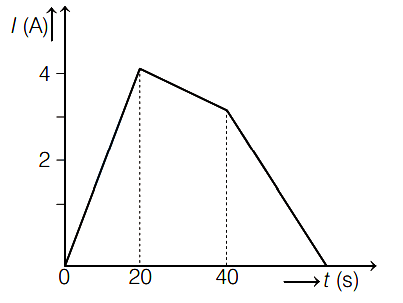
- The current following through an inductance coil of self-inductance \(6 \mathrm{mH}\) at different time instants is as shown. The emf induced between \(t=20 \mathrm{~s}\) and \(t=40 \mathrm{~s}\) is nearly
 KCET 2021 Hard