


KCET · Maths · Linear Programming
A dietician has to develop a special diet using two foods \(X\) and \(Y\). Each packet (containing \(30 \mathrm{~g}\) ) of food. \(X\) contains 12 units of calcium, 4 units of iron, 6 units of cholesterol and 6 units of vitamin A. Each packet of the same quantity of food \(Y\) contains 3 units of calcium, 20 units of iron, 4 units of cholesterol and 3 units of vitamin A. The diet requires at least 240 units of calcium, atleast 460 units of iron and atmost 300 units of cholesterol. The corner points of the feasible region are
- A \((2,72),(40,15),(15,20)\)
- B \((2,72),(15,20),(0,23)\)
- C \((0,23),(40,15),(2,72)\)
- D \((2,72),(40,15),(115,0)\)
Answer & Solution
Correct Answer
(A) \((2,72),(40,15),(15,20)\)
Step-by-step Solution
Detailed explanation
Let \(x\) and \(y\) be the number of packets of food \(X\) and \(Y\)
\[
\begin{array}{ll}
& x \geq 0, y \geq 0 \Rightarrow 12 x+3 y \geq 240 \\
\Rightarrow \quad & 4 x+y \geq 80 \\
& 4 x+20 y \geq 460 \\
\Rightarrow \quad & x+5 y \geq 115 \\
& 6 x+4 y \leq 300 \\
\Rightarrow \quad & 3 x+2 y \leq 150 \\
\Rightarrow \quad & x \geq 0, y \geq 0 \\
& 4 x+y \geq 80
\end{array}
\]
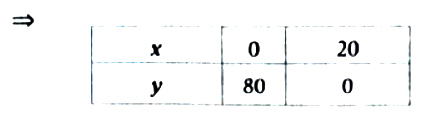
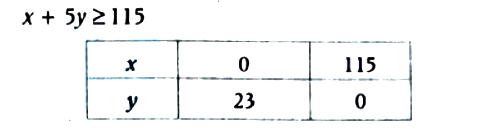
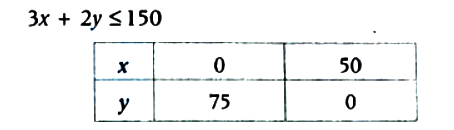
Intersection points of the lines are shown in the graph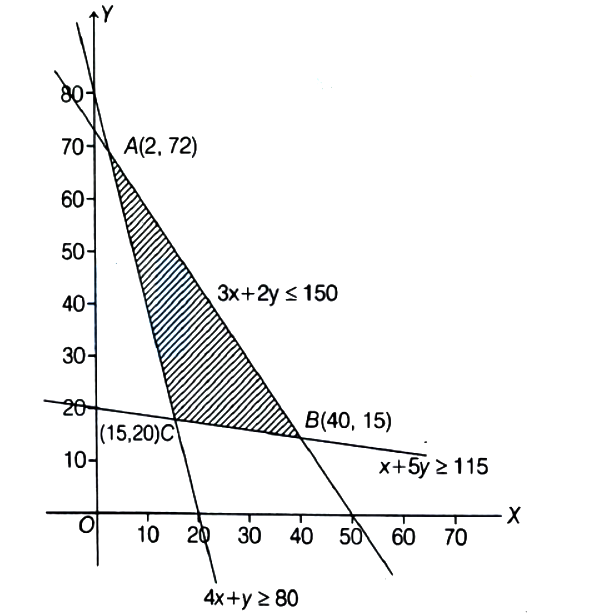
we can see that corner point of the feasible region \(A, B\) and \(C\) are \((2,72),(40,15),(15,20)\).
\[
\begin{array}{ll}
& x \geq 0, y \geq 0 \Rightarrow 12 x+3 y \geq 240 \\
\Rightarrow \quad & 4 x+y \geq 80 \\
& 4 x+20 y \geq 460 \\
\Rightarrow \quad & x+5 y \geq 115 \\
& 6 x+4 y \leq 300 \\
\Rightarrow \quad & 3 x+2 y \leq 150 \\
\Rightarrow \quad & x \geq 0, y \geq 0 \\
& 4 x+y \geq 80
\end{array}
\]
Intersection points of the lines are shown in the graph
we can see that corner point of the feasible region \(A, B\) and \(C\) are \((2,72),(40,15),(15,20)\).
See the Complete Solution
Get step-by-step explanations for this and 2.5 Lakh+ more JEE, NEET & CET questions.
- Unlock all solutions
- Practice the full chapter
- Track accuracy across PYQs
4.8 rated on Google Play · 14,000+ reviews
More questions from Maths
- The amplitude of \((1+i)^{5}\) isKCET 2007 Medium
- The value of \(\cos \left(\sin ^{-1} \frac{\pi}{3}+\cos ^{-1} \frac{\pi}{3}\right)\) isKCET 2020 Medium
- If the curves \(2 x=y^{2}\) and \(2 x y=K\) intersect perpendicularly, then the value of \(K^{2}\) isKCET 2020 Medium
- If \( A=\{x \mid x \in N, x \leq 5\}, B=\left\{x \mid x \in Z, x^{2}-5 x+6=0\right\} \), then the number of onto functions
from \( A \) to \( B \) isKCET 2019 Medium - A space vector makes the angles \(150^{\circ}\) and \(60^{\circ}\) with the positive direction of \(x\)-and \(y\)-axes. The angle made by the vector with the positive direction \(z\)-axis isKCET 2010 Easy
- \(\log \left(\sin 1^{\circ}\right) \cdot \log \left(\sin 2^{\circ}\right) \cdot \log \left(\sin 3^{\circ}\right)\) \(\ldots \log \left(\sin 179^{\circ}\right)\)KCET 2013 Easy
More PYQs from KCET
- Imagine a new planet having the same density as that of the earth, but it is two times bigger than the earth in size. If the acceleration due to gravity on the surface of the earth is \(g\) and that on the surface of the new planet is \(g'\), thenKCET 2026 Medium
- Which of the following has the maximum number of unpaired ' \(d\) ' electrons?KCET 2008 Easy
- A ray of light enters from a rarer to a denser medium. The angle of incidence is Then the reflected and refracted rays are mutually perpendicular to each other. The critical angle for the pair of media isKCET 2008 Medium
- Mass of \(0.1\) mole of methane isKCET 2008 Easy
- \(\int_{0}^{\pi / 4} \frac{\sin x+\cos x}{3+\sin 2 x} d x\) isKCET 2010 Hard
- The kinetic energy of the photoelectrons increases by \(0.52 \mathrm{eV}\) when the wavelength of incident light is changed from \(500 \mathrm{~nm}\) to another wavelength which is approximatelyKCET 2022 Medium