


KCET · Maths · Three Dimensional Geometry
A space vector makes the angles \(150^{\circ}\) and \(60^{\circ}\) with the positive direction of \(x\)-and \(y\)-axes. The angle made by the vector with the positive direction \(z\)-axis is
- A \(90^{\circ}\)
- B \(60^{\circ}\)
- C \(180^{\circ}\)
- D \(120^{\circ}\)
Answer & Solution
Correct Answer
(A) \(90^{\circ}\)
Step-by-step Solution
Detailed explanation
We know that, the condition when a space vector makes the angles \(\alpha, \beta\) and \(\gamma\) with the positive direction of \(\mathrm{x}, \mathrm{y}\) and \(\mathrm{z}\)-axes respectively is
\[
\cos ^{2} \alpha+\cos ^{2} \beta+\cos ^{2} \gamma=1
\]
Given that, \(\alpha=150^{\circ}, \beta=60^{\circ}, \gamma=\) ?
From Eq (i), \(\cos ^{2} 150^{\circ}+\cos ^{2} 60^{\circ}+\cos ^{2} \gamma=1\)
\(\left(\sin ^{2} 60^{\circ}+\cos ^{2} 60^{\circ}\right)+\cos ^{2} \gamma=1\)
\(1+\cos ^{2} \gamma=1\)
\(\Rightarrow \quad \cos ^{2} \gamma=0\)
\(\Rightarrow \quad \cos \gamma=0=\cos 90^{\circ}\)
\(\Rightarrow \quad \gamma=90^{\circ}\)
\[
\cos ^{2} \alpha+\cos ^{2} \beta+\cos ^{2} \gamma=1
\]
Given that, \(\alpha=150^{\circ}, \beta=60^{\circ}, \gamma=\) ?
From Eq (i), \(\cos ^{2} 150^{\circ}+\cos ^{2} 60^{\circ}+\cos ^{2} \gamma=1\)
\(\left(\sin ^{2} 60^{\circ}+\cos ^{2} 60^{\circ}\right)+\cos ^{2} \gamma=1\)
\(1+\cos ^{2} \gamma=1\)
\(\Rightarrow \quad \cos ^{2} \gamma=0\)
\(\Rightarrow \quad \cos \gamma=0=\cos 90^{\circ}\)
\(\Rightarrow \quad \gamma=90^{\circ}\)
See the Complete Solution
Get step-by-step explanations for this and 2.5 Lakh+ more JEE, NEET & CET questions.
- Unlock all solutions
- Practice the full chapter
- Track accuracy across PYQs
4.8 rated on Google Play · 14,000+ reviews
More questions from Maths
- The curve passing through the point \((1,2)\) given that the slope of the tangent at any point \((x, y)\) is \(\frac{3 x}{y}\) representsKCET 2020 Easy
- Let \(P \equiv(-1,0), Q \equiv(0,0)\) and \(R=(3,3)\) be three points. The equation of the bisector of the angle PQR isKCET 2010 Hard
- At \(x=1\), the function \(f(x)=\left\{\begin{array}{cc}x^{3}-1, & 1 < x < \infty \\ x-1, & -\infty < x \leq 1\end{array}\right.\) isKCET 2021 Easy
- On the set of all non-zero reals, an operation * is defined as \(a^{*} b=\frac{3 a b}{2}\). In this group, a solution of \(\left(2^{*} x\right) * 3^{-1}=4^{-1}\) isKCET 2011 Medium
- If \(\overrightarrow{\mathbf{a}} \cdot \overrightarrow{\mathbf{b}}=-|\overrightarrow{\mathbf{a}}||\overrightarrow{\mathbf{b}}|\), then the angle between \(\overrightarrow{\mathbf{a}}\) and \(\vec{b}\) isKCET 2009 Easy
- A sphere increases its volume at the rate of \(\pi \mathrm{cc} / \mathrm{s}\). The rate at which its surface area increases when the radius is \(1 \mathrm{~cm}\) isKCET 2011 Medium
More PYQs from KCET
- In the projectile motion of a particle on a level ground, which of the following remains constant with reference to time and position?KCET 2025 Easy
- The shape of \( X e F_{6} \) is,KCET 2016 Easy
- The spectrum of an oil flame is an example forKCET 2010 Easy
- A parallel plate capacitor with air as the dielectric has capacitance \(C\). A slab of dielectric constant \(K\) and having the same thickness as the separation between the plates is introduced so as to fill one-fourth of the capacitor as shown in the figure. The new capacitance will be
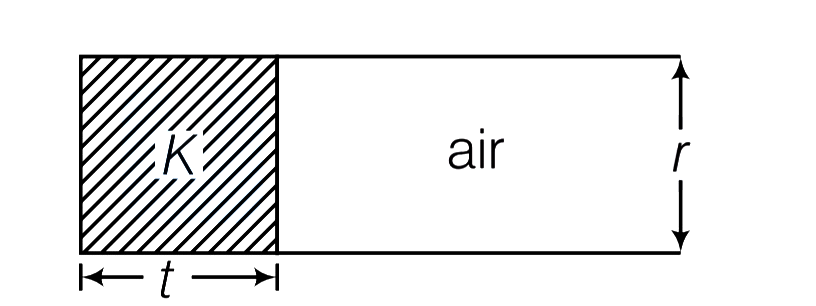 KCET 2007 Medium
 - The major product of the following reaction is \(\mathrm{CH}_{2}=\mathrm{CH}-\mathrm{CH}_{2}-\mathrm{OH} \underset{\text { Excess }}{\stackrel{\mathrm{HBr}}{\longrightarrow}}\) ProductKCET 2021 Medium
- Let \( \vec{a}=i-2 j+3 k \) if \( \vec{b} \) is a vector such that \( \vec{a} \cdot \vec{b}=|\vec{b}|^{2} \) and \( |\vec{a}-\vec{b}|=\sqrt{7} \), then \( |\vec{b}|= \)KCET 2015 Hard