


KCET · Physics · Dual Nature of Matter
The kinetic energy of the photoelectrons increases by \(0.52 \mathrm{eV}\) when the wavelength of incident light is changed from \(500 \mathrm{~nm}\) to another wavelength which is approximately
- A \(400 \mathrm{~nm}\)
- B \(1250 \mathrm{~nm}\)
- C \(1000 \mathrm{~nm}\)
- D \(700 \mathrm{~nm}\)
Answer & Solution
Correct Answer
(A) \(400 \mathrm{~nm}\)
Step-by-step Solution
Detailed explanation
Given, change in kinetic energy of photoelectrons,
\[
\begin{aligned}
\Delta K & =0.52 \mathrm{eV} \\
\lambda_1 & =500 \mathrm{~nm}, \lambda_2=?
\end{aligned}
\]
We know that, kinetic energy of emitted photoelectron (using Einstein's equation)
\[
\begin{gathered}
K=\frac{h c}{\lambda}-\phi \\
\therefore \text { At wavelength } \lambda_1 \\
K_1=\frac{h c}{\lambda_1}-\phi
\end{gathered}
\]
At wavelength \(\lambda_{2^{\prime}}\)
\[
K_2=\frac{h c}{\lambda_2}-\phi
\]
From Eqs. (i) and (ii), we have
\[
\begin{array}{cc}
& K_2-K_1=\frac{h c}{\lambda_2}-\frac{h c}{\lambda_1} \\
\Rightarrow \quad \Delta K=h c\left(\frac{1}{\lambda_2}-\frac{1}{\lambda_1}\right) \\
\Rightarrow \quad 0.52=1242\left(\frac{1}{\lambda_2}-\frac{1}{500}\right)
\end{array}
\]
\[
\begin{array}{rlrl}
\Rightarrow & & \frac{0.52}{1242} & =\frac{1}{\lambda_2}-\frac{1}{500} \\
\Rightarrow & \frac{1}{\lambda_2} & =\frac{0.52}{1242}+\frac{1}{500} \\
\Rightarrow & & \lambda_2 & \approx 400 \mathrm{~nm}
\end{array}
\]
\[
\begin{aligned}
\Delta K & =0.52 \mathrm{eV} \\
\lambda_1 & =500 \mathrm{~nm}, \lambda_2=?
\end{aligned}
\]
We know that, kinetic energy of emitted photoelectron (using Einstein's equation)
\[
\begin{gathered}
K=\frac{h c}{\lambda}-\phi \\
\therefore \text { At wavelength } \lambda_1 \\
K_1=\frac{h c}{\lambda_1}-\phi
\end{gathered}
\]
At wavelength \(\lambda_{2^{\prime}}\)
\[
K_2=\frac{h c}{\lambda_2}-\phi
\]
From Eqs. (i) and (ii), we have
\[
\begin{array}{cc}
& K_2-K_1=\frac{h c}{\lambda_2}-\frac{h c}{\lambda_1} \\
\Rightarrow \quad \Delta K=h c\left(\frac{1}{\lambda_2}-\frac{1}{\lambda_1}\right) \\
\Rightarrow \quad 0.52=1242\left(\frac{1}{\lambda_2}-\frac{1}{500}\right)
\end{array}
\]
\[
\begin{array}{rlrl}
\Rightarrow & & \frac{0.52}{1242} & =\frac{1}{\lambda_2}-\frac{1}{500} \\
\Rightarrow & \frac{1}{\lambda_2} & =\frac{0.52}{1242}+\frac{1}{500} \\
\Rightarrow & & \lambda_2 & \approx 400 \mathrm{~nm}
\end{array}
\]
See the Complete Solution
Get step-by-step explanations for this and 2.5 Lakh+ more JEE, NEET & CET questions.
- Unlock all solutions
- Practice the full chapter
- Track accuracy across PYQs
4.8 rated on Google Play · 14,000+ reviews
More questions from Physics
- A man weighs \(80\) kg. He stands on a weighing scale in a lift which is moving upwards with a uniform acceleration of \(6 \text{ m/s}^2\). What would be his weight in kg? (\(g = 10 \text{ m/s}^2\))KCET 2026 Medium
- A thermodynamic system undergoes a cyclic process \( A B C \) as shown in the diagram. The work done by the system per cycle is
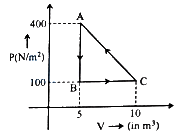 KCET 2019 Medium
 - Light of energy \(E\) falls normally on a metal of work function \(\frac{E}{3}\). The kinetic energies \(K\) of the photo electrons areKCET 2024 Easy
- In the cyclotron, as radius of the circular path of the charged particle increases (to = angular
velocity, \( v= \) linear velocity)KCET 2016 Medium - Three energy levels of hydrogen atom and the corresponding wavelength of the emitted radiation due to different electron transition are as shown. Then,
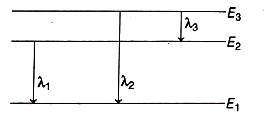 KCET 2023 Medium
 - A \(1 \mathrm{~kg}\) ball moving at \(12 \mathrm{~ms}^{-1}\) collides with a \(2 \mathrm{~kg}\) ball moving in opposite direction at \(24 \mathrm{~ms}^{-1}\). If the coefficient of restitution is \(2 / 3\), then their velocities after the collision areKCET 2021 Hard
More PYQs from KCET
- Incorrect statement about \(\alpha\)-amino acids of proteins among the following isKCET 2026 Medium
- \(\int \sqrt{5-2 x+x^2} d x\) is equals toKCET 2023 Easy
- The potential of the electric field produced by point charge at any point \((x, y, z)\) is given by \(V=3 x^{2}+5\), where \(x, y\) are in metres and \(V\) is in volts. The intensity of the electric field at \((-2,1,0)\) isKCET 2007 Easy
- In the diagram shown, the Zener diode has a reverse breakdown voltage of \(V_Z\). The current through the load resistance \(R_L\) is \(I_L\). The current through the Zener diode is
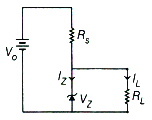 KCET 2024 Medium
 - Which of the following types of RNA carries amino acids towards ribosome during translation?KCET 2020 Hard
- Which of the following set of polymers are used as fibre?
(i) Teflon
(ii) Starch
(iii) Terylene
(iv) OrlonKCET 2024 Easy