


KCET · Chemistry · Classification of Elements and Periodicity in Properties
Which of the following has the maximum number of unpaired ' \(d\) ' electrons?
- A \(\mathrm{Zn}^{2+}\)
- B \(\mathrm{Fe}^{2+}\)
- C \(\mathrm{Ni}^{3+}\)
- D \(\mathrm{Cu}^{+}\)
Answer & Solution
Correct Answer
(B) \(\mathrm{Fe}^{2+}\)
Step-by-step Solution
Detailed explanation
\(
\begin{aligned}
\mathrm{Zn}(30)=& {[\mathrm{Ar}] 3 \mathrm{~d}^{10}, 4 \mathrm{~s}^{2} } \\
\mathrm{Zn}^{2+} &=[\mathrm{Ar}] 3 \mathrm{~d}^{10} \text { (no unpaired electron) } \\
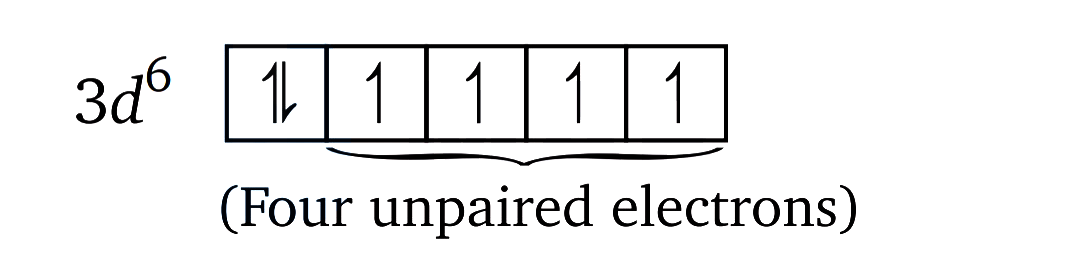
\mathrm{Fe}(26) &=[\mathrm{Ar}] 3 \mathrm{~d}^{6}, 4 \mathrm{~s}^{2} \\
\mathrm{Fe}^{2+} &=[\mathrm{Ar}] 3 \mathrm{~d}^{6} \text { (four unpaired electrons) }
\end{aligned}
\)
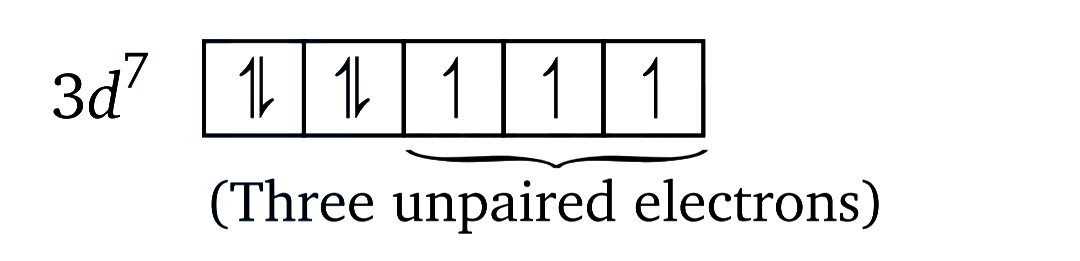
\(\begin{aligned} \mathrm{Ni}(28) &=[\mathrm{Ar}] 3 \mathrm{~d}^{8}, 4 \mathrm{~s}^{2} \\ \mathrm{Ni}^{3+} &=[\mathrm{Ar}] 3 \mathrm{~d}^{7} \text { (three unpaired electrons) } \end{aligned}\)
\(
\begin{aligned}
\mathrm{Cu}(29) &=[\mathrm{Ar}] 3 \mathrm{~d}^{10}, 4 \mathrm{~s}^{1} \\
\mathrm{Cu}^{+} &=[\mathrm{Ar}] 3 \mathrm{~d}^{10} \text { (no unpaired electron) }
\end{aligned}
\)
\begin{aligned}
\mathrm{Zn}(30)=& {[\mathrm{Ar}] 3 \mathrm{~d}^{10}, 4 \mathrm{~s}^{2} } \\
\mathrm{Zn}^{2+} &=[\mathrm{Ar}] 3 \mathrm{~d}^{10} \text { (no unpaired electron) } \\
\mathrm{Fe}(26) &=[\mathrm{Ar}] 3 \mathrm{~d}^{6}, 4 \mathrm{~s}^{2} \\
\mathrm{Fe}^{2+} &=[\mathrm{Ar}] 3 \mathrm{~d}^{6} \text { (four unpaired electrons) }
\end{aligned}
\)
\(\begin{aligned} \mathrm{Ni}(28) &=[\mathrm{Ar}] 3 \mathrm{~d}^{8}, 4 \mathrm{~s}^{2} \\ \mathrm{Ni}^{3+} &=[\mathrm{Ar}] 3 \mathrm{~d}^{7} \text { (three unpaired electrons) } \end{aligned}\)
\(
\begin{aligned}
\mathrm{Cu}(29) &=[\mathrm{Ar}] 3 \mathrm{~d}^{10}, 4 \mathrm{~s}^{1} \\
\mathrm{Cu}^{+} &=[\mathrm{Ar}] 3 \mathrm{~d}^{10} \text { (no unpaired electron) }
\end{aligned}
\)
See the Complete Solution
Get step-by-step explanations for this and 2.5 Lakh+ more JEE, NEET & CET questions.
- Unlock all solutions
- Practice the full chapter
- Track accuracy across PYQs
4.8 rated on Google Play · 14,000+ reviews
More questions from Chemistry
- Which of the following statements are true about \(\left[\mathrm{CoF}_6\right]^{3-}\) ion ?
I. The complex has octahedral geometry.
II. Coordination number of Co is 3 and oxidation state is +6 .
III. The complex is \(s p^3 d^2\) hybridised.
IV. It is a high spin complex.KCET 2024 Hard - Identify \(A, B\) and \(C\) in the sequence.
 KCET 2023 Medium
 - For \( \mathrm{Cr}_{2} \mathrm{O}_{7}{ }^{2-}+14 \mathrm{H}^{+}+6 e^{-} \rightarrow 2 \mathrm{Cr}^{3+}+7 \mathrm{H}_{2} \mathrm{O} ; \mathrm{E}^{\circ}=1.33 \mathrm{~V} \mathrm{At}\left[\mathrm{Cr}_{2} \mathrm{O}_{7}{ }^{2-}\right]=4.5 \)
millimole, \( \left[\mathrm{Cr}^{3+}\right]=15 \) millimole, \( \mathrm{E}^{\circ} \) is \( 1.067 \mathrm{~V} \). The \( \mathrm{pH} \) of the solution is nearly equal toKCET 2014 Medium - \( 10 \mathrm{~g} \) of a mixture of \( \mathrm{BaO} \) and \( \mathrm{CaO} \) requires \( 100 \mathrm{~cm}^{3} \) of \( 2.5 \mathrm{M} \mathrm{HCl} \) to react completely. The
percentage of calcium oxide in the mixture is approximately
(Given : molar mass of \( \mathrm{BaO}=153 \) )KCET 2014 Medium - For a reaction, \(\mathrm{A}+\mathrm{B} \rightarrow\) products, the rate of the reaction at various concentrations are given below
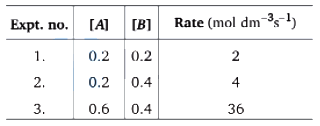
The rate law for the above reaction isKCET 2012 Easy - During the adsorption of a gas on the surface of a solid, which of the following is true?KCET 2012 Easy
More PYQs from KCET
- Match the following pKa values.
\(\begin{array}{|l|l|}
\hline Acid & pKa \\
\hline (a) Phenol & (i) 16 \\
\hline (b) p-Nitrophenol & (ii) 0.78 \\
\hline (c) Ethanol & (iii) 10 \\
\hline (d) Picric acid & (iv) 7.1 \\
\hline
\end{array}\)KCET 2019 Medium - The truth table given below is for ( \(A\) and \(B\) are the inputs, \(Y\) is the output).
\begin{array}{c|c|c}
\hlineA & B & Y \\
\hline 0 & 0 & 1 \\
\hline 0 & 1 & 1 \\
\hline 1 & 0 & 1 \\
\hline 1 & 1 & 0 \\
\hline
\end{array}KCET 2007 Easy - Consider an infinite geometric series with first term ' \( a \) ' and common ratio ' \( r \) '. If the sum is \( 4 \) and
the second term is \( \frac{3}{4} \), thenKCET 2014 Hard - Two satellites of mass \(m\) and \(9 m\) are orbiting a planet in orbits of radius \(R\). Their periods of revolution will be in the ratio ofKCET 2011 Easy
- Consider the nuclear fission reaction \({ }_0^1 n+{ }_{92}^{235} \mathrm{U} \longrightarrow{ }_{56}^{144} \mathrm{Ba}+{ }_{36}^{89} \mathrm{Kr}+3{ }_0^1 n\). Assuming all the kinetic energy is carried away by the fast neutrons only and total binding energies of \({ }_{92}^{235} \mathrm{U},{ }_{56}^{144} \mathrm{Ba}\) and \({ }_{36}^{89} \mathrm{Kr}\) to be \(1800 \mathrm{MeV}, 1200\) MeV and 780 MeV respectively, the average kinetic energy carried by each fast neutron is (in MeV )KCET 2024 Medium
- Interferons are the protein molecules produced from theKCET 2013 Hard