


KCET · Maths · Inverse Trigonometric Functions
\(\tan^{-1}\left(\dfrac{1}{1 + 1 \cdot 2}\right) + \tan^{-1}\left(\dfrac{1}{1 + 2 \cdot 3}\right) + \ldots + \tan^{-1}\left(\dfrac{1}{1 + n(n+1)}\right) = \)
- A \(\tan^{-1}\left(\dfrac{n}{n+2}\right)\)
- B \(\tan^{-1}\left(\dfrac{n+1}{n}\right)\)
- C \(\tan^{-1}\left(\dfrac{n}{n+1}\right)\)
- D \(\tan^{-1}\left(\dfrac{n+2}{n}\right)\)
Answer & Solution
Correct Answer
(A) \(\tan^{-1}\left(\dfrac{n}{n+2}\right)\)
Step-by-step Solution
Detailed explanation
The general term of the given series is \(T_k = \tan^{-1}\left(\dfrac{1}{1 + k(k+1)}\right)\).
This can be written as \(T_k = \tan^{-1}\left(\dfrac{(k+1) - k}{1 + (k+1)k}\right)\).
Using the identity \(\tan^{-1}\left(\dfrac{x - y}{1 + xy}\right) = \tan^{-1}x - \tan^{-1}y\), we get:
\(T_k = \tan^{-1}(k+1) - \tan^{-1}k\)
Writing the terms for \(k = 1, 2, \ldots, n\):
\(T_1 = \tan^{-1}2 - \tan^{-1}1\)
\(T_2 = \tan^{-1}3 - \tan^{-1}2\)
\(T_n = \tan^{-1}(n+1) - \tan^{-1}n\)
Adding all the terms, the intermediate terms cancel out:
\(S = \sum_{k=1}^{n} T_k = \tan^{-1}(n+1) - \tan^{-1}1\)
Applying the inverse tangent difference formula again:
\(S = \tan^{-1}\left(\dfrac{(n+1) - 1}{1 + (n+1)(1)}\right)\)
\(S = \tan^{-1}\left(\dfrac{n}{n+2}\right)\)
Answer: \(\tan^{-1}\left(\dfrac{n}{n+2}\right)\)
This can be written as \(T_k = \tan^{-1}\left(\dfrac{(k+1) - k}{1 + (k+1)k}\right)\).
Using the identity \(\tan^{-1}\left(\dfrac{x - y}{1 + xy}\right) = \tan^{-1}x - \tan^{-1}y\), we get:
\(T_k = \tan^{-1}(k+1) - \tan^{-1}k\)
Writing the terms for \(k = 1, 2, \ldots, n\):
\(T_1 = \tan^{-1}2 - \tan^{-1}1\)
\(T_2 = \tan^{-1}3 - \tan^{-1}2\)
\(T_n = \tan^{-1}(n+1) - \tan^{-1}n\)
Adding all the terms, the intermediate terms cancel out:
\(S = \sum_{k=1}^{n} T_k = \tan^{-1}(n+1) - \tan^{-1}1\)
Applying the inverse tangent difference formula again:
\(S = \tan^{-1}\left(\dfrac{(n+1) - 1}{1 + (n+1)(1)}\right)\)
\(S = \tan^{-1}\left(\dfrac{n}{n+2}\right)\)
Answer: \(\tan^{-1}\left(\dfrac{n}{n+2}\right)\)
See the Complete Solution
Get step-by-step explanations for this and 2.5 Lakh+ more JEE, NEET & CET questions.
- Unlock all solutions
- Practice the full chapter
- Track accuracy across PYQs
4.8 rated on Google Play · 14,000+ reviews
More questions from Maths
- The area of the region bounded by the lines \( y=m x, x=1, x=2 \), and \( x \) axis is \( 6 \) sq. units, then
' \( \mathrm{m} \) ' isKCET 2014 Easy - \(\int_1^5(|x-3|+|1-x|) d x=\)KCET 2024 Easy
- \( \int_{0}^{\frac{1}{2}} \frac{d x}{\left(1+X^{2}\right) \sqrt{1-X^{2}}} \) is equal toKCET 2018 Hard
- \(\lim _{\mathrm{n} \rightarrow \infty} \mathrm{n} \sin \frac{2 \pi}{3 \mathrm{n}} \cdot \cos \frac{2 \pi}{3 \mathrm{n}}\) isKCET 2010 Easy
- If \( |\bar{a} \times \bar{b}|^{2}+|\bar{a} \cdot \bar{b}|^{2}=144 \) and \( |\bar{a}|=4 \), then the value of \( |\bar{b}| \) isKCET 2018 Hard
- The area of the region bounded by the curve \(y^2 = x^3\), the \(y\)-axis and the lines \(y = 1\) and \(y = 8\) isKCET 2026 Easy
More PYQs from KCET
- The current following through an inductance coil of self-inductance \(6 \mathrm{mH}\) at different time instants is as shown. The emf induced between \(t=20 \mathrm{~s}\) and \(t=40 \mathrm{~s}\) is nearly
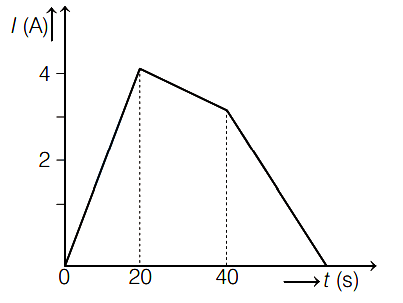 KCET 2021 Hard
 - Which of the following is correct with respect to melting point of a transition element?KCET 2023 Medium
- \( 1.0 \mathrm{~g} \) of \( \mathrm{Mg} \) is burnt with \( 0.28 \mathrm{~g} \) of \( \mathrm{O}_{2} \) in a closed vessel. Which reactant is left in excess and
how much?KCET 2018 Medium - Stalk of the stamen isKCET 2022 Easy
- A dibromo derivative of an alkane reacts with sodium metal to form an alicyclic hydrocarbon. The derivative isKCET 2010 Medium
- Silencing of a specific mRNA translation could be achieved throughKCET 2018 Medium