


JEE Advanced · Chemistry · 17. Electrochemistry
The standard reduction potential data at is given below.
\(E ^o\left( Fe ^{3+}, Fe ^{2+}\right)=+0.77 V ; \)
\( E ^o\left( Fe ^{2+}, Fe \right)=-0 . 44 V \)
\( E ^o\left( Cu ^{2+}, Cu \right)=+0.34 V ; \)
\( E ^o\left( Cu ^{+}, Cu \right)=+0.52 V \)
\( E ^o\left[ O _2(g)+4 H ^{+}+4 e ^{-} \rightarrow 2 H _2 O \right]=\) \(+1.23~V \)
\( E ^o\left[ O _2(g)+2 H _2 O +4 e^{-} \longrightarrow \text { 4OH}^{-}\right]=\) \(+0.40~V \)
\( E ^o\left( Cr ^{3+}, Cr \right)=-0.74 V ; \)
\( E ^o\left( Cr ^{2+}, Cr \right)=-0.91 V\)
Match Eo of the redox pair in List I with the values given in List II and select the correct answer using the code given below the lists :
| List I | List II | ||
| A. | P. | ||
| B. | Q. | ||
| C | R. | ||
| D. | S. |
- A a-r;b-q;c-s;d-p;
- B a-q;b-p;c-r;d-s;
- C a-s;b-p;c-r;d-q;
- D a-r;b-s;c-p;d-q;
Answer & Solution
Correct Answer
(D) a-r;b-s;c-p;d-q;
Step-by-step Solution
Detailed explanation
P)
\(Fe ^{3+}+ e ^{-} \longrightarrow Fe ^{2+} ;\quad \Delta G _{ I }^{ o }=-1 F(0.77) \)
\( Fe ^{2+}+2 e ^{-} \longrightarrow Fe ;\quad \Delta G _{ II }^{ o }=-2 F(-0.44)\)
Add \(\quad Fe ^{3+}+3 e ^{-} \longrightarrow Fe \quad ; \Delta G _{\text {III }}^{ o }=\) \(-3 F\left( E ^{ o }\right)_{ Fe ^{3+} / Fe }\)
=
Q.) (Oxidation half reaction)
(reduction half reaction)
It's an electrochemical cell, adding
at equilibrium
R.)
Adding
S
Subtracting
\(Cr ^{3+}+ e ^{-}- Cr ^{2+} \longrightarrow 0 ; \)
\( Cr ^{3+}+ e ^{-} \longrightarrow Cr ^{2+} ; \Delta G ^0=-1(F)\) \(\left( E _{ Cr ^{3+} / Cr ^{2+}}^0\right) \)
\( - F E _{\left( Cr ^{3+} / Cr ^{2+}\right)}^0= F (3 \times 0.74-2 \times 0.91) \)
\( - E _{ Cr ^{3+} / Cr ^{2+}}^0= F (2.22-1.82) \)
\( E _{ Cr ^{3+} / Cr ^{2+}}=-0.40 V\)
\(Fe ^{3+}+ e ^{-} \longrightarrow Fe ^{2+} ;\quad \Delta G _{ I }^{ o }=-1 F(0.77) \)
\( Fe ^{2+}+2 e ^{-} \longrightarrow Fe ;\quad \Delta G _{ II }^{ o }=-2 F(-0.44)\)
Add \(\quad Fe ^{3+}+3 e ^{-} \longrightarrow Fe \quad ; \Delta G _{\text {III }}^{ o }=\) \(-3 F\left( E ^{ o }\right)_{ Fe ^{3+} / Fe }\)
=
Q.) (Oxidation half reaction)
(reduction half reaction)
It's an electrochemical cell, adding
at equilibrium
R.)
Adding
S
Subtracting
\(Cr ^{3+}+ e ^{-}- Cr ^{2+} \longrightarrow 0 ; \)
\( Cr ^{3+}+ e ^{-} \longrightarrow Cr ^{2+} ; \Delta G ^0=-1(F)\) \(\left( E _{ Cr ^{3+} / Cr ^{2+}}^0\right) \)
\( - F E _{\left( Cr ^{3+} / Cr ^{2+}\right)}^0= F (3 \times 0.74-2 \times 0.91) \)
\( - E _{ Cr ^{3+} / Cr ^{2+}}^0= F (2.22-1.82) \)
\( E _{ Cr ^{3+} / Cr ^{2+}}=-0.40 V\)
See the Complete Solution
Get step-by-step explanations for this and 2.5 Lakh+ more JEE, NEET & CET questions.
- Unlock all solutions
- Practice the full chapter
- Track accuracy across PYQs
4.8 rated on Google Play · 14,000+ reviews
More questions from Chemistry
- The amount of water produced () in the oxidation of of rhombic sulphur by conc. to a compound with the highest oxidation state of sulphur is
(Given data: Molar mass of water )JEE Advanced 2019 Medium - The correct statement(s) about the compound given below is are
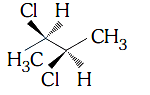 JEE Advanced 2008 Hard
 - Paragraph:
p-amino-N, N-dimethylaniline is added to a strongly acidic solution of \(X\). The resulting solution is treated with a few drops of aqueous solution of \(Y\) to yield blue colouration due to the formation of methylene blue. Treatment of the aqueous solution of \(Y\) with the reagent potassium hexacyanoferrate(II) leads to the formation of an intense blue precipitate. The precipitate dissolves an excess addition of the reagent. Similarly, treatment of the solution of \(Y\) with the solution of potassium hexacyanoferrate(III) leads to a brown colouration due to the formation of \(Z\).
Question:
The compound \(X\), isJEE Advanced 2009 Medium - Hydrogen peroxide in its reaction with KIO4 and NH2OH respectively, is acting as aJEE Advanced 2014 Medium
- The reaction of -methyloct--ene with in the presence of gives two isomeric bromides in a ratio, with a combined yield of . Of these, the entire amount of the primary alkyl bromide was reacted with an appropriate amount of diethylamine followed by treatment with aq. to give a non-ionic product in Yield. The mass (in ) of obtained is
[Use molar mass (in ): ]JEE Advanced 2023 Hard - An organic compound rotates plane-polarized light. It produces pink color with neutral solution. What is the total number of all the possible isomers for this compound?JEE Advanced 2020 Hard
More PYQs from JEE Advanced
- A student performed the experiment of determination of focal length of a concave mirror by \(u-v\) method using an optical bench of length \(1.5 \mathrm{~m}\). The focal length of the mirror used is 24 \(\mathrm{cm}\). The maximum error in the location of the image can be \(0.2 \mathrm{~cm}\).
The 5 sets of \((u, v)\) values recorded by the student (in \(\mathrm{cm})\) are : \((42,56),(48\), \(48),(60,40),(66,33),(78,39)\). The data set(s) that cannot come from experiment and is (are) incorrectly recorded, is(are)JEE Advanced 2009 Medium - An extended object is placed at point , in front of a convex lens and a concave lens is placed behind it, as shown in the figure. The radii of curvature of all the curved surfaces in both the lenses are . The refractive index of both the lenses is . The total magnification of this lens system is:
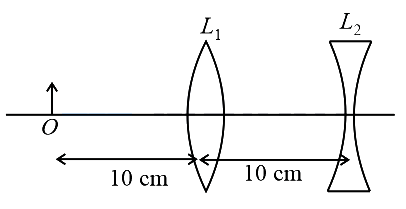 JEE Advanced 2021 Medium
 - The density (in \(\mathrm{g} \mathrm{cm}^{-3}\) ) of the metal which forms a cubic close packed (ccp) lattice with an axial distance (edge length) equal to 400 pm is \(\qquad\) .
Use: Atomic mass of metal \(=105.6 \mathrm{amu}\) and Avogadro's constant \(=6 \times 10^{23} \mathrm{~mol}^{-1}\)JEE Advanced 2025 Medium - Paragraph:
The circle \(x^2+y^2-8 x=0\) and hyperbola \(\frac{x^2}{9}-\frac{y^2}{4}=1\) intersect at the points \(A\) and \(B\).Question:
Equation of a common tangent with positive slope to the circle as well as to the hyperbola isJEE Advanced 2010 Medium - Match List I with List II and select the correct answer using the codes given below the lists:
\(\text{List I}\) \(\text{List II}\) a. Boltzmann constant p. \(\left[M L^2 T^{-1}\right]\) b. Coefficient of viscosity q. \(\left[M L^{-1} T^{-1}\right]\) c. Planck constant r. \(\left[M L T^{-3} K^{-1}\right]\) d. Thermal conductivity s. \(\left[M L^2 T^{-2} K^{-1}\right]\) JEE Advanced 2013 Easy - Three numbers are chosen at random, one after another with replacement, from the set \(S=\{1,2,3, \ldots, 100\}\). Let \(p_{1}\) be the probability that the maximum of chosen numbers is at least 81 and \(p_{2}\) be the probability that the minimum of chosen numbers is at most 40 .
The value of isJEE Advanced 2021 Medium