


JEE Advanced · Chemistry · 7. Chemical Equilibrium
The equilibrium \(2 \mathrm{Cu}^{\mathrm{I}} \rightleftharpoons \mathrm{Cu}^0+\mathrm{Cu}^{\text {II }}\) in aqueous medium at \(25^{\circ} \mathrm{C}\) shifts towards the left in the presence of
- A \(\mathrm{NO}_3^{-}\)
- B \(\mathrm{Cl}^{-}\)
- C \(\mathrm{SCN}^{-}\)
- D \(\mathrm{CN}^{-}\)
Answer & Solution
Correct Answer
(B) \(\mathrm{Cl}^{-}\)
Step-by-step Solution
Detailed explanation
\(\mathrm{Cl}^{-}, \mathrm{CN}^{-}\)and \(\mathrm{SCN}^{-}\)froms precipitate with \(\mathrm{Cu}\) (I), remove \(\mathrm{Cu}\) (I) ion from equilibrium and reaction shift in direction shift in backward direction according to Le-Chatelier's principle.
See the Complete Solution
Get step-by-step explanations for this and 2.5 Lakh+ more JEE, NEET & CET questions.
- Unlock all solutions
- Practice the full chapter
- Track accuracy across PYQs
4.8 rated on Google Play · 14,000+ reviews
More questions from Chemistry
- Match each of the diatomic molecules in Column I with its property/properties in Column II.
Column I Column II A. \(B _2\) p. Paramagnetic B. \(N_2\) q. Undergoes oxidation C. \(O _2^{-}\) r. Undergoes reduction D. \(O _2\) s. Bond order t. Mixing of 's' and 'p' orbitals JEE Advanced 2009 Medium - Among the following complexes \((K-P), \mathrm{K}_3\left[\mathrm{Fe}(\mathrm{CN})_6\right](K)\),
\(\left[\right.\) Co \(\left.\left(\mathrm{NH}_3\right)_6\right] \mathrm{Cl}_3(L), \mathrm{Na}_3\left[\mathrm{Co}(\mathrm{ox})_3\right](M)\),
\(\left[\mathrm{Ni}\left(\mathrm{H}_2 \mathrm{O}\right)_6\right] \mathrm{Cl}_2(\mathrm{~N}) ; \mathrm{K}_2\left[\mathrm{Pt}(\mathrm{CN})_4\right](\mathrm{O})\) and \(\left[\mathrm{Zn}\left(\mathrm{H}_2 \mathrm{O}\right)_6\right]\left(\mathrm{NO}_3\right)_2(P)\)
the diamagnetic complexes areJEE Advanced 2011 Medium - A solution is prepared by mixing each of , and in \(100 \mathrm{~mL}\) of water. of the resulting solution is
[Given: and of are and , respectively. ]JEE Advanced 2022 Medium - The boiling point of water in a \(0.1\) molal silver nitrate solution (solution \(\mathbf{A}\) ) is \(\mathbf{x}^{\circ} \mathrm{C}\). To this solution \(\mathbf{A}\), an equal volume of \(0.1\) molal aqueous barium chloride solution is added to make a new solution B. The difference in the boiling points of water in the two solutions \(\mathbf{A}\) and \(\mathbf{B}\) is \(\mathbf{y} \times 10^{-2}{ }^{\circ} \mathrm{C}\).
(Assume: Densities of the solutions \(\mathbf{A}\) and \(\mathbf{B}\) are the same as that of water and the soluble salts dissociate completely.
Use: Molal elevation constant (Ebullioscopic Constant), \(K_{b}=0.5 \mathrm{~K} \mathrm{~kg} \mathrm{~mol}^{-1}\); Boiling point of pure water as \(100^{\circ} \mathrm{C}\).)
The value of is ___.JEE Advanced 2021 Medium - Paragraph:
Tollen's reagent is used for the detection of aldehyde when a solution of \(\mathrm{AgNO}_3\) is added to glucose with \(\mathrm{NH}_4 \mathrm{OH}\) then gluconic acid is formed
\(\mathrm{Ag}^{+}+e^{-} \rightarrow \mathrm{Ag} E_{\text {red }}^{\circ}=0.8 \mathrm{~V} \)
\( \mathrm{C}_6 \mathrm{H}_{12} \mathrm{O}_6+\mathrm{H}_2 \mathrm{O} \rightarrow \text { Gluconic acid }\)\(\left(\mathrm{C}_6 \mathrm{H}_{12} \mathrm{O}_7\right)+2 \mathrm{H}^{+}+2 e^{-} ; -E_{\mathrm{red}}^{\circ}=\) \(-0.05 \mathrm{~V} \)
\( \mathrm{Ag}\left(\mathrm{NH}_3\right)_2^{+}+e^{-} \rightarrow \mathrm{Ag}(s)+2 \mathrm{NH}_3 ;\) \(E_{\mathrm{red}}^{\circ}=0.337 \mathrm{~V}\)
[Use \(2.303 \times \frac{R T}{F}=0.0592\) and \(\frac{F}{R T}=38.92\) at \(298 \mathrm{~K}\) ]
Question:
Ammonia is always added in this reaction. Which of the following must be incorrect?JEE Advanced 2006 Medium - With reference to the scheme given below, which of the given statement(s) about \(\mathrm{T}, \mathrm{U}, \mathrm{V}\) and \(\mathrm{W}\) is (are) correct?
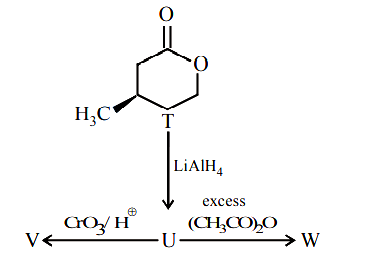 JEE Advanced 2012 Medium
More PYQs from JEE Advanced
- Among the following, intensive property is (properties are)JEE Advanced 2010 Medium
- The pair(s) of coordination complexes/ions exhibiting the same kind of isomerism is (are)JEE Advanced 2013 Medium
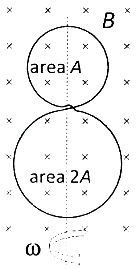
- A circular insulated copper wire loop is twisted to form two loops of area and as shown in the figure. At the point of crossing the wires remain electrically insulated from each other. The entire loop lies in the plane (of the paper). A uniform magnetic field points into the plane of the paper. At , the loop starts rotating about the common diameter as axis with a constant angular velocity in the magnetic field. Which of the following options is/are correct?
 JEE Advanced 2017 Hard
 - Calamine, malachite, magnetite and cryolite, respectively are:JEE Advanced 2019 Easy
- The correct statement(s) for orthoboric acid is/areJEE Advanced 2014 Easy
- Let the vectors \(\mathbf{P Q}, \mathbf{Q R}, \mathbf{R S}, \mathbf{S T}, \mathbf{T U}\) and UP represent the sides of a regular hexagon.
Statement I PQ \(\times(\mathbf{R S}+\mathbf{S T}) \neq \mathbf{0}\)
Statement II \(\mathbf{P Q} \times \mathbf{R S}=\mathbf{0}\) and \(\mathbf{P Q} \times \mathbf{S Q} \neq \mathbf{0}\)JEE Advanced 2007 Medium