


JEE Advanced · Physics · 28. Nuclear Physics
Paragraph:
If the measurement errors in all the independent quantities are known, then it is possible to determine the error in any dependent quantity. This is done by the use of series expansion and truncating the expansion at the first power of the error. For example, consider the relation . If the errors in , respectively, then
The series expansion for , to first power in . The relative errors in independent variables are always added. So the error in will be
Question :
The above derivation makes the assumption that . Therefore, the higher powers of these quantities are neglected.
- A
- B
- C
- D
Answer & Solution
Correct Answer
(C)
Step-by-step Solution
Detailed explanation
Converting to error,
( is number of nuclei left undecayed)
See the Complete Solution
Get step-by-step explanations for this and 2.5 Lakh+ more JEE, NEET & CET questions.
- Unlock all solutions
- Practice the full chapter
- Track accuracy across PYQs
4.8 rated on Google Play · 14,000+ reviews
More questions from Physics
- A parallel plate capacitor of capacitance has spacing d between two plates having area The region between the plates is filled with dielectric layers, parallel to its plates, each with thickness The dielectric constant of the layer is For a very large the capacitance is The value of will be____
is the permittivity of free space]JEE Advanced 2019 Hard - A double slit setup is shown in the figure. One of the slits is in medium of refractive index . The other slit is at the interface of this medium with another medium of refractive index . The line joining the slits is perpendicular to the interface and the distance between the slits is . The slit widths are much smaller than . A monochromatic parallel beam of light is incident on the slits from medium . A detector is placed in medium at a large distance from the slits, and at an angle from the line joining them, so that equals the angle of refraction of the beam. Consider two approximately parallel rays from the slits received by the detector.
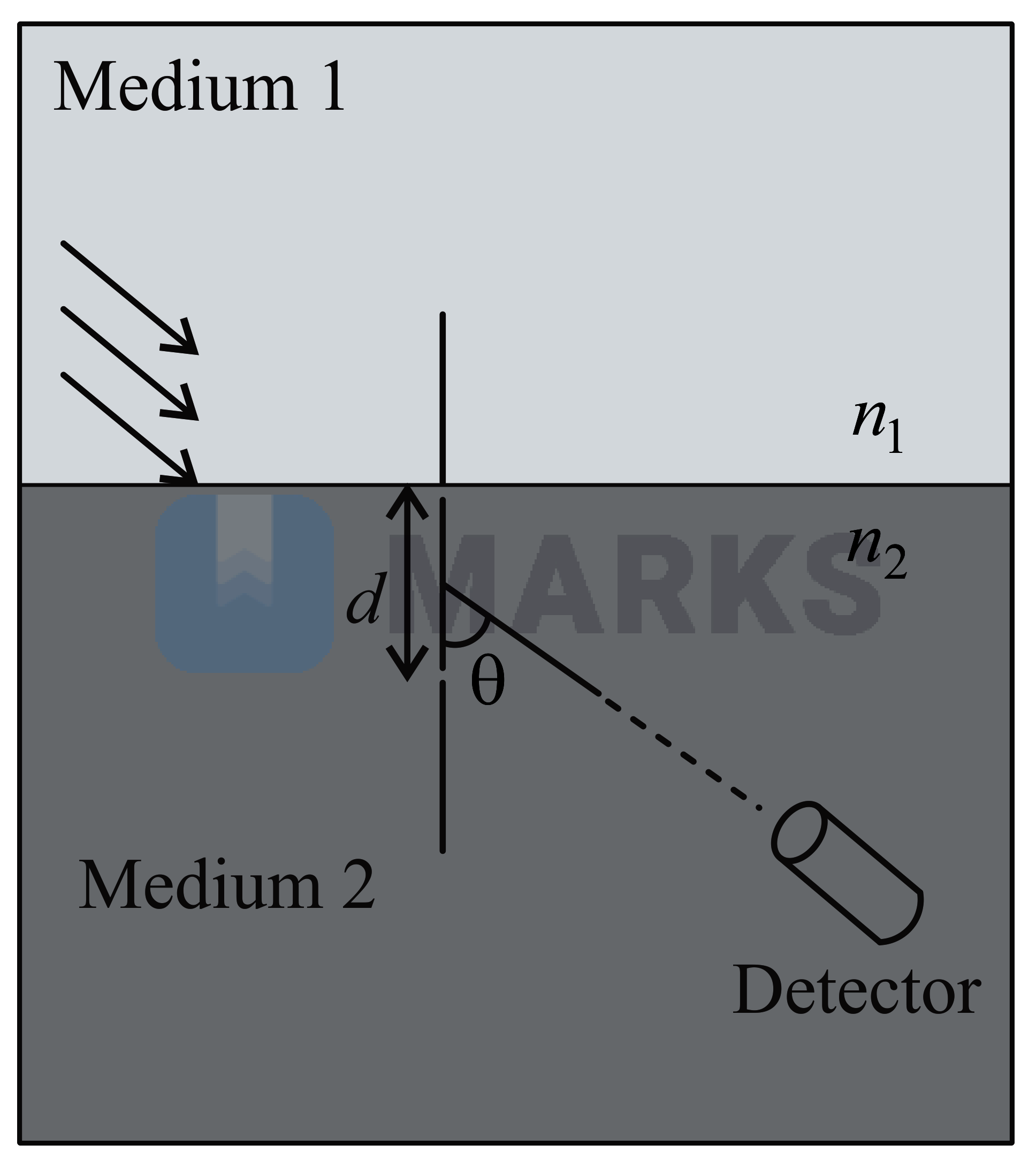
Which of the following statement(s) is(are) correct?JEE Advanced 2022 Easy - Consider the motion of a positive point charge in a region where there are simultaneous uniform electric and magnetic fields \(\vec{E}=E_{0} \hat{j}\) and \(\vec{B}=B_{0} \hat{j}\). At time \(t=0\), this charge has velocity \(\vec{v}\) in the in the \(x\)-y plane, making an angle \(\theta\) with the \(x\)-axis. Which of the following option(s) is (are) correct for time \(t>0\) ?JEE Advanced 2012 Medium
- Two large vertical and parallel metal plates having a separation of \(1 \mathrm{~cm}\) are connected to a DC voltage source of potential difference \(X\). A proton is released at rest midway between the two plates. It is found to move at \(45^{\circ}\) to the vertical JUST after release. Then \(X\) is nearlyJEE Advanced 2012 Medium
- A free hydrogen atom after absorbing a photon of wavelength gets excited from the state to the state Immediately after that the electron jumps to state by emitting a photon of wavelength Let the change in momentum of atom due to the absorption and the emission are and respectively. If Which of the option(s) is/are correct?
[Use and are Planck's constant and speed of light, respectively]JEE Advanced 2019 Medium - A source (S) of sound has frequency \(240 \mathrm{~Hz}\). When the observer \((\mathrm{O})\) and the source move towards each other at a speed \(v\) with respect to the ground (as shown in Case 1 in the figure), the observer measures the frequency of the sound to be \(288 \mathrm{~Hz}\). However, when the observer and the source move away from each other at the same speed \(v\) with respect to the ground (as shown in Case 2 in the figure), the observer measures the frequency of sound to be \(n \mathrm{~Hz}\). The value of \(n\) is ______
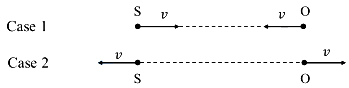 JEE Advanced 2024 Easy
More PYQs from JEE Advanced
- Paragraph:
A point charge \(Q\) is moving in a circular orbit of radius \(R\) in the \(x-y\) plane with an angular velocity \(\omega .\) This can be considered as equivalent to a loop carrying a steady current \(\frac{Q \omega}{2 \pi}\). A uniform magnetic field along the positive \(z\)-axis is now switched on, which increases at a constant rate from 0 to \(B\) in one second. Assume that the radius of the orbit remains constant. The application of the magnetic field induces an emf in the orbit. The induced emf is defined as the work done by an induced electric field in moving a unit positive charge around a closed loop. It is known that, for an orbiting charge, the magnetic dipole moment is proportional to the angular momentum with a proportionality constant \(\gamma\).
Question:
The magnitude of the induced electric field in the orbit at any instant of time during the time interval of the magnetic field change isJEE Advanced 2013 Medium - let be defined by
List – I List – II (A) is (P) Onto but not one – one (B) is (Q) neither continuous nor one-one (C) of is (R) differentiable but not one-one (D) is (S) continuous and one-one JEE Advanced 2014 Medium - Let be a function which is continuous on and is differentiable on . Let for If for all then equalsJEE Advanced 2014 Easy
- Match the extraction processes listed in column I with metals listed in column II.
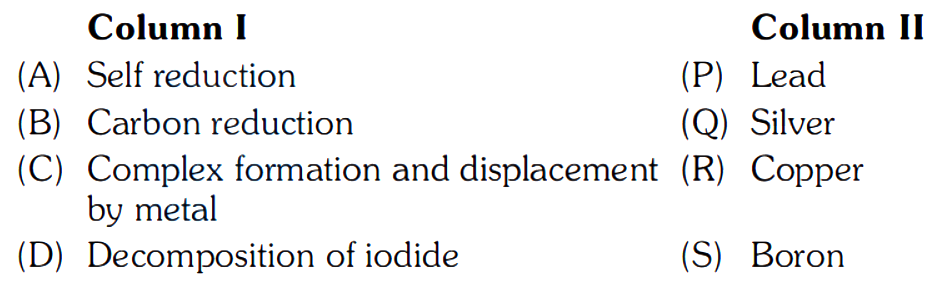 JEE Advanced 2006 Medium
 - A uniform rod of length \(L\) and mass \(M\) is pivoted at the centre. Its two ends are attached to two springs of equal spring constants \(k\). The springs are fixed to rigid supports as shown in the figure, and rod is free to oscillate in the horizontal plane. The rod is gently pushed through a small angle \(\theta\) in one direction and released. The frequency of oscillation is
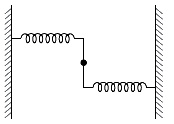 JEE Advanced 2009 Medium
 - Newman projections and are shown below:
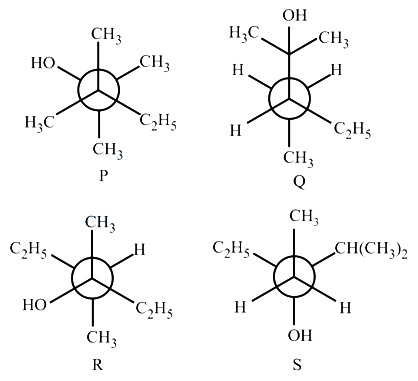
Which one of the following options represent identical molecules?JEE Advanced 2020 Medium