


JEE Advanced · Physics · 24. Ray Optics
Statement I The formula connecting \(u, v\) and \(f\) for a spherical mirror is valid only for mirrors whose sizes are very small compared to their radii of curvature.
Statement II Laws of reflection are strictly valid for plane surfaces, but not for large spherical surfaces.
- A Statement I is true, Statement II is true; Statement II is a correct explanation for Statement I
- B Statement I is true, Statement II is true; Statement II is NOT a correct explanation for Statement I
- C Statement I is true, Statement II is false
- D Statement I is false, Statement II is true
Answer & Solution
Correct Answer
(C) Statement I is true, Statement II is false
Step-by-step Solution
Detailed explanation
Laws of reflection can be applied to any type of surface.
\(\therefore\) Correct option is (c).
\(\therefore\) Correct option is (c).
See the Complete Solution
Get step-by-step explanations for this and 2.5 Lakh+ more JEE, NEET & CET questions.
- Unlock all solutions
- Practice the full chapter
- Track accuracy across PYQs
4.8 rated on Google Play · 14,000+ reviews
More questions from Physics
- Paragraph :
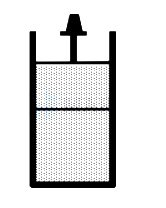
In the figure a container is shown to have a movable (without friction) piston on top. The container and the piston are all made of perfectly insulating material allowing no heat transfer between outside and inside the container. The container is divided into two compartments by a rigid partition made of a thermally conducting material that allows slow transfer of heat. The lower compartment of the container is filled with \(2\) moles of an ideal monatomic gas at \(700 K\) and the upper compartment is filled with \(2\) moles of an ideal diatomic gas at \(400 K\). The heat capacities per mole of an ideal monatomic gas are \(C_{V}=\frac{3}{2} R, C_{P}=\frac{5}{2} R\), and those for an ideal diatomic gas are \(C_{V}=\frac{5}{2} R, C_{P}=\frac{7}{2} R\).
Question :
Consider the partition to be rigidly fixed so that it does not move. When equilibrium is achieved, the final temperature of the gases will beJEE Advanced 2014 Medium - One mole of a monatomic ideal gas undergoes the cyclic process \(\mathrm{J} \rightarrow \mathrm{K} \rightarrow \mathrm{L} \rightarrow \mathrm{M} \rightarrow \mathrm{J}\), as shown in the P-T diagram.
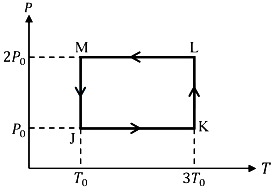
Match the quantities mentioned in List-I with their values in List-II and choose the correct option.
[\(\mathcal{R}\) is the gas constant.]List-I List-II (P) Work done in the complete cyclic process (1) \(R T_0-4 R T_0 \ln 2\) (Q) Change in the internal energy of the gas in the process JK (2) \(0\) (R) Heat given to the gas in the process KL (3) \(3 K T_0\) (S) Change in the internal energy of the gas in the process MJ (4) \(-2 R T_0 \ln 2\) \((5)-3 R T_0 \ln 2\) JEE Advanced 2024 Medium - A vernier calipers has \(1 \mathrm{~mm}\) marks on the main scale. It has 20 equal divisions on the vernier scale which match with 16 main scale divisions. For this vernier calipers, the least count isJEE Advanced 2010 Medium
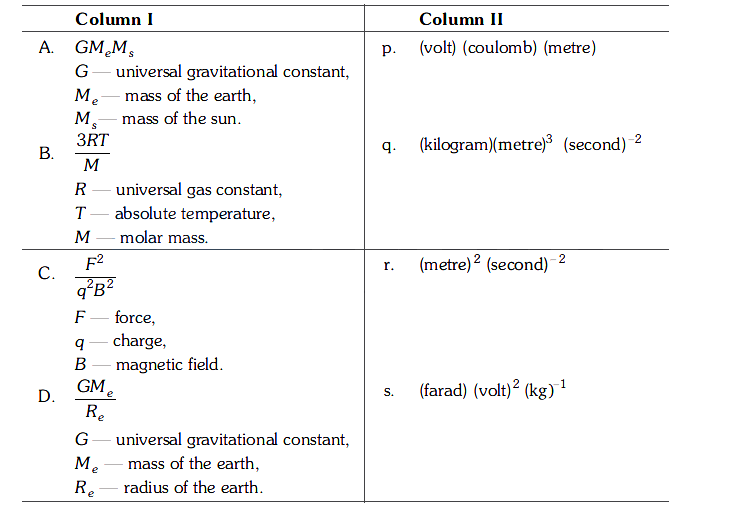
- Some physical quantities are given in Column I and some possible SI units in which these quantities may be expressed are given in Column II. Match the physical quantities in Column I with the units in Column II and indicate your answer by darkening appropriate bubbles in the \(4 \times 4\) matrix given in the ORS.
 JEE Advanced 2007 Medium
 - A particle, of mass and charge , is initially at rest. At time , the particle comes under the influence of an electric field where and . Consider the effect of only the electrical force on the particle. Then the maximum speed, in , attained by the particle at subsequent times is ____________.JEE Advanced 2018 Medium
- Match List I with List II and select the correct answer using the codes given below the lists:
\(\text{List I}\) \(\text{List II}\) a. Boltzmann constant p. \(\left[M L^2 T^{-1}\right]\) b. Coefficient of viscosity q. \(\left[M L^{-1} T^{-1}\right]\) c. Planck constant r. \(\left[M L T^{-3} K^{-1}\right]\) d. Thermal conductivity s. \(\left[M L^2 T^{-2} K^{-1}\right]\) JEE Advanced 2013 Easy
More PYQs from JEE Advanced
- A dimensionless quantity is constructed in terms of electronic charge \(e\), permittivity of free space \(\varepsilon_0\), Planck's constant \(h\) and speed of light \(c\). If the dimensionless quantity is written as \(e^\alpha \varepsilon_0^\beta h^\gamma c^\delta\) and \(n\) is a non-zero integer, then \((\alpha, \beta, \gamma, \delta)\) is given byJEE Advanced 2024 Easy
- A line intersects the circle at the points and If the midpoint of the line segment has coordinate then which one of the following options is correct?JEE Advanced 2019 Medium
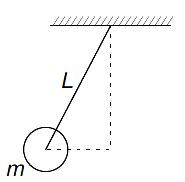
- A ball of mass \((m) 0.5 \mathrm{~kg}\) is attached to the end of a string having length \((L) 0.5 \mathrm{~m}\). The ball is rotated on a horizontal circular path about vertical axis. The maximum tension that the string can bear is \(324 \mathrm{~N}\). The maximum possible value of angular velocity of ball (in rad/s) is
 JEE Advanced 2011 Easy
 - Let denote the base of the natural logarithm. The value of the real number for which the right-hand limit is equal to a non-zero real number, isJEE Advanced 2020 Medium
- Statement I The total translational kinetic energy of all the molecules of a given mass of an ideal gas is \(1.5\) times the product of its pressure and its volume.
Statement II The molecules of a gas collide with each other and the velocities of the molecules change due to the collision.JEE Advanced 2007 Easy - Paragraph :
When a particle of mass \(m\) moves on the \(x\)-axis in a potential of the form \(V(x)=k x^2\), it performs simple harmonic motion.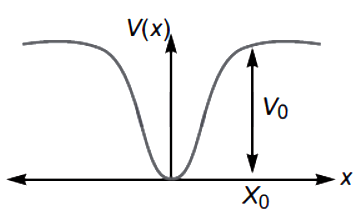
The corresponding time period is proportional to \(\sqrt{\frac{m}{k}}\), as can be seen easily using dimensional analysis. However, the motion of a particle can be periodic even when its potential energy increases on both sides of \(x=0\) in a way different from \(k x^2\) and its total energy is such that the particle does not escape to infinity. Consider a particle of mass \(\mathrm{m}\) moving on the \(x\)-axis. Its potential energy is \(V(x)=\alpha x^4(\alpha>0)\) for \(|x|\) near the origin and becomes a constant equal to \(V_0\) for \(|x| \geq X_0\) (see figure).
Question :
The acceleration of this particle for \(|x|>X_0\) isJEE Advanced 2010 Easy